Over 91% of organizations now use facial recognition technology, and this powerful capability is no longer limited to government agencies or tech companies. Everyday people can now access these platforms to reconnect with lost friends, verify online identities, or protect their personal privacy.
The world of facial recognition software has transformed dramatically in recent years. What once required specialized expertise is now available through user-friendly platforms that anyone can navigate. AI technology has made image recognition faster and more accurate than ever before.
This comprehensive guide explores the top platforms that help users find person by photo with remarkable precision. Readers will discover detailed reviews of leading services including Lenso.ai, EyeMatch.ai, PimEyes, and FaceCheck.ID. The article also covers essential topics like privacy considerations, legal guidelines, and practical tips for achieving the best results.

Whether someone wants to monitor their digital footprint, reconnect with people from the past, or verify someone’s online presence, these face search tools offer powerful solutions. The guide empowers readers to use this technology responsibly and effectively for their specific needs.
What Are Face Search Tools and Why Use Them
Modern face search tools harness the power of facial recognition to help everyday users track down images of specific people anywhere on the web. These specialized platforms work differently from traditional search engines where someone types keywords into a search box. Instead, users simply upload a photograph and let advanced algorithms handle the detective work.
As PimEyes explains, “a reverse image search is a technique that allows finding things, people, brands, etc. using a photo” with their system focusing “on a given face, not the whole picture.” This targeted approach makes reverse image search face technology incredibly powerful for identifying individuals online.

The key difference between basic reverse image search and a dedicated facial search engine lies in precision. While standard reverse image search looks for identical or visually similar images, face search specifically identifies and matches human faces even when backgrounds, angles, lighting, or contexts completely differ. This means the same person can be recognized in a professional headshot, a casual vacation photo, or a crowded group picture.
The beauty of modern face search tools is their accessibility. Users don’t need technical expertise or special training. They simply need a clear photo and a few minutes to run a search that could provide valuable peace of mind or reconnect them with people who matter.
How Face Search Technology Works
Face finder technology transforms a simple photo into a mathematical puzzle that computers can solve instantly. The process might seem like magic, but understanding the science behind it reveals just how impressive these tools have become. Anyone can use these platforms without needing technical knowledge.
When someone uploads a photo to a face search platform, artificial intelligence immediately springs into action. The system first identifies where the face appears in the image. This happens in a fraction of a second, even if the photo contains multiple people or busy backgrounds.
Next comes the fascinating part where facial recognition software maps out distinctive features. The AI measures dozens of unique characteristics that make each face different. These measurements create a detailed profile of that specific person.
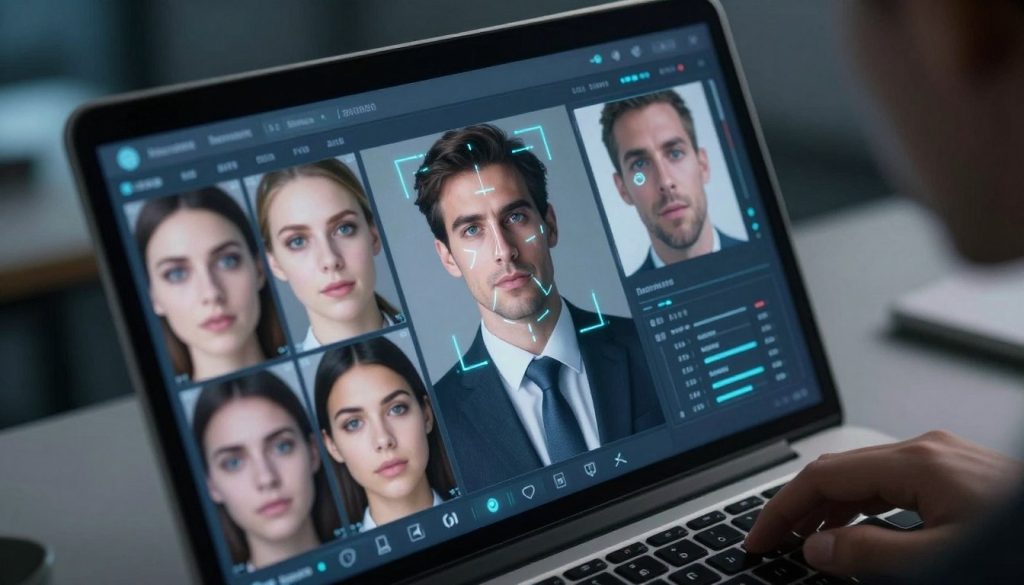
According to FaceOnLive, the technology works because “our advanced algorithm breaks down key features of the face such as the distance between the eyes, the curve of the jawline, and the shape of the nose and compares them against a massive database of facial images.” This breakdown captures what makes each person’s face unique.
The system analyzes features including:
- The distance between the eyes and their shape
- The width and curve of the nose
- The contour of the jawline
- The size and position of the mouth
- Cheekbone prominence and placement
Face matching software then converts these measurements into something computers understand perfectly: numbers. This creates a unique facial signature that represents that person’s face as a mathematical formula. Think of it like a fingerprint made of data instead of ink.
The combination of powerful face matching software and simple interfaces makes these tools accessible to everyone. Whether someone is tech-savvy or just learning to navigate digital tools, they can harness the power of facial recognition. The technology handles the complexity so users can focus on finding the people they’re searching for.
Top Face Search Tools to Find Anyone Online
Several leading face search tools have emerged as the go-to solutions for finding people by photo, each bringing distinct capabilities to the table. Whether you need to protect your privacy, reconnect with someone, or verify an online identity, choosing the right platform makes all the difference. These four facial recognition tools represent the best options available today, ranging from user-friendly consumer platforms to professional-grade investigative systems.
Each platform uses AI-powered face recognition but approaches the challenge differently. Some focus on ease of use and broad accessibility, while others prioritize detailed results or professional compliance features. Understanding what sets each tool apart helps you select the one that matches your specific needs and technical comfort level.
1. Lenso.ai
Lenso.ai stands out as one of the most versatile and accessible face search tools on the market today. The platform leverages advanced facial recognition technology to help users find pictures of any face and person online by simply uploading their photo. What makes Lenso.ai particularly effective is its specialized “People” category that filters results to show only relevant facial matches.
The search process couldn’t be simpler. Users can upload images by pasting, dropping, or choosing a photo from their computer. After uploading, they select the “People” category from the top bar to explore many photos of the same person across different websites and contexts.
This targeted approach significantly reduces irrelevant results and saves valuable time.
One of Lenso.ai’s most impressive features is its universal platform compatibility. The facial search engine works seamlessly on Android, iOS, Mac, Windows, and Linux systems. Whether you’re using a smartphone, tablet, or desktop computer, you can access the same powerful face matching software without downloading specialized apps or software.
For privacy-conscious users, Lenso.ai offers an alert system that provides proactive protection. Users can set up alerts for the people category to never miss any picture of themselves that was used without their consent. This monitoring capability helps catch unauthorized image use quickly, making it valuable for protecting personal privacy and digital reputation.
Developers and businesses benefit from Lenso.ai’s API integration capabilities. By purchasing the Developer subscription, users enjoy up to 5,000 API calls per month with Lenso.ai’s Face Search API. This feature allows companies to integrate photo identification tools directly into their own applications and workflows.
The platform excels in several practical scenarios:
- Finding where personal photos have been reposted or used without permission
- Locating images of friends or family members across the web
- Verifying the authenticity of social media profile pictures
- Tracking your digital footprint across multiple websites
- Monitoring brand ambassadors or influencer content usage
Lenso.ai works best for individuals seeking straightforward image-based people search capabilities, privacy-conscious users wanting ongoing monitoring, and developers needing API integration. The combination of ease of use, cross-platform accessibility, and alert functionality makes it an excellent choice for both casual and regular users.
2. EyeMatch.ai
EyeMatch.ai represents a modern approach to face finder technology, designed to bridge the gap between consumer-friendly interfaces and professional-grade accuracy. The platform delivers reliable facial matching results through sophisticated AI algorithms that can identify faces across various lighting conditions, angles, and image qualities.
The platform’s interface prioritizes user experience without sacrificing powerful search capabilities. Both casual users and professionals find the system intuitive enough for immediate use while offering depth for more complex searches. This balance makes EyeMatch.ai particularly valuable for users who need reliable results but don’t require enterprise-level investigative features.
EyeMatch.ai’s matching algorithms excel at handling real-world photo variations. The system can identify individuals even when image quality varies significantly or when photos show people in different contexts and environments.
The platform searches comprehensive databases of publicly available images across the web. This broad coverage ensures users can find matches from various sources, increasing the likelihood of locating the person or image they’re searching for. The reverse face lookup functionality works particularly well for verifying online identities before engaging in transactions or building relationships.
Privacy protection remains central to EyeMatch.ai’s design philosophy. The platform implements responsible data handling practices that protect both searchers and subjects. Users can conduct searches knowing their data isn’t being misused, while the system includes safeguards against malicious applications of the technology.
Key use cases where EyeMatch.ai delivers exceptional value include:
- Verifying online dating profiles and social media accounts
- Conducting safety checks before meeting people from online platforms
- Locating old friends or acquaintances for reconnection purposes
- Monitoring personal image usage across different websites
- Performing preliminary background research for safety purposes
EyeMatch.ai positions itself between the simplicity of consumer tools like Lenso.ai and the professional rigor of platforms like FaceCheck.ID. It offers more robust matching capabilities than basic reverse image search face tools while remaining accessible to users without technical expertise. The platform suits individuals concerned about online safety, people searching for lost contacts, and anyone wanting to understand their digital presence without committing to expensive professional subscriptions.
| Platform | Best For | Key Strength | Pricing Model | Technical Level |
| Lenso.ai | Personal privacy monitoring and general searches | Cross-platform compatibility and alert system | Free tier with Developer subscription for API | Beginner-friendly |
| EyeMatch.ai | Online safety verification and reconnection | Balance of accuracy and ease of use | Flexible consumer pricing | Beginner to intermediate |
Selecting the right platform depends entirely on your specific needs, technical comfort level, and budget. Casual users seeking occasional searches will find Lenso.ai or EyeMatch.ai perfectly adequate.
How to Use Face Search Tools Effectively
Using face search tools effectively requires more than just uploading a random photo and hoping for the best. Success depends on careful photo selection, proper upload techniques, and knowing how to verify results. The right approach can transform disappointing searches into powerful discoveries.
Starting with the right photo makes all the difference. A clear, recent image with good lighting gives the technology the best chance to identify facial features accurately.
Photo preparation is where successful searches begin. The ideal search photo should be front-facing or near-front rather than extreme side profiles. Clear facial features matter more than artistic composition.
Good lighting reveals details that algorithms need to match faces. Harsh shadows or dim lighting hide features that photo identification tools rely on for accurate matching.
Several factors impact how well the technology can process images:
- Resolution quality: Blurry or heavily compressed photos lose the signal algorithms need
- Facial obstructions: Sunglasses, hats, or masks cover features that help identify people
- Expressions: Neutral or mild expressions work better than extreme faces or big smiles
- Background simplicity: Simple backgrounds keep the focus on facial features
- Angle consistency: Extreme angles reduce match confidence significantly
Once the right photo is selected, the upload process becomes straightforward. Most platforms accept images through drag-and-drop, file selection, pasting from clipboard, or direct mobile camera capture.
When searches return no results, several troubleshooting strategies can help:
- Try different photos of the same person from various angles
- Adjust image brightness or contrast to improve facial feature visibility
- Use higher quality source images with better resolution
- Crop tighter on the face to eliminate distracting background elements
- Test the image across multiple platforms for comparison
Advanced users take their searches further by setting up alerts for ongoing monitoring. Some platforms allow users to track when new images matching a face appear online.
Tips for Getting Better Face Search Results
Maximizing the effectiveness of photo identification tools starts with understanding how to prepare and optimize your source images. The quality of search results depends heavily on the photos users upload and the strategies they employ.
Small adjustments can make a significant difference in matching accuracy and relevance.
Optimize Your Photos for Better Matches
Photo quality plays the most critical role in search success. Clear, high-resolution images provide face matching software with more facial data points to analyze and compare.
When multiple photos are available, always choose the sharpest, most detailed option. Blurry or pixelated images reduce matching accuracy significantly.
Lighting conditions matter more than most people realize. Well-lit faces with even illumination across all features work best with image-based people search technology.
Harsh shadows, backlighting, or extreme darkness hide the facial characteristics algorithms need to identify matches. Natural daylight or balanced indoor lighting produces optimal results.
Facial angles directly affect matching success rates. Front-facing or near-front-facing photos give algorithms the maximum amount of data to work with.
Extreme profile shots, where only one side of the face appears, significantly reduce match confidence. Three-quarter angles work reasonably well, but straight-on views remain the gold standard.
Facial expressions also influence results. Neutral or mild expressions provide the most consistent feature mapping for photo identification tools.
Extreme expressions like big laughs or exaggerated surprise can distort facial geometry enough to reduce matching accuracy. Relaxed, natural expressions work best.
Remove Obstructions and Simplify Backgrounds
Whenever possible, use photos without sunglasses, masks, hats, or hands covering facial features. Even partial obstructions limit the data available for facial analysis.
Sunglasses hide eye shape and positioning, which are critical identification markers. Medical masks cover the lower half of the face, eliminating nose shape, mouth dimensions, and jaw structure from analysis.
Background complexity can affect processing efficiency. While modern face matching software can isolate faces from busy backgrounds, simpler backgrounds reduce processing complexity and potential errors.
Clean backgrounds allow algorithms to focus exclusively on facial features without distractions.
Use Strategic Search Techniques
Running multiple searches with different photos, crops, and angles often uncovers results that single searches miss. According to FaceOnLive research, running a few crops and angles can double your odds of a hit.
Iteration represents one of the most powerful optimization strategies available to searchers.
Trying multiple platforms significantly expands coverage. Each service scans different database collections and uses slightly different algorithms.
Cross-platform searching casts a wider net than relying on a single tool. What one platform misses, another might discover.
Effective cropping can dramatically improve results. Tight crops focused just on the face eliminate distracting elements and force algorithms to concentrate on facial features.
This technique often improves matching accuracy by reducing visual noise in the source image.
Using photos from different time periods, angles, and contexts helps cast the widest possible net. Lenso.ai specifically advises users to upload multiple photos of the same person from different angles for better results.
Photo variety increases the likelihood of finding matches across diverse online sources.
Understand Confidence Scoring and Verification
Learning to interpret confidence scores helps prioritize which results deserve close attention. High-confidence matches warrant immediate investigation, while low-confidence results require additional verification.
FaceOnLive notes that effective platforms use confidence scoring to highlight stronger matches first, allowing users to review results in order of likelihood.
Cross-verification techniques confirm potential matches more reliably than facial similarity alone. Check multiple identifying details including names, locations, associated people, dates, and contexts.
Comprehensive verification reduces false positives and increases confidence in true matches.
Leverage Platform-Specific Features
Taking advantage of specialized tools maximizes efficiency. Use Lenso.ai’s “People” category to filter results specifically for face-focused matching rather than general image searches.
This category narrows results to human faces exclusively, eliminating irrelevant matches.
Alert systems provide ongoing monitoring capabilities without requiring manual repeated searches. Set up notifications to receive updates when new matching images appear online.
Platforms offering unlimited free searches allow users to refine and retest without penalty. FaceOnLive emphasizes that unlimited free searches let you adjust the photo, crop tighter, or try a second angle until results improve.
Conclusion
Face search tools have transformed how people protect their privacy, verify identities, and reconnect with others online. This guide covered everything needed to use facial recognition software effectively and responsibly.
Using facial recognition software comes with important responsibilities. Users should respect privacy boundaries and operate within legal limits. Permission matters when searching for others. Technology should enhance safety and connection without compromising dignity.
Getting started is straightforward. Begin by searching personal photos to understand digital footprints. Choose a platform based on specific needs and budget. Practice with simple searches first. Apply the optimization techniques from this guide.
Facial recognition technology continues advancing, becoming more accurate and accessible. Understanding these tools helps everyone navigate digital life with greater confidence and control. Whether the goal is privacy protection, safety verification, or personal reconnection, readers now have the knowledge to succeed responsibly.
Related Posts
What to Include in a Real Estate Newsletter Mailer to Stay Top-of-Mind
Engaging with potential clients regularly is essential in the real estate industry, and one effective way to do so is through a consistent mailer. However, simply sending out generic content isn't enough....