

Leveraging Schema Markup for Link Building Mastery
One small code change can move the needle fast: Search Engine Land reported a 30% jump in click-through rate after schema markup was added. That kind of lift is hard to ignore, especially when you want more people to find, read, and cite your work.
At its core, schema markup for link building is about clarity. It’s structured data added to HTML so search engines understand what a page means, not just what it says. When Google can connect your content to the Knowledge Graph, your pages can look richer in search results and stand out in crowded SERPs.
Those richer results—think ratings, review counts, dates, and pricing—can earn more clicks from the right people. More clicks often leads to more discovery, and discovery is where backlinks begin. Journalists, bloggers, and site owners are more likely to link to a result that looks credible and complete.
This is also where the schema markup impact on search rankings comes into play. Structured data won’t replace great content, but it can support crawlability, cleaner indexation, and stronger context around your entities and topics. In practice, that can make your best pages easier to surface—and easier to reference.
Schema comes in a few flavors, from basic HTML tagging to RDFa, but Google most often recommends JSON-LD because it’s easier to maintain and keeps structured data separate from your main page layout. In this guide, you’ll learn advanced schema markup tactics you can actually use, plus how to tie them to link building outcomes—not just rankings. If you want a deeper look at link building with structured data, start here: schema markup for link building.
Key Takeaways
- Schema markup can improve how your pages display in search, which can increase clicks and exposure.
- Better visibility helps the right publishers find your content, which can lead to more backlinks.
- The schema markup impact on search rankings often shows up through clearer context and better crawl signals.
- JSON-LD is commonly preferred because it’s easier to update and aligns with Google’s guidance.
- Advanced schema markup tactics can support both credibility in SERPs and link-worthy discoverability.
- This article focuses on how structured data supports link building outcomes, not only SEO metrics.
Understanding Schema Markup Basics
Schema markup is a quiet upgrade that helps search engines read your pages with less guesswork. It adds clear labels to key details, so your content can be understood faster and shown with more context on the results page. As competition on Google has grown, structured data has shifted from “nice to have” to a practical part of technical SEO.
schema markup benefits for SEO often show up in the small things that drive big outcomes: cleaner interpretation, better eligibility for enhanced search features, and stronger alignment with intent. Good structured data can also support crawl efficiency, help reinforce site structure, and pair well with solid metadata and mobile-first performance.
What is Schema Markup?
Schema markup is a shared vocabulary added to HTML that tells search engines what a page element means, not just what it says. For example, it can mark a number as a product price, a line of text as an author name, or a date as an event start time.
It started as a collaboration to standardize structured data across major search engines. Over time, it became a dependable way to communicate page context, especially as HTML5-era SEO grew more technical and results pages became more feature-rich.
Importance of Structured Data
Structured data fuels rich snippets and other enhanced previews that can make a listing easier to scan. That can include star ratings, review counts, publish dates, or price ranges, depending on the page type and what Google chooses to show.
Behind the scenes, schema also supports how systems organize information for features like the Knowledge Graph. When paired with smart schema markup implementation strategies, it can reduce ambiguity, reinforce topical signals, and help your content fit the right search features.
Common Types of Schema Markup
Different schema types map to different goals, from ecommerce visibility to local intent. The best choice depends on what the page is designed to do and what details users care about before they click.
| Schema type | Best for | Details it can surface in search | Where it fits on a site |
|---|---|---|---|
| Organization | Brand credibility and clarity | Name, logo, contact points, social profiles | Homepage, about page, contact page |
| Product | Ecommerce and product-led pages | Price, availability, reviews, aggregate rating | Product detail pages, category hubs |
| Article | Publishers and content marketing | Headline, date published, author, image | Blog posts, news posts, guides |
| Event | Ticketed and scheduled experiences | Date, location, ticket info, status | Event listings, venue pages |
| Recipe | Food and instructional content | Ingredients, cook time, nutrition, ratings | Recipe pages, meal prep collections |
| Review | Trust-building for products or services | Individual reviews, aggregate ratings | Product pages, service pages, testimonials |
| LocalBusiness | Local search and “near me” intent | Address, phone, hours, service area | Location pages, contact page |
To keep it practical, start with one page type and build from there. Strong schema markup implementation strategies focus on accuracy, consistency, and matching the markup to visible on-page content. Done well, schema markup benefits for SEO can stack over time as your site becomes easier for search engines to parse and present.
How Schema Markup Enhances SEO
Schema markup turns key page details into clear signals that search engines can read fast. That clarity supports richer results and cleaner matches to intent, which is a big part of the schema markup benefits for SEO. It also helps your pages look more complete when people compare options in a crowded results page.

Improving Search Engine Visibility
When you add structured data, you label what your content is, not just what it says. That can unlock rich results like star ratings, event details, recipe steps, and other enhanced previews. Over time, this clearer context is often tied to schema markup impact on search rankings because relevance is easier to assess.
It also supports stronger visibility in competitive local searches. In a “hotels in LA” results page, listings can show review stars, price ranges, and key facts right away, which makes the choice feel simpler for searchers.
Impact on Click-Through Rates
Better presentation can drive more clicks, even when your position stays the same. Search Engine Land has reported case study results showing about a 30% CTR improvement after schema implementation. That lift tends to come from richer snippets that answer quick questions before the click.
For e-commerce, Product schema that surfaces pricing and availability has been associated with a similar 30% CTR uptick. Shoppers can spot the right item faster, which supports the schema markup benefits for SEO through stronger engagement signals.
Tips for Effective Use
Start with the pages that already earn impressions, then make the preview more useful. Focus on details people care about most, like ratings, dates, locations, FAQs, or shipping-related product info. This same approach can also support schema markup for link building, since clearer facts make your page easier to cite.
-
Keep markup accurate and consistent with on-page content to match credibility expectations tied to Google E-E-A-T.
-
Use schema to reinforce key entities (brand, product, organization, author) so search engines connect the dots across your site.
-
Pair structured data with technical basics like mobile-friendly layouts and fast load times, since performance shapes how pages compete.
| Schema focus | What shows in results | Why it helps |
|---|---|---|
| Product (price, availability) | Price, stock status, sometimes ratings | Reduces buyer uncertainty and can raise CTR, supporting schema markup impact on search rankings through improved engagement |
| Local business (reviews, price range) | Star ratings, key business details | Makes local listings more persuasive for comparison searches like hotels and restaurants |
| Article and FAQ | Expanded snippet space and quick answers | Builds trust fast and can attract mentions, reinforcing schema markup for link building over time |
Integrating Schema Markup in Content Strategy
Schema works best when it supports the story your page already tells. When you plan it with your editors and SEO team, you can keep structured data consistent across templates and updates. That consistency also sets the stage for link building with schema markup, because other sites can understand and reference your key facts faster.

Think of schema markup implementation strategies as part of your publishing workflow, not a one-time task. Add it, test it, and revisit it after content changes. Clean markup builds trust with search engines and helps your pages stay eligible for rich results.
Best Practices for Implementation
Google favors JSON-LD since it’s easier to add without rewriting your HTML. Keep the markup tightly aligned with what the page shows, like names, dates, prices, and locations. If the page changes, the structured data should change, too.
After you deploy, run a check with Google’s Structured Data Testing Tool to catch missing fields and formatting errors. If you need quicker rollouts, Google Tag Manager can push JSON-LD through Custom HTML tags. These schema markup best practices for link building help prevent messy signals that can weaken visibility.
Content Types That Benefit Most
Some pages get more lift because people look for quick answers. News and articles can surface key details like headline, date published, and author. Local business pages can highlight address, phone, and hours for stronger local discovery.
Product pages often benefit from price, availability, and reviews, while recipes can show cook time and nutrition. Events are another strong fit since date, location, and ticket price help users decide fast. When these details display clearly, link building with schema markup becomes easier because publishers can cite your page with confidence.
Tools to Generate Schema Markup
Schema markup generators can speed up drafts, especially for common types like Product, Article, and Event. For WordPress, the MetaSync plugin can automate embedding structured data at scale. Search Atlas also supports workflows through Schema Creator, Tag Manager, and Report Builder for tracking improvements over time.
On Shopify, apps or manual edits can work well for product data, while Joomla often relies on extensions. No matter the platform, schema markup implementation strategies should include validation and routine updates, so your data stays accurate as inventory, hours, and editorial details shift.
| Content type | High-impact schema fields | Why it matters for visibility | How it supports schema markup best practices for link building |
|---|---|---|---|
| Articles and news | Headline, datePublished, author | Clarifies freshness and credibility in results | Makes it easier for publishers to quote and attribute the right page |
| Local business pages | Address, phone, openingHours | Improves local discovery and reduces user friction | Gives partners consistent NAP details to reference in listings and mentions |
| E-commerce product pages | Price, availability, aggregateRating, review | Boosts SERP appeal and purchase intent signals | Encourages affiliates and reviewers to link to the exact SKU with clear specs |
| Recipes | CookTime, recipeIngredient, nutrition | Helps users compare options quickly from search | Food sites can cite the recipe with fewer follow-up questions, supporting link building with schema markup |
| Events | StartDate, location, offers price | Speeds up decision-making for attendees | Press pages and community calendars can link with fewer errors in dates and details |
Boosting Link Building Efforts with Schema
When people find your page fast and understand it at a glance, they are more likely to share it. That’s the quiet advantage of schema markup for link building. It helps search engines read your content with less guesswork, which can lift visibility and bring in the kind of readers who cite sources.
Link building with schema markup also works because it adds clear signals, like reviews, pricing, dates, and organization details. Those details can show up in rich results and make a listing look more complete. More clicks can mean more editors, bloggers, and customers landing on the page and referencing it later.
How Schema Influences Linking Behavior
Structured data can nudge linking behavior in a few practical ways. First, rich snippets can raise click-through rate, which expands reach and creates more chances for natural citations. Second, clearer entity signals can help a page appear in prominent SERP features, so it becomes a “go-to” resource people point to.
It can also support trust. When key facts are easy to verify on the results page, a site owner may feel more confident linking to it. With advanced schema markup tactics, you can reinforce what the page is about, who it’s for, and what makes it credible—without changing the core writing.
- More discovery: better presentation can bring more qualified visitors who later cite your page.
- Cleaner context: clearer categorization helps your content match the right queries.
- Higher comfort: visible business and review signals can reduce doubt for publishers.
Case Studies of Successful Implementations
In reported examples, schema use has been tied to measurable gains. Search Engine Land described a case where schema markup was associated with a 30% increase in CTR. Separate e-commerce reporting noted that adding Product schema, including price and availability, also aligned with a reported 30% CTR uplift from stronger SERP visibility.
Another example involved a medical information platform using health-related structured data to strengthen rich snippet presence for relevant queries. That kind of visibility can support authority signals and engagement, which often shapes whether others treat a page as a reference.
| Implementation focus | What users see in search | Reported impact | Why it can attract links |
|---|---|---|---|
| Product schema with price and availability | Pricing, stock status, and stronger product context | Reported ~30% CTR uplift in an e-commerce example | More shoppers and reviewers reach the page, increasing citation opportunities |
| Schema used in a Search Engine Land case study | Enhanced result appearance tied to structured data | Associated with a 30% CTR increase | Higher visibility can turn the page into a commonly referenced source |
| Health-related structured data | Clearer medical topic signals and richer SERP presentation | Increased engagement and stronger rich snippet presence (reported example) | Improved credibility makes publishers more willing to cite and link |
| Schema paired with solid technical SEO | Faster pages with fewer crawl and mobile issues | Better reach when combined with crawlability, speed, and mobile readiness | More reliable access helps editors and readers stick with the source |
For many teams, the sweet spot is simple: strong content, clean technical performance, and schema markup for link building that matches the page’s real meaning. Once that base is in place, advanced schema markup tactics can help the right pages stand out in crowded results, supporting steady link discovery over time.
Common Mistakes to Avoid with Schema Markup
Schema can make your pages easier to understand, but small slipups can cancel the gains. Many teams rush the work, then wonder why rich results never show up. Getting it right means steady checks, clean data, and smart schema markup implementation strategies that match how your site actually works.
Misconfigurations to Watch Out For
The biggest trap is marking up details that a visitor can’t see on the page. If the structured data says “in stock” or lists an author, your content should say the same thing in plain text. This alignment supports trust and helps schema markup best practices for link building work the way you expect.
Another common issue is skipping validation after edits. A theme change, new plugin, or a copied template can break JSON-LD without warning. Make testing part of your release routine, especially when you adjust products, FAQs, or article pages.
Schema also gets stale. Prices change, events pass, and bios get updated, but old markup can hang around for months. A light monthly review keeps your data current and reinforces schema markup implementation strategies that scale as your site grows.
Platform quirks matter too. WordPress plugins can output duplicate fields, Shopify apps may miss key properties, and Joomla extensions can fail to render markup on some templates. When results look inconsistent, check the source code on real pages, not just the editor view.
| Mistake | What it looks like | Why it hurts | Better approach |
|---|---|---|---|
| Mismatch with on-page content | Markup claims a rating or price that isn’t shown | Creates trust gaps and weakens eligibility for enhancements | Keep visible copy and structured data in sync, down to dates and availability |
| No validation after updates | Broken properties after a theme, app, or plugin change | Errors block rich results and waste crawl time | Validate key templates after each release and spot-check top pages |
| Outdated schema | Old event dates, staff info, or product status | Sends mixed signals to search engines and users | Schedule recurring reviews tied to content updates |
| Platform-specific output gaps | Markup appears on desktop templates but not mobile, or duplicates appear | Inconsistent rendering reduces coverage across the site | Audit rendered HTML on live pages and standardize template rules |
Overusing Schema Markup
More schema isn’t always better. Loading a page with every possible type can confuse parsers and bloat your code. Strong schema markup best practices for link building focus on the few types that match the page’s purpose, like Article, Product, FAQPage, or Organization.
It’s also important to avoid anything that looks fake or manipulative. Don’t add reviews that aren’t real, and don’t label content as something it isn’t. Clean, honest structured data supports E-E-A-T signals and keeps your schema markup implementation strategies aligned with search guidelines.
Measuring the Success of Schema Markup
Schema can feel invisible until you track what changes on the results page. The schema markup benefits for SEO show up as clearer listings, richer previews, and stronger engagement signals you can measure over time.
To keep results clean, pair performance data with quality checks. Use Google’s Structured Data Testing Tool to confirm your markup is valid and eligible for rich results, then compare those pages against similar pages without enhancements.
Key Metrics to Track
Start with click-through rate. When rich results appear, searchers often get answers faster, and that can raise clicks without changing your position. This is where schema markup impact on search rankings becomes practical: better visibility can shift behavior even before rankings move.
Also track how often you earn rich results and other SERP features. Watch for review stars, price ranges, event dates, FAQs, or enhanced article previews, depending on your schema type.
| Metric | What to watch | Why it matters | Tools to use |
|---|---|---|---|
| CTR (page-level) | Week-over-week and month-over-month changes after markup goes live | Shows whether rich snippets improve listing appeal | Google Search Console, Search Atlas Report Builder |
| Rich result visibility | Impressions and appearances with enhanced features | Confirms your structured data is surfacing on SERPs | Google Search Console, Structured Data Testing Tool |
| Indexation and crawl signals | Coverage status, crawl activity, and sudden drops after releases | Helps spot technical issues that block structured data value | Google Search Console, server logs |
| Markup errors and warnings | New issues after CMS edits, template changes, or plugin updates | Prevents silent losses in eligibility for rich results | Structured Data Testing Tool, Search Atlas Tag Manager |
Analyzing Changes in Link Acquisition
When you use schema markup for link building, focus on the chain reaction: stronger snippets can drive more visits, more discovery, and more mentions. Track referral traffic and new backlinks to pages that gained rich results, then compare against a baseline period.
Pay attention to which schema types attract attention in your niche. Product, Review, LocalBusiness, and Article markup can make previews more specific, which helps journalists, bloggers, and customers cite the right page.
To keep analysis steady, group pages by intent and topic. Then review changes in CTR, rich result impressions, and new linking domains together, using the same date ranges so the story stays consistent.
Future Trends in Schema Markup and Link Building
Schema is moving fast, and it is no longer just for products and local listings. Publishers, blogs, and media sites now use advanced schema markup tactics to win richer search results and stand out in crowded topics. As search results get more visual and more direct, structured data helps your content stay clear, searchable, and easier to cite.
Voice search is a big driver. More people ask questions out loud, so pages that match natural language can gain an edge. Speakable schema can flag key passages for text-to-speech, and that can shape the schema markup impact on search rankings over time. When your answers are easy to pull, they are also easier to reference, which supports link building with schema markup.
Emerging Technologies and Their Impact
Google’s Search Generative Experience is pushing the web toward machine-readable context. In that setup, clean JSON-LD helps systems connect entities, facts, and sources with less guesswork. AI and machine learning also raise the bar for media data, so richer metadata for images and videos can improve how content is classified and surfaced.
Schema is also stretching into rich experiences like AR and VR, where discovery depends on clear descriptions of what users will see. At the same time, teams want better UX insight, so structured data tied to forms and calls to action can support stronger testing and conversion tracking. These shifts make advanced schema markup tactics feel less optional and more like core infrastructure.
Predictions for Schema Evolution
Expect more schema types and attributes to move from “new” to normal as search engines expand the Knowledge Graph. Keeping markup updated will matter as much as adding it, since standards and SERP features keep changing. The sites that treat structured data as ongoing upkeep, and not a one-time project, will see a steadier schema markup impact on search rankings and stronger link building with schema markup.
FAQ
What is schema markup, and how does it relate to structured data?
Schema markup is structured data added to HTML that gives search engines clear signals about what a page means. This helps Google interpret content faster and connect it to the Knowledge Graph, which can improve how your pages appear and are understood in search results.
Why does structured data matter for link building?
Structured data can unlock richer SERP displays like star ratings, review counts, dates, and pricing, which helps pages stand out. More visibility often leads to more clicks, and that added attention can increase discovery by journalists, bloggers, and site owners—creating more chances to earn backlinks.
How does schema markup impact search rankings and overall SEO performance?
Schema markup supports technical SEO by improving content clarity for crawlers, strengthening context, and helping search engines categorize pages more accurately. While schema is often framed as a behind-the-scenes lever, its impact on crawlability, indexation, and relevance signals can contribute to stronger SERP performance that indirectly improves backlink quality and acquisition.
What are the schema markup benefits for SEO beyond rich snippets?
Beyond rich results, schema supports better machine understanding of your site, which can reinforce knowledge panels and other enhanced SERP features. It also fits into broader technical priorities like site structure, internal linking clarity, metadata alignment, and mobile-first expectations that can improve CTR and engagement.
Is there proof that schema can improve click-through rate?
Yes. A Search Engine Land case study reported a 30% increase in CTR after implementing schema markup. A separate example tied Product schema (including pricing and availability) to a reported 30% CTR uptick due to stronger visibility on the results page.
Which schema types are most useful for improving visibility and earning links?
Common high-impact types include Organization (brand/contact info), Article (headline, author, publish date), Product (price, availability, reviews), Event (date, location, ticket info), Review (aggregate ratings), LocalBusiness (hours, phone, address), and Recipe (ingredients, cook time, nutrition). These details can make listings more useful and more link-worthy.
What’s a real-world example of schema improving local visibility?
In searches like “hotels in LA,” results can show star ratings, review totals, and price ranges right on the SERP. That extra detail helps searchers choose faster, which can increase clicks and broaden exposure—often a precursor to more mentions and backlinks.
What formats can schema markup be implemented in?
Schema can be implemented using basic HTML tagging approaches and more advanced formats like RDFa. For modern SEO, JSON-LD is widely used and is recommended by Google because it’s easier to add and maintain without rewriting HTML attributes.
What are schema markup implementation strategies that work best for most sites?
Strong approaches include using JSON-LD, keeping the markup aligned with visible page content, and validating regularly. Many teams start with the pages most likely to earn clicks and citations—like articles, product pages, local pages, and event listings—then expand coverage once results are stable.
What are schema markup best practices for link building?
Focus on properties that improve SERP clarity—like dates, prices, availability, and ratings—because they can drive higher CTR and wider discovery. Keep everything accurate to support trust signals associated with Google’s E-E-A-T expectations, since publishers and site owners are more likely to link to credible sources.
How do I validate schema and catch errors before they hurt performance?
Use Google’s Structured Data Testing Tool to check for errors, warnings, and eligibility for rich results. Validation matters because broken or inconsistent markup can prevent rich results and reduce the visibility gains that support link earning.
Can schema markup be deployed without editing site code directly?
Yes. Schema can be implemented through Google Tag Manager using Custom HTML tags for faster deployment and testing. This is often helpful when engineering bandwidth is limited or when you want controlled rollouts across templates.
Which content types benefit most from structured data?
Pages that benefit heavily include news and articles (timely visibility), local business pages (hours and location intent), e-commerce products (price, availability, reviews), recipes (nutrition and cook time), events (date and ticket info), and reviews (ratings that build trust).
What tools can help generate, deploy, and measure schema markup?
Common options include schema markup generators and validation tools like Google’s Structured Data Testing Tool. Some workflows also use Search Atlas tools such as Schema Creator, MetaSync plugin for WordPress, Tag Manager, and Report Builder to create, embed, and analyze structured data.
How does schema markup influence linking behavior in practice?
When schema triggers richer previews, your page can earn more clicks and more readers. That wider reach increases the odds that journalists, bloggers, and resource curators find your work and cite it, which is the core mechanism behind link building with schema markup.
What case studies show schema working as an advanced SEO tactic?
Examples include a Search Engine Land case study showing a 30% CTR lift, and an e-commerce example where Product schema (pricing and availability) was linked to a 30% CTR increase. There’s also an example of a medical information platform using health-related schema to secure richer SERP presence and stronger engagement, helping reinforce credibility.
What are the most common schema misconfigurations to watch out for?
The biggest issues are markup that doesn’t match on-page content, skipping validation after changes, and letting structured data become outdated as pages evolve. Platform-specific implementation gaps can also happen when relying on WordPress plugins, Shopify apps or manual edits, or Joomla extensions that don’t render consistently.
Can you overuse schema markup, and does it hurt?
Yes. Overloading a page with excessive structured data can create confusion and reduce clarity. Stick to the most relevant schema types and properties, and avoid manipulative tactics like fake reviews or misleading data.
What should I measure to understand schema markup impact on search rankings and link growth?
Track CTR, rich result visibility, and enhanced SERP features like knowledge panels. Pair that with technical indicators such as crawlability and indexation health, then correlate improved SERP presentation with changes in brand mentions and backlink acquisition over time.
How do I connect structured data improvements to backlink acquisition?
Compare pages with schema-enhanced SERP listings against similar pages without enhancements. Look for leading indicators like CTR gains and richer snippet visibility, then monitor whether those pages see more referral discovery, citations, and backlinks in the weeks that follow.
What are advanced schema markup tactics that support future search features?
Advanced tactics include using Speakable schema for voice search and adding richer metadata for images and videos to help classification. Structured data is also positioned as compatible with Google’s Search Generative Experience (SGE), where clean machine-readable context can influence how content is understood and surfaced.
How is schema expected to evolve, and why does that matter for link building?
Schema is expected to expand with more attributes and emerging types as search engines enrich the Knowledge Graph and SERP experiences. Since this is ongoing maintenance—not a one-time task—keeping structured data current can protect visibility gains that drive discovery and long-term link earning.
What is schema markup for link building, and how does it differ from traditional link building?
Schema markup for link building uses structured data to improve how your content appears and performs in search, which increases exposure and makes your pages easier to evaluate at a glance. Traditional link building often relies on outreach or partnerships, while link building with schema markup focuses on earning links through better SERP presentation, trust cues, and higher discoverability.
How does schema markup support schema markup for link building in publisher-style ecosystems?
In blogs and publisher-style sites, schema like Article (headline, date, author) can improve search previews and make reporting easier to verify and cite. That added clarity helps content compete for richer SERP displays, which can increase editorial discovery and organic citations.
What is schema markup for link building in the context of schema markup implementation strategies and technical SEO?
It’s the practice of deploying structured data in a way that strengthens technical SEO fundamentals—clear context, efficient crawling, and accurate indexing—while also improving SERP presentation. When those pieces work together, you can earn more high-intent clicks and increase the chance that authoritative sites link back to your pages.

Boost Your Plumbing Site with Link Building Services
Google handles about 99,000 searches every second. That adds up to roughly 8.5 billion searches a day and more than 2 trillion a year. When a pipe bursts, homeowners search fast—and they usually call one of the first few results they see.
If you run a U.S. plumbing company, great work in the field is only half the battle. You also need a marketing plan that brings steady calls, and plumbing SEO services sit at the center of that plan. Helpful pages, short videos, and clear service info build trust before a customer ever picks up the phone.
That’s where plumbing link building comes in. The right links act like public proof that your business is real, relevant, and worth ranking. With link building services for plumbing website growth, your goal isn’t “more links.” It’s better links from local, niche, and industry sites that match what you do.
Most campaigns start with a link audit and a competitor check using tools like Majestic. This step can flag risky links, spot gaps, and show where other plumbers earn authority. From there, providers build links through real outreach, listings, and placements that support stable ranking gains and better crawling.
Link management matters, too. Broken pages and lost placements can drain “link juice,” so teams often monitor fixes with tools like Dead Link Checker. Many shops also align this work with your Google Business Profile and content that performs well on Facebook, Instagram, YouTube, and even TikTok.
If you’d rather stay focused on service calls, pros can handle outreach, publishing, and tracking while you keep the trucks moving. Some agencies—such as Local SEO Search Inc. and Plumbing Webmasters—price packages starting around $1,000 per month, with room to scale based on your market. For a broader look at core options, link building services are often treated as a central part of modern SEO packages.
Key Takeaways
-
Search visibility matters because homeowners make quick choices after a Google search.
-
plumbing SEO services work best when strong content and link authority support each other.
-
plumbing link building should focus on relevant, local, and industry-fit sites—not volume.
-
Good campaigns begin with an audit, competitor research, and a plan to avoid harmful links.
-
Ongoing link management helps protect rankings by catching lost links and broken pages.
-
link building services for plumbing website growth can free up time while specialists track results.
Why Link Building is Essential for Plumbing Websites
Plumbing customers in the U.S. usually start with a quick search, then pick a short list. That’s why links matter. They help your site look credible, earn clicks, and compete in crowded zip codes where local SEO for plumbing companies can decide who gets the call.
Good links also support SEO for plumbers by connecting your brand to trusted sources across the web. When the right sites mention you, it sends a strong signal that your business is real, active, and worth showing to searchers.
Understanding Link Building
Link building for plumbers means earning inbound links from external domains that point to your website. These mentions can come from community pages, industry resources, or local news sites.
Common approaches include local sponsorships, targeted email outreach, and content promotion that earns real attention. Another proven angle is broken link building, where a dead resource link gets replaced with a better, updated page on your site.
Link campaigns usually include three link types:
- NoFollow links often show up in directories or social profiles. Google may treat them as a “hint,” so they can still help discovery and brand signals.
- DoFollow links are placed by editors or site owners inside content, and they tend to pass stronger value.
- Internal links connect your own pages and guide visitors. For example, a water heater blog post can link to your water heater installation or repair page, helping users and search engines find key services.
Benefits of Quality Backlinks
Strong plumbing backlinks improve visibility, build authority, and lift overall search performance. They also make your site look more established, which matters when people compare options in a hurry.
Quality beats quantity. One great link can outweigh dozens of weak ones, especially if it comes from a trusted, relevant site with real readership.
What separates a strong link from a weak one often comes down to relevance, anchor text, and where the link sits on the page. A link inside the main content, placed early where people will see it, can drive more clicks than something buried in a footer.
| Quality factor | Higher-impact link | Lower-impact link |
|---|---|---|
| Domain trust | Established media or industry leader with editorial standards | Thin site with little history and unclear ownership |
| Relevance | Home services, construction, or local community topics tied to your service area | Unrelated niche content that doesn’t match plumbing intent |
| Placement | In the main article text near supporting details | Sidebar, footer, or a long list of random links |
| Real audience | Pages that earn visits, shares, and natural engagement | Pages with little traffic and no signs of readership |
A clear example of authority difference is that a link from the Los Angeles Times carries far more weight than a low-traffic personal blog. The same logic applies when you chase local SEO for plumbing companies: credibility travels through the right sources.
How Search Engines Use Links
Links help search engines find pages, understand relationships between topics, and judge trust. External links are among the top two criteria used in Google’s indexing algorithm, and Google weighs both the amount and quality of plumbing backlinks when deciding what to index and how to rank it.
That link profile can be the difference between gaining new customers and losing them to a competitor down the street. It also ties into local SEO for plumbing companies, since directory links can support visibility in Google Search and Google Maps.
Precision matters. Risky shortcuts can trigger a manual penalty and may even remove pages from Google’s index, which is why SEO for plumbers works best when links are earned in a clean, credible way.
The Types of Link Building Services Available
Not every campaign looks the same, and that’s a good thing. The best plumbing link building plans match your service area, your specialty, and your budget. A solo plumber may need fast local signals, while a multi-city brand often needs wider coverage and steadier publishing.
Strong plumbing marketing strategies also pair links with plumbing website optimization, so new visitors land on pages that load fast, read clearly, and make it easy to call.

Guest Blogging for Plumbing Businesses
Guest blogging is a common service because it earns editorial backlinks from real articles. For plumbers, placements often come from home service, home improvement, general contracting, renovation, or construction sites since plumbing-only blogs can be limited.
Quality providers handle outreach, pitching, and placement on relevant sites, then publish content that fits the audience and topic. This is where plumbing website optimization matters, because a guest post should point to a page that answers the search intent and builds trust.
Guest blogging works best when content production stays consistent. Many teams also bundle outreach with writing to keep plumbing link building moving at a steady pace.
Local Directory Submissions
Directory submissions focus on citations: accurate profiles across trusted local business directories. Google Business Profile is a key listing for plumbers, and it can include a website link, often as a nofollow backlink.
These listings can support visibility in Google Search and Google Maps, especially for “near me” and service-area searches. As part of plumbing marketing strategies, many services also set up and maintain social profiles on Facebook, Instagram, YouTube, and TikTok, which helps customers confirm you’re active and legitimate.
Directory work may feel basic, but it creates a clean footprint that supports plumbing website optimization by sending consistent business signals across the web.
Influencer Collaborations
In plumbing, “influencers” are often community partners, trade groups, and respected businesses that can vouch for your work. The goal is a real endorsement and a relevant mention, not a paid link scheme.
One practical path is outreach to suppliers of materials, tools, and replacement parts. This can be especially effective for exclusive or certified sellers who keep partner pages, installer directories, or resource lists.
Local supplier partnerships sometimes include a simple link exchange, as long as it stays relevant and focused on quality. Providers often tailor this style of plumbing link building for solo plumbers, small plumbing companies, multi-city plumbing brands, and specialized providers such as water treatment or trenchless repair, based on how customers search in each market.
Pricing can vary widely across vendors, from a few hundred dollars per month to high-end retainers, so it helps to review service types and guardrails before you commit. A quick overview is available through white hat link building service options that outline common approaches and typical ranges.
| Service type | Best fit for | Where links usually appear | What to watch |
|---|---|---|---|
| Guest blogging | Plumbers who want authority growth beyond their city | Editorial articles on home services, renovation, construction, and contractor sites | Relevance, real traffic, and natural placement to a useful page |
| Local directory submissions | New businesses, rebrands, and teams expanding service areas | Google Business Profile and other local directories; supporting social profiles | NAP consistency, duplicates, and outdated phone numbers or addresses |
| Influencer collaborations | Brands with strong local relationships or niche services | Supplier partner pages, community resources, trade associations, local business features | Keep it authentic, avoid paid-link footprints, and prioritize trusted partners |
How to Choose the Right Link Building Service
Picking link building services for plumbing website growth is not just about getting “more links.” It’s about earning the right links, on the right sites, at a steady pace that looks natural. That matters for SEO for plumbers because local competitors often fight for the same high-intent searches.
Before you sign a contract, ask how the provider plans, builds, and reports. Strong plumbing SEO services feel organized, transparent, and easy to track week to week.
Assessing Experience and Expertise
Start by screening for white-hat link building. Shortcuts like Private Blog Networks or paid placements can trigger a manual penalty, and in severe cases, deindexation. Either outcome can wipe out visibility fast.
Look for a team that can run the full workflow: keyword research, competitor analysis, and targeted content for your service area. Link work should connect to real pages you want to rank, like drain cleaning, water heater repair, or emergency service. For SEO for plumbers, that local fit is often the difference between calls and silence.
It also helps when an agency has real market proof. Local SEO Search highlights work across 10,000+ local companies in Canada, while Plumbing Webmasters cites work with thousands of plumbers over more than a decade. Experience like that usually comes with clearer processes and fewer surprises.
If you’re weighing whether to outsource or build in-house, review a detailed overview of outsourced link building and the deliverables a legitimate provider should share.
Evaluating Client Testimonials
Testimonials and case studies should show what changed: rankings, traffic, and lead volume. Vague praise is easy to write, but it doesn’t prove the work moved the needle for plumbing SEO services.
Ask how often you’ll get updates and what they include. Helpful reporting shows live URLs, the page context, and the exact anchor used. For link building services for plumbing website campaigns, that level of detail makes it easier to keep quality high and avoid risk.
Checking the Quality of Links
Quality links share three traits: relevance, clear anchor text, and strong placement. A plumbing backlink should come from a site that makes sense for home services or local coverage, not random topics. Anchors should describe the destination page, not “click here.” Placement should be in the main content, not buried in a footer or sidebar.
| Quality check | What to ask for | What to avoid | Why it matters for SEO for plumbers |
|---|---|---|---|
| Relevance | Sites tied to home services, local news, or related trade topics | Off-topic blogs and unrelated directories | Relevance improves trust signals and helps local rankings hold steady |
| Anchor text | Descriptive anchors tied to the target page and service intent | Overused exact-match anchors or generic text | Balanced anchors reduce spam signals and improve page understanding |
| Placement | Links inside the body content, ideally early in the article | Sitewide links, footers, and low-visibility sidebars | Editorial placement tends to pass stronger value and reads naturally |
| Transparency | Live URLs, page screenshots if needed, and a reason for each placement | “Guaranteed links” with no site list, context, or proof | Clear proof protects your brand and keeps link velocity consistent |
It’s also smart to verify competitor backlink sources with tools like Majestic. When a provider can explain why a link was placed and how it supports link building services for plumbing website goals, you’re more likely to get steady, defensible results.
Strategies for Effective Link Building
Strong link building comes from being useful, visible, and locally involved. When those pieces work together, plumbing backlinks feel earned, not forced, and they support plumbing website optimization over time.

Creating Compelling Content
The fastest way to attract plumbing backlinks is to publish content people want to cite. Think “linkable assets” like local cost guides, simple checklists, and short videos that answer real homeowner questions.
For example, a post titled The Average Cost of Water Bills in Fort Worth, TX tends to earn more shares and references than a generic “How to Save Water” article. It’s specific, timely, and useful for both residents and local reporters.
Avoid thin or repetitive pages that say the same thing as every other site. Helpful content also supports local SEO for plumbing companies when you connect it with smart internal links, like routing a leak-detection article to your slab leak service page.
If you want a clear view of how outreach-driven links are planned in other industries, the workflow behind strategic link building is a good reference point for building a consistent process.
Leveraging Social Media Platforms
Social channels can help the right people discover your work, even if many profile links are nofollow. Keep your business active on Facebook, Instagram, YouTube, and TikTok with short tips, before-and-after clips, and quick safety reminders.
This steady visibility supports plumbing website optimization by bringing in branded searches, repeat visits, and more chances for others to reference your guides. Over time, those touchpoints can lead to real plumbing backlinks from blogs, neighborhood sites, and local news.
Engaging with Local Community
Local relationships still drive some of the best links. Sponsor a youth sports team, support a neighborhood clean-up, or offer a short plumbing safety talk through a community center, then share the recap so partners can mention it.
Build connections with local suppliers and relevant plumbing organizations, and look for co-marketing that helps customers, not just rankings. When it’s genuinely useful, a simple “recommended partners” mention can support local SEO for plumbing companies without looking spammy.
| Business type | Best local link angles | Content that earns mentions | What to watch for |
|---|---|---|---|
| Independent plumbers | Neighborhood associations, property managers, community event pages | Emergency prep tips, shutoff valve guides, same-day service FAQs | Stay consistent with citations and service area pages for plumbing website optimization |
| Small plumbing companies | Supplier partner pages, home service blogs, Chamber of Commerce features | Install and maintenance explainers, rebates and permit checklists | Avoid “one-size-fits-all” pages that weaken trust and reduce plumbing backlinks |
| Multi-city brands | City sponsorships, regional media, local directories with real traffic | City-specific pricing ranges, location pages with unique photos and FAQs | Don’t duplicate city pages; unique details help local SEO for plumbing companies |
| Specialized providers (water treatment, trenchless repair) | Manufacturer resources, trade org mentions, niche publications | Testing results breakdowns, comparison guides, “is it worth it?” explainers | Use clear proof points and link to supporting service pages to strengthen plumbing website optimization |
Measuring Success of Link Building Efforts
Good plumbing link building is only useful if it moves the numbers that lead to calls. Set clear targets, like growing backlinks by 10% in six months, lifting organic visits by 20% in three months, or raising social shares by 30% in a month. When plumbing SEO services include steady reporting, it’s easier to connect link growth to real demand in your service area.
Analyzing Traffic and Rankings
Start with visibility trends that match revenue: keyword visibility, local visibility, and which pages bring in the most calls over time. Track the number of new links and their quality, then watch how rankings shift alongside them. Google weighs both backlink quantity and quality, so plumbing marketing strategies should always compare link gains with changes in impressions, clicks, and map results.
Tools for Link Building Analytics
Majestic helps you compare competitor backlink profiles, which can reveal the sites and topics that already drive links in your market. Dead Link Checker is useful for spotting broken backlinks that point to 404 pages, so you can reach out and reclaim that value. Many teams also use pipeline analytics, CRM logs, and automation to track outreach, domain strength, and progress shared in link-building measurement reports.
Adjusting Strategies Based on Results
Use the data to refine plumbing link building month after month. If links lift rankings but calls stay flat, shift toward pages and topics tied to service intent, and keep outreach personal since better targeting often earns better links. Stay white-hat by leaning on industry outreach, content marketing, and brand mentions; avoid buying links or using PBNs, and be cautious with disavow since Google often ignores spammy links instead of punishing your site.
FAQ
What are link building services for a plumbing website?
Link building services for a plumbing website focus on earning inbound links from other trusted domains to your site. In practice, plumbing link building often includes local sponsorships, email outreach, and content promotion to secure real placements that support SEO for plumbers and generate more calls.
Why is plumbing link building such a big deal for rankings and leads?
Google search demand is massive—Statcounter estimates about 99,000 searches per second, or 8.5 billion searches daily and 2+ trillion searches annually. For U.S. plumbing companies, stronger search visibility can become a primary growth lever, and plumbing backlinks help build the authority needed to rank and convert that demand into booked jobs.
How do backlinks fit into a full plumbing marketing plan?
Even great service quality can’t reach its full potential without a strong plumbing marketing plan, and SEO is at the core for traffic and leads. Plumbing SEO services often combine plumbing website optimization, content, and link acquisition so your brand shows up when homeowners search and feel confident enough to call.
What’s the difference between NoFollow, DoFollow, and internal links?
A: NoFollow links often come from directories and social profiles where users add a URL; Google may treat them as less impactful but still a “hint.” DoFollow links are editorial endorsements placed by third parties and usually carry more ranking value. Internal links connect pages on your own site and help users and Google reach key service pages, like linking a water heater blog post to a water heater repair or installation page.
Do quality backlinks really matter more than quantity?
Yes. Quality over quantity is the rule in plumbing SEO—one high-quality link can outweigh 100 low-quality links. Strong links come from trusted, credible, relevant sites with real audiences, not random pages that don’t relate to home services.
What makes a plumbing backlink “high-quality”?
High-quality plumbing backlinks are relevant to plumbing or home services, use clear anchor text that matches the destination, and appear inside the main content (not a footer or sidebar). A link from a major publisher like the Los Angeles Times carries far more authority than a low-traffic personal blog.
How do search engines use links to rank plumbing websites?
External links are among the top two criteria used in Google’s indexing algorithm, and Google considers both the amount and quality of backlinks when deciding whether to index a page. In competitive markets, a stronger backlink profile can be the difference between gaining new customers and losing clicks to another plumber.
Do local directory links help local SEO for plumbing companies?
Yes. Research referenced in the industry shows local directory links can improve local SEO rankings in Google Search and Google Maps. Listings also reinforce trust signals, which can support higher call volume from local-intent searches.
What is the “campaign” approach used by plumbing link building providers?
A campaign approach usually starts with auditing your current link profile and competitors to find gaps, spammy links, and opportunities. Next comes building high-quality, relevant backlinks from local directories, niche blogs, and industry sites. Then the provider tracks authority growth and local/keyword visibility and adjusts based on what improves rankings and drives calls month after month.
Can bad link building tactics get a plumbing site penalized by Google?
Yes. Using the wrong tactics can trigger a manual penalty and may even remove a site from Google’s index, which is why white-hat plumbing link building is essential. Risky tactics include buying backlinks and using Private Blog Networks (PBNs).
Is guest blogging still effective for plumbing SEO services?
Guest blogging can be effective when it’s white-hat and placed on relevant sites. Since plumbing-specific blogs can be limited, placements often target home service, home improvement, general contracting, renovation, or construction publications where homeowners already look for advice and recommendations.
What are citations and how do directory submissions help plumbing website optimization?
Citations are consistent business listings across directories, usually including a link to your site. Google Business Profile is a key directory for plumbers and may provide a nofollow link, but it still supports discovery and local relevance. Directory consistency also supports local SEO for plumbing companies by reinforcing your business details across the web.
Do social media profiles count as plumbing backlinks?
Many social links from Facebook, Instagram, YouTube, and TikTok are nofollow, but they can still help with discovery, brand trust, and traffic that turns into calls. For plumbing marketing strategies, social profiles also act as proof of activity and legitimacy when homeowners compare options.
What do “influencer collaborations” look like for plumbers?
In a plumbing context, influencers can be community partners, local organizations, or well-known industry voices who provide genuine mentions and links. A practical angle is working with suppliers of tools, materials, and replacement parts—especially exclusive or certified sellers—where a relevant listing or partner page link can be earned through real collaboration.
Are link exchanges with local suppliers safe?
They can be, when they’re relevant and genuinely helpful to users. For example, a plumbing company might feature a trusted supplier as a resource, while the supplier lists the plumber as a local service partner. The key is keeping it natural, local, and value-driven rather than treating it like a link scheme.
How should different plumbing business models approach link building?
Campaigns are often tailored. Solo plumbers usually focus on local mentions that support emergency and repair searches, while small companies build authority around installs, maintenance, and repairs. Multi-city brands need scalable city-based placements, and specialized providers (like water treatment or trenchless repair) benefit from niche placements that attract qualified leads.
What should I look for when choosing plumbing SEO and link building providers?
Look for proven, white-hat processes that include keyword research, competitor analysis, targeted content creation, blogger outreach, and ongoing monitoring with clear reporting. Many reputable providers begin with a link profile audit, identify harmful links, and map competitor backlink opportunities before building new links.
Which companies are known in the plumbing SEO and link building space?
Industry sources commonly reference Local SEO Search Inc. and Plumbing Webmasters. Local SEO Search Inc. notes experience across 10,000+ local companies in Canada, while Plumbing Webmasters says it has supported thousands of plumbers for over a decade with long-term link acquisition strategies.
How much do plumbing link building and SEO packages typically cost?
Pricing varies by market and competition, but some plumbing SEO agencies position packages starting around
FAQ
What are link building services for a plumbing website?
Link building services for a plumbing website focus on earning inbound links from other trusted domains to your site. In practice, plumbing link building often includes local sponsorships, email outreach, and content promotion to secure real placements that support SEO for plumbers and generate more calls.
Why is plumbing link building such a big deal for rankings and leads?
Google search demand is massive—Statcounter estimates about 99,000 searches per second, or 8.5 billion searches daily and 2+ trillion searches annually. For U.S. plumbing companies, stronger search visibility can become a primary growth lever, and plumbing backlinks help build the authority needed to rank and convert that demand into booked jobs.
How do backlinks fit into a full plumbing marketing plan?
Even great service quality can’t reach its full potential without a strong plumbing marketing plan, and SEO is at the core for traffic and leads. Plumbing SEO services often combine plumbing website optimization, content, and link acquisition so your brand shows up when homeowners search and feel confident enough to call.
What’s the difference between NoFollow, DoFollow, and internal links?
A: NoFollow links often come from directories and social profiles where users add a URL; Google may treat them as less impactful but still a “hint.” DoFollow links are editorial endorsements placed by third parties and usually carry more ranking value. Internal links connect pages on your own site and help users and Google reach key service pages, like linking a water heater blog post to a water heater repair or installation page.
Do quality backlinks really matter more than quantity?
Yes. Quality over quantity is the rule in plumbing SEO—one high-quality link can outweigh 100 low-quality links. Strong links come from trusted, credible, relevant sites with real audiences, not random pages that don’t relate to home services.
What makes a plumbing backlink “high-quality”?
High-quality plumbing backlinks are relevant to plumbing or home services, use clear anchor text that matches the destination, and appear inside the main content (not a footer or sidebar). A link from a major publisher like the Los Angeles Times carries far more authority than a low-traffic personal blog.
How do search engines use links to rank plumbing websites?
External links are among the top two criteria used in Google’s indexing algorithm, and Google considers both the amount and quality of backlinks when deciding whether to index a page. In competitive markets, a stronger backlink profile can be the difference between gaining new customers and losing clicks to another plumber.
Do local directory links help local SEO for plumbing companies?
Yes. Research referenced in the industry shows local directory links can improve local SEO rankings in Google Search and Google Maps. Listings also reinforce trust signals, which can support higher call volume from local-intent searches.
What is the “campaign” approach used by plumbing link building providers?
A campaign approach usually starts with auditing your current link profile and competitors to find gaps, spammy links, and opportunities. Next comes building high-quality, relevant backlinks from local directories, niche blogs, and industry sites. Then the provider tracks authority growth and local/keyword visibility and adjusts based on what improves rankings and drives calls month after month.
Can bad link building tactics get a plumbing site penalized by Google?
Yes. Using the wrong tactics can trigger a manual penalty and may even remove a site from Google’s index, which is why white-hat plumbing link building is essential. Risky tactics include buying backlinks and using Private Blog Networks (PBNs).
Is guest blogging still effective for plumbing SEO services?
Guest blogging can be effective when it’s white-hat and placed on relevant sites. Since plumbing-specific blogs can be limited, placements often target home service, home improvement, general contracting, renovation, or construction publications where homeowners already look for advice and recommendations.
What are citations and how do directory submissions help plumbing website optimization?
Citations are consistent business listings across directories, usually including a link to your site. Google Business Profile is a key directory for plumbers and may provide a nofollow link, but it still supports discovery and local relevance. Directory consistency also supports local SEO for plumbing companies by reinforcing your business details across the web.
Do social media profiles count as plumbing backlinks?
Many social links from Facebook, Instagram, YouTube, and TikTok are nofollow, but they can still help with discovery, brand trust, and traffic that turns into calls. For plumbing marketing strategies, social profiles also act as proof of activity and legitimacy when homeowners compare options.
What do “influencer collaborations” look like for plumbers?
In a plumbing context, influencers can be community partners, local organizations, or well-known industry voices who provide genuine mentions and links. A practical angle is working with suppliers of tools, materials, and replacement parts—especially exclusive or certified sellers—where a relevant listing or partner page link can be earned through real collaboration.
Are link exchanges with local suppliers safe?
They can be, when they’re relevant and genuinely helpful to users. For example, a plumbing company might feature a trusted supplier as a resource, while the supplier lists the plumber as a local service partner. The key is keeping it natural, local, and value-driven rather than treating it like a link scheme.
How should different plumbing business models approach link building?
Campaigns are often tailored. Solo plumbers usually focus on local mentions that support emergency and repair searches, while small companies build authority around installs, maintenance, and repairs. Multi-city brands need scalable city-based placements, and specialized providers (like water treatment or trenchless repair) benefit from niche placements that attract qualified leads.
What should I look for when choosing plumbing SEO and link building providers?
Look for proven, white-hat processes that include keyword research, competitor analysis, targeted content creation, blogger outreach, and ongoing monitoring with clear reporting. Many reputable providers begin with a link profile audit, identify harmful links, and map competitor backlink opportunities before building new links.
Which companies are known in the plumbing SEO and link building space?
Industry sources commonly reference Local SEO Search Inc. and Plumbing Webmasters. Local SEO Search Inc. notes experience across 10,000+ local companies in Canada, while Plumbing Webmasters says it has supported thousands of plumbers for over a decade with long-term link acquisition strategies.
How much do plumbing link building and SEO packages typically cost?
Pricing varies by market and competition, but some plumbing SEO agencies position packages starting around $1,000 per month, with an emphasis on transparent pricing and customization. The goal is measurable growth in rankings and calls, not a generic list of links.
How can I verify an agency’s link quality and competitor backlink claims?
You can review competitor backlink sources and compare profiles using tools like Majestic. A trustworthy provider can explain why each placement is relevant, where the link sits on the page, and what anchor text is used—without hiding behind vague promises.
What content earns links naturally in plumbing SEO?
“Linkable assets” earn editorial links because they’re useful, specific, and credible. Location-specific topics can work well, such as “The Average Cost of Water Bills in Fort Worth, TX”, because local publishers and community sites are more likely to reference them than generic plumbing content.
How does helpful content support link building and calls?
Search engines and customers respond best to helpful, optimized content—posts and videos that answer real plumbing concerns. When that content is well-organized and supported by plumbing backlinks, it can build trust before the phone rings and improve conversion once visitors land on your site.
What should plumbing companies avoid in link building?
Avoid buying backlinks, which violates Google spam policies and can include paying for links or exchanging goods/services for links. Avoid PBNs, which may work briefly but often lead to manual penalties and deindexation risk. Also be cautious with disavowing links—industry guidance notes that multiple Google employees have said the disavow tool is obsolete, and incorrect disavows can harm rankings.
How do I measure whether plumbing backlinks are actually working?
Track outcomes tied to revenue: improvements in keyword visibility, local visibility, and which pages or queries drive the most calls. Because Google uses backlink quantity and quality to help determine indexing, link growth should be reviewed alongside ranking movement and local pack performance.
What tools help monitor link building progress and fix issues?
A: Majestic helps analyze competitor backlinks and uncover new outreach targets. Dead Link Checker can find broken backlinks pointing to your site so you can reclaim value by fixing 404s or requesting updates. Many campaigns also track authority growth, keyword improvements, and local visibility as part of ongoing reporting.
Why do plumbing SEO services adjust link building strategies over time?
Link building works best as an iterative campaign. By tracking authority growth and performance, providers can refine outreach, content topics, and placements based on what consistently improves rankings and drives calls month after month—while staying within white-hat methods that protect long-term visibility.
,000 per month, with an emphasis on transparent pricing and customization. The goal is measurable growth in rankings and calls, not a generic list of links.
How can I verify an agency’s link quality and competitor backlink claims?
You can review competitor backlink sources and compare profiles using tools like Majestic. A trustworthy provider can explain why each placement is relevant, where the link sits on the page, and what anchor text is used—without hiding behind vague promises.
What content earns links naturally in plumbing SEO?
“Linkable assets” earn editorial links because they’re useful, specific, and credible. Location-specific topics can work well, such as “The Average Cost of Water Bills in Fort Worth, TX”, because local publishers and community sites are more likely to reference them than generic plumbing content.
How does helpful content support link building and calls?
Search engines and customers respond best to helpful, optimized content—posts and videos that answer real plumbing concerns. When that content is well-organized and supported by plumbing backlinks, it can build trust before the phone rings and improve conversion once visitors land on your site.
What should plumbing companies avoid in link building?
Avoid buying backlinks, which violates Google spam policies and can include paying for links or exchanging goods/services for links. Avoid PBNs, which may work briefly but often lead to manual penalties and deindexation risk. Also be cautious with disavowing links—industry guidance notes that multiple Google employees have said the disavow tool is obsolete, and incorrect disavows can harm rankings.
How do I measure whether plumbing backlinks are actually working?
Track outcomes tied to revenue: improvements in keyword visibility, local visibility, and which pages or queries drive the most calls. Because Google uses backlink quantity and quality to help determine indexing, link growth should be reviewed alongside ranking movement and local pack performance.
What tools help monitor link building progress and fix issues?
A: Majestic helps analyze competitor backlinks and uncover new outreach targets. Dead Link Checker can find broken backlinks pointing to your site so you can reclaim value by fixing 404s or requesting updates. Many campaigns also track authority growth, keyword improvements, and local visibility as part of ongoing reporting.
Why do plumbing SEO services adjust link building strategies over time?
Link building works best as an iterative campaign. By tracking authority growth and performance, providers can refine outreach, content topics, and placements based on what consistently improves rankings and drives calls month after month—while staying within white-hat methods that protect long-term visibility.

Boost Sales: Link Building for Digital Products
More than 90% of web pages get zero traffic from Google, according to Ahrefs. That’s a tough truth for U.S. creators selling templates, courses, apps, and downloads. In a crowded market, great design won’t help if buyers never see your page.
That’s where link building for digital products earns its keep. Links act like public “votes of confidence” from other sites. When reputable websites point to your store or landing page, search engines read that as trust, and shoppers feel safer clicking in.
With ad costs climbing and privacy changes limiting targeting, many digital marketing strategies are shifting back to what lasts: organic search. Strong online brand visibility can lower your reliance on paid clicks, because the traffic keeps coming even when you pause a campaign.
This guide breaks down link types, smart outreach, guest posts, reviews, influencer partnerships, broken link building, digital PR, and unlinked brand mention wins. It also shows how to measure results and avoid shortcuts that can trigger penalties. For a deeper look at how rankings connect to revenue, see how to increase sales with SEO.
The goal is simple: more authority, better rankings, and more qualified traffic that turns into sales. And for link building for digital products, the biggest lifts often come when links point close to purchase intent—product pages, collections, and high-intent landing pages that match what buyers are searching for.
Key Takeaways
- Online brand visibility can matter more than product quality if buyers can’t find you in search.
- Links work like trust signals that can improve rankings and click-throughs.
- As ad targeting gets harder, organic growth becomes a steadier path for many digital marketing strategies.
- Links aimed at high-intent pages often drive more sales than links to general blog posts.
- A strong plan includes outreach, partnerships, PR-style mentions, and clean, penalty-safe tactics.
- Success depends on tracking results, not guessing, so you can double down on what converts.
Understanding Link Building and Its Importance
When you sell digital products, trust moves fast online. Link building helps earn that trust by connecting your pages to respected sources in your space. It also supports online brand visibility, so buyers see you in more places than just your store.
This matters even more for SEO for eCommerce, where small ranking shifts can change sales. Many click studies show top Google results get about 10x more clicks than position ten. So every quality signal counts.
What is Link Building?
Link building is the process of getting other websites to link to yours. In search, each link works like a vote of confidence that your page is useful enough to cite.
Some links come from reviews, resource pages, roundups, or guest posts. Others come from digital PR, broken-link fixes, and partnerships. A helpful overview of the balance between content marketing and link building shows why both sides matter.
Why Link Building Matters for Digital Products
Digital product pages are often harder to earn links to. Many are built to convert fast, with “buy now” copy and short descriptions. That can make them low on “linkability,” especially when they don’t include guides, FAQs, comparisons, or demos.
That’s where content marketing for websites can help. Educational assets attract attention, while smart internal linking passes relevance to your key product and collection pages. Over time, this mix can lift buyer-intent searches and strengthen online brand visibility.
The Impact of Links on SEO
Links influence rankings, traffic, and how Google finds your pages. Strong links from trusted, relevant sites tend to carry more weight than a large batch of weak links. They can also send referral visitors who already care about what you sell.
| How links help | What it changes in SEO for eCommerce | What you may notice on-site |
|---|---|---|
| Authority signals from relevant publishers | Better ability to compete on tough keywords and categories | More clicks on product pages from high-intent searches |
| Referral pathways from niche sites and newsletters | Extra traffic not tied to rankings alone | Higher-quality sessions that browse pricing, bundles, and demos |
| Improved crawl paths through linked pages | Faster discovery and steadier indexation of catalogs | New or updated pages showing up in search sooner |
| Diverse link profile across related topics | Stronger topical authority for buyer and research queries | More consistent impressions that support online brand visibility |
In a SEOFOMO survey, link authority accounted for nearly 40% of the SEO success formula for ecommerce. That lines up with what many teams see in practice: content marketing for websites brings the story, and links help Google treat it as credible.
Types of Links Beneficial for Digital Products
Not all links do the same job. Some guide shoppers to the right page, while others signal trust to search engines. A balanced approach to link building for digital products supports SEO for eCommerce and keeps online brand visibility growing over time.
Think of your site like a store with clear aisles and signs. When links are placed with intent, people browse longer, product pages feel easier to find, and search bots crawl with less friction. That mix can lift conversions without relying on guesswork.
Internal Links: Building Structure
Internal links connect pages on your own site, like a path from a blog guide to a bundle, or from a category page to a best-seller. They help users move with purpose, which supports SEO for eCommerce through better engagement and clearer site structure.
They also pass value from stronger pages to pages that need a boost. If a cornerstone guide performs well, it can feed related pricing pages, collections, and long-tail product listings, improving online brand visibility where purchase intent is highest.
- Category/collection pages that route shoppers to specific products
- Pricing pages that answer “what’s included” fast
- Bundles and best-sellers that deserve priority crawl time
- Guides and FAQs that reduce support load and keep users moving
External Links: Gaining Authority
External links point from your site to other credible resources. Used with care, they can add context and make content feel more complete. In link building for digital products, this helps readers trust what they’re seeing and can support online brand visibility by reinforcing topical relevance.
The key is restraint and fit. A few well-chosen references can strengthen a page, while a messy set of unrelated links can distract buyers and weaken the page’s focus for SEO for eCommerce.
Backlinks: Earning Credibility
Backlinks are links from other sites to yours, and they act like public votes of confidence. A mention from a respected publication, a newsletter, or a niche review site can bring qualified traffic and strengthen SEO for eCommerce at the same time.
Quality matters more than volume. The right links to the right pages can separate page-one results from obscurity, especially when backlinks point to revenue pages like product listings, bundles, and high-intent collections.
| Link type | Main purpose | Best pages for digital products | Buyer impact |
|---|---|---|---|
| Internal links | Improve navigation and spread authority across your site | Collections, best-sellers, bundles, pricing, cornerstone guides | Helps shoppers find the right offer faster and stay engaged |
| External links | Add context and support claims with trusted sources | Guides, comparisons, tutorials, policy and trust pages | Builds confidence and reduces hesitation during research |
| Backlinks | Earn authority and reputation signals from other websites | High-intent collections, product pages, launch pages, evergreen guides | Brings new audiences closer to purchase and strengthens online brand visibility |
Effective Strategies for Link Building
Strong links come from real value and smart targeting, not volume. When your plan blends digital marketing strategies with clear intent, each link can bring in the right readers and future buyers. The key is to treat content marketing for websites like a product feature, not an add-on.
Identifying Target Websites
Start with sites that already speak to your audience: industry blogs, review hubs, newsletters, creator sites, and resource pages. Relevance matters more than hype. A link should send qualified visitors, not just inflate a report.
Use competitor research to spot easy wins. Tools like Ahrefs and SEMrush can show domains that link to competitors but not to you. Then qualify each site for topical fit, engaged readers, and steady publishing.
- Match the site’s topics to your product’s use cases and search intent
- Check if posts get comments, shares, or newsletter pickups
- Prioritize pages that can drive clicks, not only “authority”
Crafting Valuable Content
Commercial pages earn links when they help people decide. Add buyer guides, “how to choose” sections, comparison tables, visuals, short demos, and FAQs pulled from real searches. That lift supports content marketing for websites and makes your pages easier to cite.
Content tools like SurferSEO or Clearscope can reveal missing subtopics, related questions, and terms your competitors cover. Use those insights to build sections that read naturally and answer common objections.
| Page Upgrade | What to Add | Why People Link to It | Where It Fits |
|---|---|---|---|
| Buyer guide block | “Who it’s for,” key features, and a simple decision checklist | It saves readers time and reduces choice overload | Top of product and category pages |
| Comparison table | Side-by-side options, pricing tiers, and best-use scenarios | It’s easy to quote in reviews and roundups | Mid-page, near plan selection |
| Search-driven FAQ | Short answers to setup, licensing, refunds, and updates | It clears friction and supports trust | Lower page, before purchase buttons |
| Linkable asset page | Trend report, data summary, templates, or a mini toolkit | It offers standalone value worth referencing | Blog or resources hub with internal links |
Outreach Techniques for Link Building
Once the pages are worth citing, move into backlink outreach with a simple pipeline. Keep messages short, personal, and specific about what improves the reader’s experience. This approach fits modern digital marketing strategies because it respects the publisher’s goals.
- Guest posting: Pitch one clear topic that matches the publication’s audience and recent themes, with a natural link to a relevant resource.
- Reviews and tutorials: Invite creators to test and explain your digital product; let them be honest so the link feels earned.
- Broken link building: Offer a stronger replacement when a page cites a dead resource, framed as a quick fix for readers.
- Unlinked mentions: Track brand mentions with Google Alerts or Ahrefs Alerts and request a link where it helps users.
- Resource pages and roundups: Suggest your best guide or toolkit as an addition to existing “best tools” lists.
For scale, tools like Pitchbox can help track contacts, replies, and live placements while you keep personalization intact. Done well, backlink outreach works best when it supports content marketing for websites and builds relationships that last beyond one link.
Utilizing Social Media for Link Building
Social platforms can help your best pages get found fast. With over five billion users spending about 143 minutes a day scrolling, the reach is hard to ignore. The real win is discovery: even when links are nofollow, steady sharing can spark mentions that lift online brand visibility.
To keep social media engagement high, lead with value before you ask for clicks. Mix quick tips, short clips, and helpful replies with your link posts. That rhythm supports digital marketing strategies focused on long-term trust, not quick spikes.

Platforms to Focus On
Start where your buyers and industry peers already spend time. LinkedIn is strong for B2B offers, professional guides, and research summaries that get re-shared by teams. YouTube works well for demos and tutorials that creators cite in descriptions.
Instagram and TikTok can push discovery with visuals, Reels, and short how-tos that earn saves and shares. Facebook Groups can also drive targeted traffic when you show up with answers, not pitches. For platform-specific link placements, use this social media link building guide to map bios, About sections, posts, and Stories into one simple workflow.
| Network | Best “linkable” format | Where links usually live | Signal that supports online brand visibility |
|---|---|---|---|
| Data posts, checklists, mini case studies | Featured section, posts, comments | Fast re-shares and saves from peers | |
| YouTube | Tutorials, comparisons, walkthroughs | Description, pinned comment | High watch time and repeat searches |
| Carousels, infographics, short demos | Bio link, Story links | Saves and shares that extend reach | |
| X | Threads, timely insights, product updates | Bio, posts | Early replies that widen distribution |
Engaging with Influencers
Influencer work can turn attention into earned links when the fit is real. Research shows 90% of marketers say influencer marketing is effective, and 72% say it brings higher quality customers. That matters because stronger audience match tends to drive better social media engagement and more credible references.
Aim for integrations that feel natural: tutorials, use-cases, and “best of” roundups. One-off shout-outs fade fast, but practical content can live on in blogs, YouTube descriptions, creator storefront pages, and newsletters. Treat endorsements as a trust transfer; it works best when the creator already believes in the product.
Promoting Your Digital Products
Promote linkable assets, not just product pages. Guides, trend reports, simple tools, and clean infographics get shared more often, which helps online brand visibility across platforms. Make visuals easy to repost, and include clear attribution text so others know what to cite.
Track what works with UTM tags, then check GA4 and tools like Hootsuite for referral traffic and saves. This keeps digital marketing strategies grounded in real behavior. Add social proof—testimonials and user-generated screenshots—to reduce hesitation and make your pages easier for others to reference.
Creating Compelling Content for Links
Strong links start with pages people want to reference. When content feels useful and clear, it supports link building for digital products without sounding pushy. It also helps content marketing for websites stay focused on real questions, not fluff.
For teams working on SEO for eCommerce, link-worthy content can pull in shoppers, reviewers, and publishers at the same time. The goal is simple: create something that earns a citation because it saves time or reduces risk.
Types of Content that Attract Links
Some formats earn links faster because they match intent and feel easy to quote. Use topic demand signals from Google Trends, SEMrush, and Ahrefs to shape the angle and terms.
- Buying guides and “how to choose” pages that compare options and spell out trade-offs.
- How-to tutorials that show steps and expected results for templates, courses, software, and downloads.
- Data studies, surveys, and trend reports that journalists can pull stats from.
- Infographics that turn numbers into a clean story and include simple embed text for attribution.
- Interactive tools like calculators or quizzes that give a personalized output people share.
- Category or collection pages rebuilt as resource hubs with FAQs, visuals, and comparisons.
Importance of Quality over Quantity
A few great assets beat a pile of average posts. When research is solid and the writing is tight, people stay longer, share more, and cite it more often. That momentum supports content marketing for websites and keeps link building for digital products steady.
Quality also matters in guest posting. A smaller set of relevant publications can drive better traffic and brand trust than a long list of weak placements. For SEO for eCommerce, relevance often wins over raw volume.
Content Promotion Techniques
Promotion works best when it’s targeted. Segment your audience by intent, like “learning,” “comparing,” and “ready to buy,” then match the message to each group. This keeps outreach efficient and natural.
| Promotion channel | What to share | Best fit outcome | Link-friendly detail to include |
|---|---|---|---|
| Email newsletter | Guide, study, or tool | Fast engagement from warm readers | Clear “share with a teammate” line and a short summary block |
| Internal linking on your site | Linkable asset pointing to product pages | Better crawl paths and stronger topical signals | Descriptive anchor text that matches the page purpose |
| Resource page outreach | Evergreen tutorial or hub page | Steady, relevant backlinks over time | One-sentence value proof and a tight category match |
| Digital PR pitching | Original data or trend report | Editorial mentions and authority links | Key stat, methodology note, and a quote-ready takeaway |
Keep a simple distribution checklist: email your list, publish supporting internal links, share on social, and pitch to bloggers and journalists. When the asset is strong, these steps reinforce SEO for eCommerce and make link building for digital products feel earned, not forced.
Measuring Link Building Success
Link building feels simple until you try to prove what it changed. For SEO for eCommerce, the goal is not just more links, but more qualified visits and stronger product-page visibility. Solid tracking also keeps backlink outreach focused on sites that send real buyers, not just vanity metrics.

Tools for Tracking Links
Ahrefs, SEMrush, and Moz help you spot new backlinks, measure Domain Rating or Domain Authority, and watch which pages earn links over time. Google Search Console adds keyword movement and indexing signals, while Google Analytics shows what referral visitors do after they land.
For link reclamation, Google Alerts and Ahrefs Alerts can flag fresh mentions that never became a link. If you run backlink outreach at scale, Pitchbox keeps the pipeline clean by tracking contacts, opens, replies, and live link status. A deeper workflow for measurement is also outlined in link building tracking practices.
Key Metrics for Evaluation
It helps to measure progress like a scorecard, especially when SEO for eCommerce targets competitive terms. Aim for steady gains in unique, relevant domains, then connect that growth to rankings, traffic, and conversions.
| Metric | What to Look For | Why It Matters | Where to Check |
|---|---|---|---|
| New referring domains | Consistent growth from unique sites, not repeat links from one place | Signals broader authority and reduces risk from over-reliance on one publisher | Ahrefs, SEMrush, Moz |
| Link quality and topical fit | Relevant pages with strong DR/DA and natural context | Improves ranking impact and keeps backlinks aligned with buyer intent | Ahrefs, Moz |
| Keyword movement | High-intent terms rising toward page one, especially product-led queries | Ties link gains to discovery and demand | Google Search Console |
| Referral conversions | Purchases, trials, demo requests, or email sign-ups from linking pages | Shows whether links bring customers, not just clicks | Google Analytics |
| Crawl and index signals | Linked pages crawled more often after updates | Helps new offers and refreshed pages get found sooner | Google Search Console |
Adjusting Strategies Based on Data
When certain placements drive both visits and sales, put more effort there. For example, a review site that sends ready-to-buy traffic may beat a high-traffic blog that never converts. The same idea applies to guest posts: keep the topics that lift rankings and lead to sign-ups.
If commercial pages struggle to earn links, make them easier to cite with short guides, FAQs, or simple visuals. Then relaunch backlink outreach to publishers who cover that category. Competitor research in Ahrefs or SEMrush can also reset expectations, since link needs are relative to the pages already ranking.
Email marketing campaigns can support the whole loop by promoting linkable assets, sharing new research, and staying on a publisher’s radar without constant pitching. That steady contact often turns one placement into repeat mentions, which can help SEO for eCommerce pages build authority over time.
Overcoming Common Link Building Challenges
Link building looks simple on paper, but it gets messy fast. A smart plan protects rankings while still pushing revenue. When your digital marketing strategies are built on trust, your links tend to survive updates and keep paying off.
Recognizing and Avoiding Bad Links
Bad links often promise speed, not results. Random directories, spun posts, and paid networks can trigger penalties or quiet drops. A safer path is relevance: earn mentions from sites that actually serve your buyers.
Stick with white-hat moves that Google tends to reward over time, like value-first guest posts, digital PR, resource outreach, reclaiming unlinked mentions, and broken link building. This kind of backlink outreach may take longer, but it builds steadier authority. It also supports online brand visibility because the links show up in places people already trust.
| Link Type | Common Signs | Typical Outcome | Better Alternative |
|---|---|---|---|
| Low-quality directory links | Unrelated categories, thin pages, lots of ads | Little value; can dilute trust signals | Resource pages tied to your niche and buyer needs |
| Private blog networks | Similar layouts, forced anchors, vague “guest” posts | Penalty risk and unstable rankings | Editorial placements earned through digital PR and expert angles |
| Spam comments and forum blasts | Off-topic threads, repetitive text, automated posting | No real authority; brand looks careless | Helpful community answers that build credibility, even without links |
| Irrelevant guest posts | Site covers every topic, author bios feel generic | Weak relevance; low referral traffic | Guest posts that teach, include data, and match the site’s audience |
Dealing with Competition
In crowded markets, everyone fights for the same keywords and the same clicks. When content and technical SEO look similar, backlinks can be the tie-breaker. Strong online brand visibility often comes from being cited as the best source, not just being indexed.
Product pages can be tough to pitch, so turn them into link-worthy hubs. Add short guides, comparison charts, FAQs, user reviews, or even a simple calculator that helps buyers decide. Then aim your backlink outreach at pages that already link to similar resources, not just direct competitors.
Competitor backlink gap analysis helps you spot realistic targets and set clear benchmarks. It also keeps your digital marketing strategies grounded, since you’re chasing links that are proven to exist in your niche.
Time Management in Link Building
Link building eats time when every email starts from zero. A repeatable system makes it manageable and keeps quality high. Treat outreach like a pipeline with stages, follow-ups, and clear “next actions.”
- Use a CRM-style tracker for prospects, pitches, responses, and placements.
- Build templates with room for real personalization, like a recent article reference.
- Create an asset library: stats, screenshots, mini case studies, and quotes by product type.
Balance foundational work with higher-leverage plays based on capacity. Guest posts, reviews, and influencer collaborations can be steady, while broken link building and digital PR can spike results. Over time, these digital marketing strategies compound, and online brand visibility grows with every strong mention.
Future Trends in Link Building for Digital Products
Link building is shifting fast, and digital sellers in the United States need to keep up. With more people shopping online, online brand visibility now depends on smart, steady signals of trust. The next wave will reward teams that pair strong content with clean execution and clear data.
The Role of AI and Automation
AI can speed up research without turning outreach into spam. Tools like Ahrefs and Semrush help spot good prospects, while alerts for unlinked mentions catch easy wins. Pitchbox can manage follow-ups, and SurferSEO or Clearscope can fill topical gaps so your pages support SEO for eCommerce and earn links naturally.
Evolving SEO Standards
Google is pushing harder on topical authority, so relevant links matter most for pricing pages, collections, and high-intent landing pages. Trust signals still lead the pack, and strong backlinks can support E-E-A-T in a way buyers can feel. HARO (Help A Reporter Out) remains a practical path to real media mentions, which can lift online brand visibility without chasing low-quality volume.
Adapting Strategies for Long-Term Success
Long-term wins come from value-first assets, like guides, tools, and product comparisons, then tight internal links that pass authority to revenue pages. Keep an always-on measurement loop for referring domains, rankings, traffic, and conversions, and expand what works. For fresh ideas that connect digital marketing strategies with link-worthy content, seedigital marketing for ecommerceand build relationships with publishers, creators, and journalists that last.
FAQ
Why don’t great products and good design guarantee sales for U.S. online sellers?
The U.S. market is crowded, and buyers often start with Google. If your store or landing page isn’t visible for buyer-intent searches, even a great digital product can’t compete. Organic visibility turns “hidden” products into discoverable offers.
What is link building for digital products?
Link building for digital products is the process of earning hyperlinks from other websites to your site. For SEO for eCommerce, a backlink works like an endorsement that your content or product is valuable enough to reference.
How do links work as “votes of confidence” in SEO?
A link from another site signals trust and relevance to Google and to real readers. When the linking site is respected in your niche, that “vote of confidence” can strengthen rankings and improve online brand visibility.
Why does organic traffic matter more now than it used to?
Customer acquisition costs keep rising, and privacy changes have reduced the precision of some paid targeting. Link building supports a more sustainable growth path by improving rankings and earning referral traffic without paying for every click.
What SEO benefits can quality backlinks deliver for digital product stores?
Quality backlinks can support higher organic rankings, more targeted traffic, and stronger brand authority. Linked pages also tend to be crawled more often, which can improve indexation for catalogs, bundles, and newly launched downloads.
How important are links for eCommerce SEO performance?
Authority signals are a major factor in competitive categories. A SEOFOMO survey reported link authority was nearly 40% of the SEO success formula for ecommerce, showing how much weight authority can carry when many stores have similar on-page SEO.
What’s the difference between internal links and external links?
Internal links connect pages inside your site to improve navigation and pass “link equity” to priority pages. External links (backlinks) come from other sites and help build reputation, credibility, and rankings.
How should internal linking support digital product revenue pages?
Treat it like a river feeding smaller streams. When a strong guide earns authority, internal links can pass that value to best-selling products, bundles, pricing pages, collection pages, and high-intent landing pages.
Why is it harder to earn links to commercial pages than to blog posts?
Transactional pages are often “low linkability” because they focus on “buy now” and can be thin on helpful information. Adding FAQs, comparisons, demos, and “how to choose” sections makes product and collection pages more reference-worthy.
Should links point to blog content or product pages for digital products?
Both matter, but outcomes often improve when some links point closer to purchase intent. Links to product pages, collections, and high-intent landing pages can reduce dependence on blog-only traffic and improve conversion potential.
How do collection pages help with SEO for digital products?
Well-built collection pages can target buyer-intent keywords and pass authority to items within the set. Strong internal links from the collection to each product also help discovery and can speed up crawling for new listings.
How do I identify the right websites for backlink outreach?
Prioritize relevant, reputable sites with an engaged audience that matches your niche, such as industry blogs, review sites, newsletters, creator websites, and resource pages. A link should send qualified visitors, not just “SEO value.”
How can competitor backlink gap analysis improve my link building?
Tools like Ahrefs or SEMrush can reveal domains that link to competitors but not to you. This helps you find realistic outreach targets and set expectations based on what Google already rewards in your category.
How can I make a digital product page more “linkable”?
Add value beyond a sales pitch. Include buyer guides, comparison tables, visuals, embedded videos, FAQs based on real searches, and even interactive tools like quizzes or calculators when relevant.
How do SurferSEO or Clearscope fit into content marketing for websites?
They help you spot topical gaps and strengthen page coverage so content answers more buyer questions. Better topical depth can improve rankings and make the page more useful for publishers who might reference it.
Which link building strategies work best for digital products?
A strong mix includes guest blogging, third-party reviews or tutorials, influencer partnerships, broken link building, digital PR, resource page outreach, and unlinked brand mention reclamation. The best digital marketing strategies combine authority-building with referral traffic that converts.
How does guest blogging help link building for digital products?
A guest article on a relevant publication can earn an editorial link and introduce your product to an aligned audience. The highest impact comes from high-quality topics that naturally reference your guide, collection, or purchase page.
Can digital products benefit from reviews and demos for backlinks?
Yes. Reviews, walkthroughs, and tutorials often include links to the purchase page and can drive high-intent traffic. Authenticity matters—avoid controlling the narrative, and focus on real use-cases and outcomes.
What is broken link building, and why does it work?
Broken link building is finding dead outbound links on relevant sites, offering a strong replacement resource, and asking the publisher to update the link. It works because it’s a user-experience fix that improves the page for readers.
What is unlinked brand mention reclamation?
It’s the process of turning existing mentions into backlinks by requesting a link when a site references your brand but doesn’t link to you. You can monitor mentions using Google Alerts or Ahrefs Alerts.
What is digital PR in the context of link building?
Digital PR is earning coverage and links by pitching newsworthy assets like surveys, data studies, and trend reports to journalists and publishers. It can generate high-authority backlinks and build credibility fast.
How can HARO support backlink outreach for digital products?
A: Help A Reporter Out (HARO) connects sources with journalists looking for expert quotes. Helpful, specific responses can lead to authoritative media mentions and backlinks that reinforce trust.
How do social platforms support link building if many links are nofollow?
Social media engagement increases reach and discovery. Even when links are nofollow, social amplification can put your assets in front of bloggers, creators, and editors who can later publish followed editorial backlinks.
Which platforms should U.S. sellers prioritize for social amplification?
Focus on channels where creators and publishers actively discover ideas, such as YouTube, LinkedIn, X, Reddit, and niche communities. The goal is visibility among people who write, curate, and link.
How do influencer partnerships contribute to links and sales?
Influencer partnerships can earn links from creator blogs, YouTube descriptions, storefront pages, and newsletters. Industry research also shows strong results: 90% of marketers believe influencer marketing is effective, and 72% agree it brings higher quality customers.
What types of content attract backlinks for digital products?
High-performing assets include in-depth buying guides, how-to tutorials, comparison pages, data studies, trend reports, infographics, and interactive tools. These assets act as references and can be internally linked to revenue pages.
How do I create an infographic people will actually link to?
Pick clear data points, simplify the story, and design for fast scanning. Make it easy to embed and share, and provide clear attribution so publishers know how to credit your site with a link.
Why is quality over quantity so important with backlinks?
The right links to the right pages can be the difference between page-one rankings and obscurity. Random, low-quality placements rarely help and can add risk, while relevant editorial links build durable authority.
How should I promote linkable assets beyond social media?
Use email marketing campaigns to share guides, tools, and reports with subscribers and partners. Combine that with targeted outreach to bloggers, newsletters, and resource pages to increase the odds of earned editorial mentions.
What tools should I use to track backlinks and results?
Use Ahrefs, SEMrush, or Moz to monitor backlinks and referring domains. Use Google Analytics to evaluate referral traffic and conversions from linking pages, plus alerts for mentions and reclamation.
What metrics matter most when measuring link building success?
Track new referring domains, the relevance and authority of linking sites, organic traffic growth, keyword movement for buyer-intent terms, and referral conversions. Also watch crawl behavior, since important linked pages are often crawled more frequently.
How can I scale outreach without losing personalization?
Build a repeatable outreach pipeline with clear stages and templates, then personalize the parts that prove you understand the publisher’s audience. Tools like Pitchbox can help manage contacts, replies, and live link tracking.
What link building tactics should I avoid to reduce penalty risk?
Avoid shortcuts like spammy link schemes and low-quality networks. Sustainable growth comes from ethical methods like guest posting with real value, digital PR, broken link building, resource outreach, and reclaiming unlinked mentions.
How do I compete when other sellers are also investing in SEO?
When content and technical SEO are similar, backlinks often become the differentiator. Use competitor analysis to set benchmarks, then strengthen topical authority by earning relevant links to your collections, pricing pages, and high-intent landing pages.
How long does link building take to impact rankings and revenue?
It’s a compounding investment, not an overnight switch. Early wins can come from link reclamation and reviews, while bigger authority gains often come from consistent outreach, digital PR, and building relationships over time.
How does topical authority change link building priorities?
Google increasingly rewards sites that demonstrate depth in a niche. Earning relevant links to cornerstone guides and key commercial pages helps reinforce topical authority and improves visibility for buyer-intent searches.
What role do AI and automation play in modern link building?
Automation can support ethical execution, like prospecting with Ahrefs or SEMrush data, monitoring mentions with alerts, and managing outreach workflows. AI can also help enrich pages by identifying topical gaps, improving consistency across content marketing for websites.
How do I connect link building to sales lift for digital products?
Pair linkable assets with strong internal linking to product pages, bundles, and pricing. Then measure which backlinks drive qualified traffic and conversions, and prioritize repeatable channels that improve both rankings and revenue.
What should I expect from a complete link building guide for digital products?
A strong guide should cover link types, foundational and advanced tactics like guest blogging, reviews, influencer partnerships, broken link building, digital PR, and unlinked brand mention reclamation. It should also include social amplification, measurement, and safe practices to protect long-term online brand visibility.

Boost Sales: Link Building for Amazon Listings
More than half of U.S. shoppers start their product search on Amazon, not Google. That’s why link building for amazon listings can do more than send a few clicks—it can help you boost product visibility and bring in buyers who are ready to compare and purchase.
Think of links as pathways back to your product detail page. When the right sites, creators, and content point to your listing, you can show up in more places off Amazon, including Google results. That added reach can help increase product sales, especially when the traffic matches what you sell.
Links work best inside a full growth system. Your listing has to convert once shoppers land. Amazon allows up to 200 characters in the title, but many sellers aim for 80 or fewer for clarity. Description limits vary by category, so it pays to follow the rules for your niche.
Then test what actually moves the needle. Amazon Manage Your Experiments lets Brand Registry sellers run clean split tests on titles, images, and more. It’s the fastest way to turn extra traffic into orders instead of bounces.
To scale faster, pair external links with Amazon Ads. Sponsored Products can drive an average 50% lift in weekly ordered units within the first year after launch. Sponsored Brands lets you feature a logo, headline, and multiple products, including video. Display campaigns can also reach shoppers on and off Amazon using contextual signals, not just keywords.
There’s a bonus, too. If you send your own traffic, you may earn a Brand Referral Bonus—about 10% of the sales price on average—tracked through Amazon Attribution. Used well, link building for amazon listings becomes a practical way to boost product visibility, increase product sales, and build momentum that compounds over time.
Key Takeaways
-
Link building for amazon listings can drive qualified shoppers to your product detail pages.
-
Strong external links can help boost product visibility beyond Amazon, including on Google.
-
Traffic converts better when your listing is clear—Amazon titles allow 200 characters, but 80 or fewer often reads best.
-
Use Amazon Manage Your Experiments to test titles and images so you increase product sales, not just clicks.
-
Sponsored Products, Sponsored Brands, and Display ads can amplify results when paired with external traffic.
-
Amazon Attribution and the Brand Referral Bonus can reward you for sending your own traffic.
What is Link Building for Amazon Listings?
Link building for Amazon listings is the practice of getting other sites and channels to point shoppers to your product page or Storefront. Done well, it supports an Amazon link strategy that brings steady, relevant visitors. It can also help improve search visibility beyond Amazon, especially in Google.
Understanding Link Building Basics
Backlinks are inbound hyperlinks from other websites that point to an Amazon listing. In SEO terms, they act like signals of trust when they come from respected sources. For sellers, backlinks for Amazon often show up as product roundups, review mentions, or resource pages.
Common sources include blog posts that highlight use cases, online press coverage, social media shares, and affiliate links from creators on YouTube or TikTok. Even when a link is set to nofollow, it can still send qualified traffic and add variety to your link profile. Over time, a natural mix of follow and nofollow links tends to look more credible.
Importance of Links for SEO on Amazon
Amazon doesn’t publish its full ranking system, so it’s smart to focus on what you can control. A solid Amazon link strategy can help you earn outside traffic that engages with the listing, which is widely tied to better performance. That means clicks that turn into longer sessions, add-to-carts, and sales matter.
Links also connect to on-page relevance. If your title and bullets use clear, shopper-first terms like battery life, size, or color options, the page can match search intent more closely. This alignment helps improve search visibility for both Amazon shoppers and people searching in Google.
How Links Influence Product Visibility
External SEO is the “Google angle.” High-quality backlinks for Amazon from press features, niche blogs, social posts, and your own brand site can increase perceived trust for the Amazon page. When Google sees stronger authority signals, it may be more likely to surface the listing for product searches.
Links also create repeatable traffic paths you control. If your TikTok bio, email newsletter, and YouTube description send consistent visitors, you rely less on Amazon-only discovery. The goal is steady, relevant sessions that support conversion and improve search visibility over time.
| Link source | Typical link type | What it can do for visibility | Best fit for |
|---|---|---|---|
| Blog product roundup | Often follow | Builds authority signals and sends high-intent shoppers | New launches and seasonal promos |
| Online press coverage | Mixed follow/nofollow | Boosts trust and brand search interest | Breakthrough products and brand stories |
| YouTube description | Commonly nofollow | Drives steady clicks from viewers with clear intent | Demos, comparisons, and how-to content |
| TikTok profile or video caption | Commonly nofollow | Creates bursts of traffic that can lift engagement | Impulse buys and trend-friendly items |
| Brand website “Where to Buy” page | Often follow | Reinforces legitimacy and supports an Amazon link strategy | Established brands and multi-channel sellers |
| Affiliate link from a creator | Usually tracked, often nofollow | Expands reach while keeping targeting tight | Margin-friendly products with repeat demand |
Benefits of Effective Link Building Strategies
Smart link building does more than send clicks. It helps your listing get found in more places, builds credibility, and improves buyer intent when shoppers land. When you tie it to amazon SEO basics, the result is cleaner traffic and stronger performance signals.

Link building also takes time to compound. Many brands notice early movement in weeks, then bigger gains as more quality sites link in and those pages get crawled and indexed. This timeline is similar to what’s described in link building results over time, where momentum builds as trusted domains stack up.
Increased Product Visibility on Amazon
Relevant backlinks can lift your product pages in Google for buyer-ready searches, which brings in shoppers who may never browse Amazon categories. That off-Amazon visibility can also support on-Amazon activity, since sales velocity and engagement often line up with key Amazon ranking factors.
In practice, listings that earn strong external mentions and steady referral traffic can see sales uplifts in the 10–30% range versus sellers who rely only on internal discovery. If your goal is to rank higher on Amazon, this outside demand can act like a steady tailwind.
Enhanced Trust and Authority
Links from credible outlets—think established blogs, niche review sites, and respected creators—send trust signals to search engines. On Amazon, that trust shows up in behavior: longer time on page, fewer quick exits, and more adds to cart.
Pair link-driven traffic with proof points that reduce doubt. For many categories, Amazon Vine can help generate authentic early reviews, which supports conversion when new shoppers arrive. This blend helps amazon SEO efforts feel natural instead of forced.
Driving Targeted Traffic to Listings
A link on a relevant comparison, “best of” roundup, or how-to guide brings people who already want what you sell. That’s different from broad clicks that bounce fast. Targeted visitors tend to convert better, which can reinforce Amazon ranking factors tied to performance.
Once traffic lands, your listing still has to close the sale. Keep titles and bullets clear, make images easy to scan, stay in stock, and keep shipping competitive—so the extra traffic helps you rank higher on Amazon instead of leaking away.
| Benefit | What improves | What to watch | Common time window |
|---|---|---|---|
| More discovery (Google + off-Amazon) | Impressions for commercial queries and brand mentions tied to amazon SEO | Referral sessions, Google clicks, branded search lift | Early signs in 2–6 weeks; larger gains over 3–12 months |
| Stronger listing performance | Engagement and sales velocity that align with Amazon ranking factors | Conversion rate, add-to-cart rate, sales from external traffic | Often builds as links get indexed; peaks can show closer to 9–11 months |
| Higher trust | Authority from reputable referring domains and better buyer confidence | Quality of linking sites, review growth, time on page | Noticeable as soon as credible placements go live; compounds over time |
| More efficient traffic | Better-fit shoppers from niche content and product-led pages | Conversion rate by source, bounce rate, cost per placement | Can improve within weeks if the placement matches search intent |
Key Strategies for Amazon Link Building
A strong Amazon link strategy starts with the basics: make the listing worth clicking. Before you chase traffic, optimize product listings with clear images, tight titles, and benefit-led bullets. That way, every visit has a better shot at turning into a sale.
For backlinks for Amazon, aim for sources that fit your product and your buyer. A few relevant mentions from trusted creators and publishers can do more than a long list of random links.
Leveraging Influencer Marketing
Creator posts work best when they feel like real use, not a script. Ask for a direct mention of your product page or Amazon Storefront, and make it easy to track with clean campaign notes. This keeps your Amazon link strategy organized and repeatable.
Pair creator content with Amazon Social Media Promo Codes so viewers have a clear reason to click now. When the offer is simple, it supports conversions after you optimize product listings for fast scanning and quick decisions.
Utilizing Social Media Platforms
TikTok and YouTube can send steady, high-intent visitors when you publish how-to clips, comparisons, and short demos. Mix in brand-owned channels like email to keep traffic consistent during slow weeks.
When social traffic lands, stack the visit with Amazon-native incentives. Amazon Coupons add a visible badge that can lift click appeal, while Sponsored Products and Sponsored Brands can keep your item in sight as shoppers browse.
Engaging in Guest Blogging and Collaborations
Guest posts and partner articles are safer ways to earn backlinks for Amazon because they rely on useful content, not tricks. Look for sites where your product fits the audience and the topic, like buying guides, checklists, or routine-based tutorials.
Digital PR can also help you earn editorial links from press features and blogs. Keep the pitch tight, lead with what’s new or helpful, and route readers to a page where you optimize product listings for clarity, proof, and easy comparison.
| Channel | Best use | Link placement | Amazon lever to pair | Why it supports authority |
|---|---|---|---|---|
| Influencer content | Product demos and real-life use | Storefront or listing mention in captions and bios | Amazon Social Media Promo Codes | Earned attention from an audience that already trusts the creator |
| TikTok and YouTube | Discovery and education at scale | Video description, pinned comment, or profile link hub | Amazon Coupons | Repeat exposure builds familiarity before the click |
| Guest blogging and collaborations | Evergreen traffic from relevant topics | Contextual mention inside a guide or comparison | Sponsored Products | Topical relevance signals quality around your category |
| Press and editorial coverage | Authority building and brand validation | Feature roundup or review-style coverage | Sponsored Brands | High-trust environments strengthen your Amazon link strategy over time |
Best Practices for Building Links to Amazon Listings
Smart link building for amazon listings is less about chasing volume and more about earning the right mentions. When your product page is easy to trust and easy to shop, outside clicks can support stronger engagement signals that align with Amazon ranking factors.
Before you scale outreach, make sure the listing is shopper-ready. Keep titles clear, aim for 80 characters when you can, and stay under Amazon’s 200-character limit. Use Manage Your Experiments to test images and wording so traffic has a better shot to improve search visibility through stronger conversion.

Focusing on Quality over Quantity
One solid mention from a respected review site or industry publication can outperform dozens of weak links. Prioritize high-authority domains, real editorial context, and placements that match your product category.
Anchor text should read like a normal citation. Mix partial-match phrases with generic anchors, and avoid repeating exact keywords too often. This helps your link profile look natural while still reinforcing relevance tied to Amazon ranking factors.
Also mix follow and nofollow links. Even when authority does not pass, nofollow links can bring qualified shoppers and brand searches that help improve search visibility over time.
Monitoring and Managing Your Links
Links are not “set and forget.” Track new mentions, lost links, and the pages that send real traffic. Tools like Ahrefs, Moz, and Semrush can help you spot spam signals, check domain strength, and find gaps against competing listings.
Set simple targets you can measure, like net new referring domains and keyword movement. For more structured planning ideas, the B2B link building playbook offers practical ways to think about quality, velocity, and outreach workflow.
| Practice | What to Do | Why It Helps | What to Track |
|---|---|---|---|
| Source selection | Pitch relevant media, review sites, trade associations, and vetted directories | Builds trust and sends qualified shoppers to link building for amazon listings targets | Domain quality, topical fit, referral sessions |
| Anchor text mix | Use brand, partial-match, and generic anchors instead of exact-match repeats | Keeps links natural while still supporting Amazon ranking factors | Anchor diversity, ranking stability, keyword lift |
| Destination choice | Test linking to a product listing vs. a Brand Storefront based on shopper intent | Improves landing-page relevance and can improve search visibility via better engagement | Conversion rate, bounce rate, time on page |
| Link profile balance | Accept a mix of follow and nofollow mentions from real sites | Diversifies traffic and reduces footprint risk for link building for amazon listings | Referring domains, link velocity, traffic quality |
Keeping Up with Amazon’s Guidelines
Stay with tactics that protect buyer trust: blogger outreach, affiliate partnerships, guest posting, HARO-style placements, and content marketing. Avoid paid link schemes and anything that feels like manipulation.
When in doubt, ask a simple question: would this mention make sense to a reader even if search engines did not exist? That mindset keeps link building for amazon listings durable, and it supports long-term gains tied to Amazon ranking factors and efforts to improve search visibility.
Tools and Resources for Successful Link Building
Good link building gets easier when you have the right stack. The goal is simple: support amazon SEO, earn backlinks for Amazon from real sites, and boost product visibility without wasting time on low-value traffic.
When you plan outreach, it helps to study what already works in your niche. A focused workflow, plus a vetted partner like white hat link building, can keep your efforts consistent while you track results week to week.
SEO Tools for Analyzing Links
Ahrefs is strong for link tracking and competitive research. You can spot new referring pages, measure link growth, and see which placements send steady clicks that may boost product visibility over time.
SEMrush is also useful for reviewing competitor backlink sources and authority signals. Together, these tools help you find patterns that support amazon SEO and guide where to pursue backlinks for Amazon.
| Tool | Best use for link building | What to watch | How it supports amazon SEO |
|---|---|---|---|
| Ahrefs | Track new links, review competitor link sources, monitor ranking shifts | Referring domains, anchor text mix, link velocity, top linked pages | Helps prioritize placements that lift relevance and boost product visibility |
| SEMrush | Compare backlink profiles and evaluate link strength signals | Authority signals, topical fit, link type, spam risk indicators | Supports cleaner backlink choices for Amazon-focused campaigns |
| Amazon Attribution | Measure off-Amazon traffic performance with tagged links | Detail page views, add-to-carts, purchases tied to each channel | Connects external efforts to outcomes that improve amazon SEO signals over time |
Platforms for Influencer Outreach
Influencer partnerships work best when the offer is clear and the link is trackable. Affiliate-style deals can reward creators for sending qualified shoppers, which can boost product visibility and make backlinks for Amazon more valuable.
Amazon Social Media Promo Codes add a built-in perk for creators. A clean discount URL is easy to share, and it gives shoppers a reason to click instead of scrolling past.
Content Creation Tools
Off-site clicks only matter if the listing converts. Manage Your Experiments helps you A/B test titles and images, while A+ Content modules let you explain features with rich layouts that support amazon SEO and buyer confidence.
Shoppable videos can show the product in action right on the detail page. Pair that with Brand Referral Bonus, which averages about 10% of the sales price, and you can fund more outreach that earns backlinks for Amazon and helps boost product visibility.
Measuring the Success of Your Link Building Efforts
Link building only pays off when you track what it changes. A clean review routine helps you improve search visibility, catch weak traffic sources, and spot the links that help you rank higher on Amazon.
Start by pulling your data into one view with Ahrefs or SEMrush, then compare it to Amazon Attribution and your Business Reports. If you want a simple framework to keep the checks consistent, this monitoring workflow is a practical starting point.
Key Metrics to Watch
Look beyond total link counts. Focus on relevance, steady growth, and whether each placement sends visitors who behave like buyers and help increase product sales.
- Referring domains: new, relevant sites over time, not random directories.
- Keyword movement: changes in Google rankings for product and Storefront terms.
- External traffic: volume and consistency from YouTube, social posts, email, and press.
- On-Amazon behavior: detail page clicks, conversion rate after the visit, and sales lift.
- CTR per link: which placements earn clicks, not just impressions.
- ROI per link: what each backlink costs versus the revenue it influences.
| What to track | Where to get it | What it tells you | How often to review |
|---|---|---|---|
| Referring domains quality (relevance, authority) | Ahrefs | Whether backlinks are building trust and helping improve search visibility | Weekly |
| Competitor backlink gaps | SEMrush | Which sites link to competing listings and where you can earn coverage | Biweekly |
| CTR per placement | UTM links + Amazon Attribution | Which sources drive real clicks that may help you rank higher on Amazon | Weekly |
| Conversion rate after external clicks | Amazon Attribution + Business Reports | If the traffic matches buyer intent and can increase product sales | Weekly |
| Revenue impact per link (ROI) | Amazon Attribution + ad and outreach costs | Which backlinks are worth repeating, scaling, or pausing | Monthly |
| Brand mentions and new link opportunities | Google Alerts | Fresh outreach angles and shifts in competitor activity | Weekly |
Using Analytics for Continuous Improvement
When clicks rise but sales stay flat, treat it like a listing issue first. Tighten your main image, clarify the title, and test variations with Manage Your Experiments.
Then strengthen the story with A+ Content and add shoppable videos so visitors understand the value fast. If you need a gentle nudge for colder audiences, Amazon Coupons and Social Media Promo Codes can help improve search visibility through higher engagement signals.
Protect momentum on the operations side, too. Stockouts can erase gains even when you rank higher on Amazon, so use the FBA Restock tool to plan replenishment based on demand and seasonality while you work to increase product sales.
Common Mistakes to Avoid in Link Building
Link building can lift amazon SEO, but it can also backfire fast. The safest wins come from steady, trusted sources and strong tracking. Keep your plan simple, measured, and tied to real shoppers—not shortcuts.
Ignoring Amazon Policies
One common mistake is pushing traffic in ways that break Amazon rules. Stick to approved paths like Amazon Attribution (with Brand Registry and an Amazon Ads account) and the Brand Referral Bonus, which often returns about 10% of the sales price on average. Use these tools so your campaigns stay compliant while supporting key Amazon ranking factors.
Focusing Solely on Quantity
Another trap is chasing dozens of weak links instead of a few strong ones. Prioritize high-quality backlinks from relevant sites with real editorial standards, and keep anchor text natural with a mix of partial-match and generic terms. For a clean overview of what to avoid—like low-trust tactics and ignored fixes—see these link building strategies and focus on steady growth that supports amazon SEO.
Neglecting the Importance of Content Quality
Even great links fail if you don’t optimize product listings before the clicks arrive. Keep titles clear (up to 200 characters, with 80 or fewer often working best), and follow category limits in bullets and descriptions. Use Manage Your Experiments, add A+ Content and shoppable videos, and don’t send traffic to out-of-stock items—FBA Restock tool guidance helps protect conversion, which feeds Amazon ranking factors and long-term amazon SEO.
FAQ
What is link building for Amazon listings?
Link building for Amazon listings means earning inbound hyperlinks from other websites that point to your Amazon product detail page or Amazon Storefront. These backlinks act like endorsements in SEO and can improve off-Amazon discoverability, especially in Google search results, while also sending shoppers straight to your listing.
How do backlinks for Amazon help me rank higher?
Amazon doesn’t publish its full ranking system, but sellers widely see that external traffic signals—clicks, engagement, and conversions—can support better placement over time. Backlinks can drive that traffic, and strong links from relevant sites can also help your Amazon page show up more often in Google for commercial searches.
Do backlinks improve Amazon SEO, or is it only for Google?
Backlinks are most direct for Google SEO, where high-authority links can increase trust and visibility. On Amazon, backlinks matter because they can send qualified external traffic that improves engagement and sales velocity, both of which are commonly tied to stronger performance in search.
What kinds of backlinks are best for Amazon listings?
The most valuable backlinks for Amazon come from credible, relevant sources like blog posts that recommend your product, online press coverage, product roundups, and affiliate links from influencers or content creators. Social media shares also help by driving traffic, even when the link is nofollow.
What’s the difference between follow and nofollow links for Amazon?
A follow link can pass SEO authority signals, which may help Google rankings more directly. A nofollow link doesn’t pass that authority, but it can still drive traffic and build a natural link profile. A healthy Amazon link strategy usually includes a mix of follow and nofollow links over time.
How many backlinks do I need to boost product visibility?
It depends on your niche and competition. Some products can see movement with 10–20 high-quality links, while competitive categories may need 50+. The focus should stay on relevance and domain authority, not raw volume.
Can link building increase product sales on Amazon?
Yes, when it brings targeted shoppers who are ready to buy. Industry experience often shows that listings supported by robust external traffic and high-quality backlinks can see 10–30% sales uplift compared to listings that rely only on Amazon’s internal discovery.
Why does conversion matter so much when driving external traffic?
External clicks only help if shoppers purchase after landing. To convert, your page needs clear copy, strong images, competitive shipping, and in-stock inventory. This is why link building works best when paired with Amazon product listing optimization.
What Amazon listing elements should I optimize before building backlinks?
Start with the basics: a clear title (Amazon’s limit is 200 characters, with 80 characters or fewer recommended for clarity), strong bullets, and images that answer common buyer questions. Use A+ Content, video, and category-appropriate descriptions (limits vary by category) to support conversion once visitors arrive.
How can I test what converts better on my Amazon listing?
Use Amazon Manage Your Experiments to run split tests on elements like title variations, main images, or A+ Content modules. This helps you keep improving conversion rate while your link building for Amazon listings brings in more traffic.
Should I link to my product listing or my Amazon Storefront?
Both can work. Linking to a product detail page is best when you want one SKU to rank and convert. Linking to an Amazon Storefront can work better for brand discovery and cross-selling, especially if that Storefront page performs well in Google.
What are safe, policy-friendly ways to build backlinks for Amazon?
Safer approaches include blogger outreach, guest posting, content marketing placements, affiliate partnerships, and digital PR like HARO placements. These methods focus on relevance and credibility, which supports trust and long-term visibility.
What anchor text should I use for backlinks to Amazon listings?
Keep anchor text natural. Use a blend of partial-match anchors, brand terms, and generic anchors like “view on Amazon.” Avoid heavy exact-match anchors so the link profile looks organic and aligns with terms your listing already ranks for.
How do influencers and affiliate links fit into backlinks for Amazon?
Influencer marketing can create high-intent traffic through creator reviews, TikTok demos, YouTube videos, and blog content that includes affiliate links to your Amazon listing or Storefront. These backlinks often attract shoppers already interested in the category, improving conversion efficiency.
Can social media traffic help my Amazon ranking factors?
Social platforms like TikTok and YouTube, plus email, can send consistent, qualified visits to your listing. While Amazon’s exact algorithm is private, steady external traffic can support engagement and conversion signals that are widely associated with stronger performance and boost product visibility.
What Amazon ad types pair best with external link building?
Sponsored Products (CPC) can drive visibility fast, with an average 50% lift in weekly ordered units within the first year after launching a campaign. Sponsored Brands (Brand Registry required) supports brand headlines, logos, and video. Amazon DSP display campaigns can reach shoppers on and off Amazon using contextual signals, not only keywords.
What is the Brand Referral Bonus, and how does it relate to external traffic?
Amazon’s external traffic incentive can pay a Brand Referral Bonus (about 10% of the sales price on average) for eligible traffic you send. It’s supported by Amazon Attribution, which helps measure which channels and placements drive sales and improve search visibility.
What are Amazon Social Media Promo Codes, and how do they support link building?
Amazon Social Media Promo Codes create shareable URLs for percentage-off discounts. Creators and brands can use them in social posts, video descriptions, and email campaigns to improve click-through and help external audiences convert once they land on your Amazon page.
How can Amazon Vine help when I’m driving traffic from backlinks?
Amazon Vine can help generate authentic reviews by providing units to trusted Amazon reviewers. More credible reviews can reduce hesitation for external visitors and increase conversion rate, which supports sales velocity once backlink-driven traffic arrives.
Which tools help me track backlinks and competitor link strategies?
Ahrefs helps track backlinks, monitor referring domains, and watch keyword ranking changes over time. SEMrush is useful for competitor backlink research, authority comparisons, and spotting link opportunities relevant to your category and products.
What metrics should I watch to measure link building success?
Track growth in referring domains, link quality and relevance, and changes in Google rankings for commercial keywords tied to your listing or Storefront. On Amazon, watch detail page sessions, conversion rate, ordered units, and sales lift over time—especially after traffic spikes from press, creators, or blog placements.
What should I do if backlinks drive clicks but sales don’t increase?
Tighten your conversion system. Improve title clarity, images, and bullets, and use Manage Your Experiments to test what performs better. Strengthen storytelling with A+ Content and add shoppable videos so buyers understand the product fast.
What common mistakes hurt Amazon link strategy results?
The biggest issues are chasing low-quality links, overusing exact-match anchor text, and ignoring conversion readiness. Link building fails when traffic lands on weak pages, out-of-stock items, or listings with unclear copy and poor visuals.
How can inventory issues affect results from link building?
Stockouts can stop momentum because external visitors can’t buy, which can weaken sales velocity after a traffic push. Use replenishment planning tools like the FBA Restock tool, which factors in sales history, demand forecasts, seasonality, and your replenishment settings.
Is link building enough, or do I need a full Amazon growth system?
Link building works best as part of a bigger system: optimize product listings, drive qualified external traffic, run Amazon Ads, and keep your offer competitive. When the page converts well, backlinks can help improve search visibility, increase product sales, and reduce reliance on Amazon-only traffic.

Boost Your Site with Link Building for Landing Pages
Leadpages says its platform collects 9.1 million+ leads per month—a reminder that landing pages can turn simple clicks into real customers when the page and the traffic match.
That’s why link building for landing pages matters. A strong link profile can lift trust, improve search engine optimization, and drive steadier website traffic than ads alone.
Landing pages are often the first thing people see after a Google pay-per-click ad, a Facebook ad, an email, or a link in a blog post. They’re built to fit one message in one moment, so visitors know they’re in the right place.
Not every landing page has the same job. One page may aim for email sign-ups, while another sells a high-ticket offer. That goal shapes what kind of website traffic you want, and what links are worth earning.
The smart approach is simple: build, test, and optimize. Tools like Unbounce support drag-and-drop design, dynamic text replacement, no-code A/B testing, real-time analytics, and Smart Traffic that routes visitors to the page variant most likely to convert.
Leadpages also leans into speed and simplicity with no-code creation, mobile optimization, A/B testing, and SEO and performance tools. It also reports serving 466k+ businesses worldwide and delivering “5x more conversions than the industry average.”
Across this guide, you’ll see how link building for landing pages connects to search engine optimization and higher-quality website traffic. We’ll also cover how to measure what works with A/B tests, analytics, and quick feedback tools like Five Second Test and Olark.
Key Takeaways
-
Link building for landing pages can boost trust and bring in more qualified website traffic.
-
Landing pages work best when the page message matches the link or ad that sent the click.
-
Your goal (leads vs. sales) should guide your link targets and outreach.
-
Testing and iteration support better conversions and stronger search engine optimization over time.
-
Unbounce and Leadpages offer no-code building, A/B testing, and analytics to improve results.
-
Fast, mobile-friendly pages matter because they shape user experience and performance.
Understanding Link Building for Landing Pages
Landing pages often get traffic from Google PPC ads, Facebook ads, email clicks, and links from your own blog posts. Link building adds another path: trusted sites that send people into the same focused page. When done well, it supports organic search ranking without changing the clean, conversion-first layout.
What Is Link Building?
In practical terms, link building means earning inbound links from other pages to a specific landing page. Those links act like referrals. They can bring qualified clicks, build credibility, and help search engines understand what your page is about.
One common method is fixing dead references on relevant sites and offering a better replacement. This approach is often called broken link building, and it works best when your page truly matches the topic behind the original link.
Importance of Link Building
Landing pages can compete in organic search ranking when links and on-page work move together. A fast, stable page keeps visitors from bouncing, and it helps search engines trust the experience.
Tools and templates can reduce technical risk. GetResponse and LaunchRock publish fully mobile responsive templates, which matters in Google’s eyes. Leadpages also promotes industry-leading page load speeds and built-in SEO tools, which can help earned traffic convert instead of drop off.
| Landing page factor | Why it matters for earned traffic | Brand example | How it ties to SEO strategies |
|---|---|---|---|
| Mobile responsiveness | Reduces friction for visitors arriving from inbound links on phones | GetResponse, LaunchRock | Supports consistent UX signals that can protect organic search ranking |
| Page speed | Faster load keeps attention during the first few seconds | Leadpages | Improves engagement, helping SEO strategies perform after links go live |
| Message-match | Aligns what the visitor expects with what the page delivers | Unbounce | Turns link authority into real results instead of wasted clicks |
How It Differs for Landing Pages
Blog posts can explore a topic and still keep readers browsing. Landing pages remove distractions, often with limited navigation and one clear call-to-action. That means inbound links need tight intent alignment, or visitors leave fast and the authority gets wasted.
You often have about five seconds to make an impression, so relevance matters more than sheer volume. Unbounce’s dynamic text replacement can help match page wording to the keyword cues implied by a linking page, which supports conversion while keeping your SEO strategies focused.
Crafting Effective Landing Pages
A landing page works best when it meets visitors with the right message at the right time. For many people, it’s the first thing they see after a click from an ad, an email, or a partner site. That first impression shapes trust, conversions, and even how well link building for landing pages performs.
Strong search engine optimization starts with a page that loads fast and reads clean on a phone. Leadpages promotes industry-leading page load speeds, and GetResponse uses templates built to be fully mobile responsive. When the page feels quick and easy, more visitors stay long enough to act.
Key Elements of a High-Converting Landing Page
A clear headline and a single goal help people decide fast. Keep the call to action specific, place it where it’s easy to spot, and remove extra navigation that pulls attention away.
Testing keeps you honest. Unbounce offers no-code A/B testing and Smart Traffic to route visitors to the best version, while Leadpages supports A/B testing across headlines, images, and CTAs. This kind of iteration turns opinions into measurable improvements.
Message match matters, too. Unbounce dynamic text replacement can align copy to the keywords people searched, which boosts relevance and reduces bounce. A page that answers one intent well is easier to cite, share, and reference.
Teams also move faster when design doesn’t stall. Unbounce, Leadpages, and GetResponse all use drag-and-drop builders that let non-designers publish changes without waiting on a dev queue.
| Landing page element | What it improves | Practical way to validate it |
|---|---|---|
| Fast load + mobile layout | Lower bounce and smoother form completion, supporting search engine optimization signals like engagement | Test on multiple phones and connections; watch time-on-page changes after speed updates |
| A/B testing (headline, CTA, visuals) | Higher conversion rate and clearer positioning for referrals | Run one change at a time; keep the winner and repeat on the next page element |
| Message match and personalization | Better relevance for ad clicks and partner traffic; stronger topic focus for link building for landing pages | Compare conversion by keyword group using dynamic text replacement and UTM tags |
| Proof points (results, testimonials, data) | Trust and fewer objections during checkout or signup | Track scroll depth and CTA clicks before and after adding credibility blocks |
Role of Content in Link Building
Content marketing can make a landing page link-worthy, even when the page is built to convert. The key is clarity in the first few seconds: state the offer, who it’s for, and what happens next. The Five Second Test can help spot confusion by showing a word cloud of what people noticed right away.
Analytics close the loop. Unbounce real-time insights and Leadpages integrations can show which messages hold attention from referral traffic and which versions leak clicks. When the page is useful and specific, it becomes easier to earn natural mentions, which connects directly to link building basics without relying on shortcuts.
Strategies to Acquire Quality Backlinks
The best links don’t come from luck. They come from clear intent, a tight message, and a landing page that stays focused. When you pair smart link building techniques with a page built to convert, high-quality backlinks can turn into steady website traffic instead of quick bounces.

Before you pitch anyone, make sure the landing page matches the promise of the link. Keep the call to action simple, cut extra navigation, and reduce choices. That way, each click has a better shot at becoming a lead or sale.
Guest Blogging and Outreach
Guest posts work best when the link fits the sentence and the reader’s problem. Aim for a contextual mention that feels natural, not forced. This is one of the most reliable link building techniques because it earns trust while sending qualified website traffic.
Outreach gets easier when you lead with audience match. Pitch topics that mirror what the publication already covers, then route readers to a landing page with one clear action. If the message doesn’t match, even high-quality backlinks can turn into wasted clicks.
- Choose sites where your offer is a clear next step for their readers.
- Place links near the most helpful point in the article, not only in a bio.
- Use a landing page that stays distraction-minimized and CTA-first.
Collaborating with Influencers
Influencer partnerships can produce high-quality backlinks when the campaign page is built for that exact audience. Instead of one generic page, create variants that mirror the influencer’s wording, pain points, and expected outcomes. That alignment protects conversion rates while growing website traffic.
Tools can speed up personalization without losing consistency. Unbounce dynamic text replacement can match on-page language to the terms an audience already uses. Unbounce variants with one-click A/B tests, plus Leadpages variations and testing, help you adjust fast as you learn.
| Tactic | How it supports link building techniques | What it improves on the landing page | Impact on website traffic quality |
|---|---|---|---|
| Dynamic text alignment (Unbounce) | Keeps influencer messaging consistent from post to page | Stronger message match and clearer intent | More qualified clicks, fewer quick exits |
| Rapid page variants (Unbounce, Leadpages) | Lets you tailor campaigns by segment without rewriting everything | Sharper offers for different audience groups | Higher conversion from the same referral volume |
| Fast iteration with test results | Helps keep high-quality backlinks valuable over time | Better headlines, CTAs, and page flow | Improved lead rate from ongoing traffic sources |
Utilizing Social Media
Social platforms can drive immediate website traffic, but they also help links travel. A strong landing page can spark secondary mentions from bloggers, creators, and newsletter writers who discover it through shares. Those follow-on mentions often become high-quality backlinks.
Social clicks are often mobile, so speed and clarity matter. Unbounce Smart Traffic can route visitors to the page variant most likely to convert, while Leadpages mobile optimization helps the experience stay fast and readable. When the page performs well, link building techniques on social feel less like posting and more like momentum.
Once new links go live, keep improving the page so the value compounds. Unbounce real-time analytics and machine-learning conversion benchmarks, along with Leadpages actionable conversion data, can show where visitors stall. Small fixes can protect conversions as website traffic grows from each new placement.
Analyzing Competitor Backlinks
Competitor backlink review is less about copying and more about learning what earns attention in your market. When you compare pages that attract high-quality backlinks, you start to see patterns that support steady organic search ranking. It also helps you pressure-test your SEO strategies against what already works.

For landing pages, look beyond homepages and blogs. Pay attention to links that point straight to offer pages, lead magnets, course or event sign-ups, and even “coming soon” pages like the ones LaunchRock is known for. Those URLs often show what people are willing to share and cite.
Tools to Analyze Competitor Strategies
Start by auditing link profiles with tools such as Ahrefs, Semrush, and Moz. Filter for the exact page URL, not just the domain, so you can spot which landing pages attract links and which ones never do. This view also highlights whether those high-quality backlinks come from editorial mentions, SaaS directories that rank, or partner pages.
As you gather data, keep the landing-page context front and center. If competitors send links to email capture offers versus premium coaching sales pages, that split tells you what type of promise gets shared. For teams that want a tighter roadmap, SaaS link building examples can clarify which link sources tend to align with product-led growth pages.
| What to check | What it tells you | How it affects organic search ranking | Landing-page action |
|---|---|---|---|
| Linked page type (lead magnet, webinar, pricing, “vs” page) | Which offers attract attention and citations | Concentrates authority on high-intent URLs | Build matching pages in Leadpages or Unbounce and keep message match tight |
| Link source (editorial mention, directory, integration partner) | How trust is earned in the niche | Improves topical relevance signals | Prioritize sources with real traffic and SaaS/B2B relevance, not just high DR |
| Anchor text themes | What terms publishers associate with the offer | Shapes relevance for target queries | Create variants with Unbounce dynamic text replacement for closer intent alignment |
| Page experience (mobile, speed, layout clarity) | Whether referral visitors will stick around | Supports engagement signals that help sustain rankings | Match mobile baselines with GetResponse responsive templates and speed tooling in Leadpages |
| Funnel depth (thank-you page, nurture, webinar flow) | How competitors convert the click after the link | Protects link value by turning traffic into action | Map post-click steps using GetResponse funnels, webinars, and automation scenarios |
Gaining Insights from Competitor Links
Once you spot which pages attract links, translate that into a cleaner plan for where your authority should land. If a competitor’s linked pages are tightly message-matched to search intent, build multiple versions and test headlines, proof blocks, and CTAs. That kind of alignment supports SEO strategies without forcing awkward copy.
If competitors lean on proof, notice how Leadpages emphasizes actionable conversion data, millions of clicks per day, and 9.1m+ leads per month. The real lesson is the structure: clear claims, placed near the promise, supported by metrics that can be verified. When your landing pages earn high-quality backlinks, these credibility cues can help referral traffic convert while your organic search ranking strengthens over time.
The Role of Internal Linking
Internal linking is the on-site partner to inbound links. It helps pages share value and helps people find what they need fast. When done well, it supports search engine optimization and keeps your site easy to explore.
Landing pages often trim menus to cut distractions. That’s smart for conversions, but it doesn’t remove the need for internal links. Use blog posts, resource hubs, and comparison pages to guide qualified visitors into a focused offer and lift website traffic.
Benefits of Internal Links for SEO
Internal links show how your content connects. They help search engines understand topic clusters, key pages, and intent. That structure supports search engine optimization even when inbound links are still growing.
They also shape behavior. A helpful link placed at the right moment can move a reader from learning to action. That flow improves engagement signals and can raise website traffic to your highest-value landing pages.
Structuring Your Internal Links for Success
Match anchor text to what people expect to see next. Use clear, keyword-aligned phrases, then make sure the landing page mirrors that language with Unbounce dynamic text replacement. The closer the match, the smoother the handoff.
Once internal links send visitors over, the page has to earn the click. Unbounce A/B testing and AI insights can refine layout and messaging, while Leadpages optimization tools can test headlines, CTAs, and images without heavy lift.
Mobile performance matters, because internal clicks often happen on phones. Choose mobile responsive templates in GetResponse or LaunchRock, and lean on Leadpages mobile optimization features so website traffic from internal paths behaves like traffic from inbound links.
| Internal linking move | What it strengthens | Practical example on a site |
|---|---|---|
| Intent-based anchor text | Relevance for search engine optimization | A blog sentence like “compare pricing options” pointing to a comparison page, then into a focused signup landing page |
| Message match on the landing page | Lower bounce and steadier website traffic | Unbounce dynamic text replacement reflecting the linked phrase so the headline matches what the visitor clicked |
| Conversion testing after the click | Better ROI from inbound links and internal paths | Unbounce A/B tests for layout plus Leadpages tests for CTA wording and hero images |
| Mobile-first consistency | Fewer drop-offs across devices | GetResponse or LaunchRock responsive templates paired with Leadpages mobile tweaks for faster, cleaner forms |
Monitoring and Measuring Success
When you invest in link building for landing pages, you need clean signals that tie each backlink to real actions. That’s how SEO strategies stay practical, not just busy work. Keep your view wide: watch the landing page, the traffic source, and the lead quality in the same report.
Key Metrics to Track Link Building Efforts
Start with conversion performance by variant and segment. Unbounce makes this easier with real-time analytics, and Smart Traffic can route visitors to the best-fit version based on factors like device and location. This helps you spot when a backlink sends the right audience, not just more clicks.
Next, measure lead volume and conversion lift in a way your team can act on. Leadpages highlights actionable conversion data and publishes benchmarks like 9.1m+ leads collected per month and “5x more conversions than the industry average,” which can help you pressure-test goal setting. Strong organic search ranking often follows when your landing page delivers on what the link promised.
Don’t skip first-impression clarity. Five Second Test outputs, including word clouds and written responses, can show what visitors think the page is about within moments. If that message doesn’t match the referring link’s intent, your SEO strategies may look fine on paper while performance slips in practice.
| Metric | What it reveals | Where to track it | How to use it |
|---|---|---|---|
| Conversion rate by variant | Which landing page version turns referral traffic into leads | Unbounce analytics + Google Analytics | Route outreach to the best-matching page and refine copy to keep message match tight |
| Segment performance (device, location) | Whether a backlink works better for certain audiences | Unbounce Smart Traffic reporting | Adjust targeting, layout, and speed for the segments that convert |
| Lead volume and lift | Whether new links drive meaningful growth, not vanity sessions | Leadpages analytics + built-in lead management | Compare campaigns against goals and prioritize sources that produce qualified leads |
| First-impression comprehension | If visitors understand the offer fast enough to stay engaged | Five Second Test results | Rewrite headlines and tighten visuals so referral visitors get instant clarity |
| CTR and ROI per link | Which backlinks earn clicks and revenue efficiently | Google Analytics + CRM revenue attribution | Scale the placements that pay off and retire links that drain effort |
Tools for Monitoring Backlink Performance
For tracking, use platforms that connect the full chain from referral to revenue. Unbounce integrations with Google Analytics, plus tools like HubSpot, Salesforce, Mailchimp, Zapier, webhooks, Twilio, Chili Piper, and Insightly, can help you map leads back to referral sources and campaigns. That makes link building for landing pages easier to manage across paid, email, and sales follow-up.
Backlink audits matter, too, especially when you’re refining organic search ranking over time. Tools like Ahrefs and Semrush can consolidate link data, flag changes, and help you compare competitor link profiles. If you’re exploring repair tactics, broken link building can also fit into a clean monitoring routine, since fixed placements are easier to track and validate.
Finally, treat on-page feedback as a measurement tool, not just support. Olark can show agents visitor context, like pages viewed, and capture repeat questions that signal mismatched link intent or unclear promises. When you pair that feedback with your SEO strategies, you can adjust anchors, placements, and landing copy without guessing.
Best Practices for Sustainable Link Building
Sustainable link building techniques start with clarity: match the promise in the link with what the visitor sees on your page. You often have about five seconds to earn trust, so the headline, offer, and proof need to line up fast. Strong content marketing makes that easier because it gives people a real reason to reference your page. The goal is steady, high-quality backlinks that bring the right visitors, not quick spikes that fade.
Avoiding Black Hat Techniques
Skip paid link schemes, spun articles, and private blog networks. They may look like shortcuts, but they can hurt rankings and send low-intent clicks that bounce. Earn high-quality backlinks by being useful, specific, and easy to verify. If you want a practical framework, a best link-building strategy should balance link volume with link quality, tied to clear business goals.
Building Relationships for Long-term Success
Real outreach works best when it feels personal and stays consistent. When an editor or creator likes your work, they can send qualified visitors again and again, as long as you keep the page relevant. Tools like Unbounce make it easy to spin up partner-ready pages with drag-and-drop templates, while Leadpages helps teams collaborate with smart features like individual logins and feedback inside the builder. That workflow keeps link building techniques and content marketing aligned, even when campaigns move fast.
Adapting Your Strategy Over Time
As your niche changes, your pages and outreach should change with it. Unbounce supports quick iteration with one-click A/B tests, AI copywriting, Smart Traffic routing, and conversion benchmarks that help you compare results in your industry. Leadpages also supports ongoing A/B testing, AI content generation, and a strong focus on SEO and performance as high-quality backlinks accumulate. Add a Five Second Test to catch confusing first impressions, and use Olark transcripts to spot questions that stall conversions, then update the page so new links keep paying off.
FAQ
What does “link building for landing pages” mean in practical terms?
It means earning inbound links from other websites that point straight to a specific landing page. The goal is to boost visibility, credibility, and qualified clicks that can convert, not just to collect links.
Why do landing pages matter so much for visibility and conversions?
A landing page is often the first page someone sees after clicking a Google pay-per-click ad, a Facebook ad, an email link, or a link from another blog post. It’s designed to deliver the right message at the right time, so visitors know exactly what to do next.
How do landing page goals change the type of backlinks you should pursue?
A page built for email capture usually benefits from links placed in educational content, newsletters, and resource roundups. A page selling a high-ticket offer needs links that bring higher-intent visitors, like partner mentions, review pages, and niche communities where people are ready to decide.
How is link building different for landing pages compared to blog posts?
Blog posts can answer broad questions and attract many top-of-funnel links. Landing pages reduce distractions, often remove navigation, and focus on one call-to-action, so message match matters more than link volume to avoid bounces and wasted authority.
What does the “build-test-optimize” approach look like with Unbounce?
Unbounce supports a fast loop: build with a drag-and-drop builder and conversion-optimized templates, test with no-code A/B testing, then optimize using real-time analytics. It also offers AI copywriting and Smart Traffic, which routes visitors to the variant they’re most likely to convert on.
What does the “build-test-optimize” approach look like with Leadpages?
Leadpages lets you create pages with a no-code builder, test variations, and iterate using analytics and integrations. It also includes AI content generation plus SEO & performance tools focused on page load speeds, along with mobile optimization and a library of 250+ templates.
What proof points back up Leadpages as a platform?
Leadpages reports serving 466k+ businesses worldwide, collecting 9.1m+ leads per month, and delivering 5x more conversions than the industry average. Those scale signals can help teams trust the testing and iteration process.
Why do speed and mobile responsiveness affect organic search ranking for landing pages?
Mobile responsiveness is treated as critical in Google’s view, and slow or clunky mobile pages can lose both rankings and conversions. Leadpages highlights industry-leading page load speeds and SEO tools, while fully mobile responsive templates from GetResponse and LaunchRock help reduce risk and support better performance from earned traffic.
How can Unbounce dynamic text replacement help with SEO strategies and conversions?
Dynamic text replacement can align page copy to the keywords people searched or the phrasing implied by a linking page. That tighter relevance helps visitors feel “in the right place,” improving conversions and making it easier to earn high-quality backlinks from highly specific topics.
Why is first-impression clarity so important for link-driven traffic?
Visitors can decide fast whether a page fits their intent—often within about five seconds. If the page doesn’t confirm the promise made by the referring site, people leave, and the link’s value is wasted.
How does the Five Second Test improve landing page performance for referral traffic?
Five Second Test shows what people notice right away and returns a word cloud plus viewer responses. That feedback helps you tighten the headline, offer, and call-to-action so new backlinks send visitors into a page that feels instantly relevant.
How does Olark help you optimize a landing page after you earn backlinks?
Olark can surface recurring questions and points of confusion through live chat. Agents can also see visitor context, like pages viewed, which helps identify mismatched link intent and fix messaging gaps that block conversions.
What link building techniques work best for landing pages?
The strongest approaches are contextual placements that match intent: guest blogging, partner resources, influencer collaborations, and niche newsletter features. Each one should send readers into a focused, distraction-minimized landing experience with a single clear CTA.
How should guest blogging and outreach point to a landing page without hurting conversions?
The outreach content should pre-qualify readers, then link with clear context so the click feels natural. When the landing page continues the same promise, it reduces bounce and improves both website traffic quality and conversions.
How do influencer campaigns tie into landing pages and inbound links?
Influencers can drive both direct clicks and secondary links from creators, bloggers, and newsletters that follow them. Building campaign-specific landing page variants in Unbounce or Leadpages keeps the message aligned with each audience segment.
How can you personalize influencer traffic at scale?
Use Unbounce variants and one-click A/B tests to tailor pages for different influencer audiences. Dynamic text replacement can mirror the terms an influencer uses, while Smart Traffic can route visitors to the variant most likely to convert.
How does social media support link acquisition for landing pages?
Social platforms can send immediate traffic and also amplify visibility so other publishers discover your offer and link to it later. A fast, mobile-optimized page (like one built in Leadpages) helps social clicks convert instead of bouncing.
What should you look for when analyzing competitor link profiles for landing pages?
Focus on links pointing to offer pages, lead magnets, course or event pages, and “coming soon” pages (a common use case for LaunchRock). Also note the intent behind those pages—email capture versus premium offers—so you can map which offers attract links in your niche.
How do you turn competitor backlink insights into better organic search ranking?
If competitor pages are tightly message-matched, improve your relevance using dynamic text replacement and more precise variants. If they lean on proof and performance, strengthen your own verifiable results and optimize the post-click journey so earned links produce measurable conversion lift.
Do internal links still matter if landing pages remove navigation?
Yes. Landing pages often reduce distractions, but internal links from blog posts, resource hubs, and comparison pages help guide visitors to the right offer. Internal linking supports search engine optimization by distributing attention and funneling qualified traffic to focused pages.
How should you structure internal linking to support landing page SEO and conversions?
Link from relevant site pages using intent-aligned anchor text, then ensure the landing page mirrors that language. Keep the experience fast and mobile-first, and use A/B testing to confirm the page converts once internal traffic arrives.
Which metrics matter most when combining backlinks and landing page optimization?
Track conversion rate by variant and segment, lead volume, and conversion lift from referral sources. Also watch clarity signals from Five Second Test and engagement patterns that indicate whether the link context matches the landing page promise.
What tools help you measure backlink-driven conversions accurately?
Unbounce supports real-time analytics and integrates with Google Analytics, HubSpot, Salesforce, Mailchimp, Zapier, webhooks, Twilio, Chili Piper, and Insightly to attribute leads and revenue. Leadpages also offers analytics, integrations, and built-in lead management to track and sync leads with a CRM.
What are sustainable link building best practices for landing pages?
Prioritize relevance, clarity, and value so links are earned, not forced. Sustainable link building works best when the landing page fulfills the promise made by the linking source and keeps improving through testing and feedback loops.
What should you avoid in link building for landing pages?
Avoid black hat tactics that try to manipulate rankings without serving users. If a page doesn’t match the intent behind the link, visitors will exit quickly, and the authority gained won’t translate into conversions.
How do you build long-term partnerships that keep sending qualified visitors?
Create partner-ready pages quickly and personalize them for each audience without developer delays using Unbounce or Leadpages. Leadpages also supports team workflows with individual logins and in-builder feedback, which helps agencies and in-house teams coordinate campaigns.
How do you adapt your strategy over time as your link profile grows?
Keep iterating. Unbounce supports rapid variant creation, one-click A/B tests, AI copywriting, Smart Traffic routing, and conversion benchmarks powered by machine learning. Leadpages supports ongoing testing and AI content generation, while emphasizing speed and SEO tooling to sustain organic growth.
How do content marketing and landing pages work together to earn high-quality backlinks?
The offer has to be instantly clear and genuinely useful, so it deserves a mention. When content marketing drives attention to a focused landing page—and the page is tested, fast, and mobile-friendly—publishers are more likely to link, and visitors are more likely to convert.
Can backlinks act as another acquisition channel alongside PPC, social ads, and email?
Yes. Backlinks become an additional “somewhere else” that sends visitors into the same landing experience used for Google ads, Facebook ads, email campaigns, and internal promotions, strengthening both visibility and conversions over time.

Effective Link Building for Browser Extensions
More than half of all web traffic now comes from mobile devices, and that shift has changed how people find and trust new tools—including extensions. If your listing is hard to discover, even a great product can stay invisible.
That’s why link building for browser extensions still matters. Backlinks act like public votes that help search engines and users see your extension as worth a click. In practice, it’s one of the strongest levers in SEO for browser extensions, but it can eat up hours fast.
The good news: you don’t have to do it the hard way. With the right SEO Chrome extensions, your team can work inside the browser and cut tab switching to a minimum. That makes browser extension marketing feel less like busywork and more like a repeatable system.
In this guide, you’ll learn a simple workflow for link building for browser extensions—from planning content to outreach and tracking results. We’ll also show practical tools like MozBar, Ahrefs SEO Toolbar, Majestic, Woorank, Check My Links, SEOminion, Hunter, Wayback Machine, Linkclump, Clearbit Connect, Streak, Grammarly, and NoFollow, plus how they fit into real campaigns.
And because links should lead to outcomes, we’ll connect the dots to traffic and revenue using increasing sales with SEO as the larger goal. If you’re building in the United States, these steps can help you earn trust, rank for high-intent searches, and win more installs without relying only on ads.
Key Takeaways
- Link building for browser extensions boosts discoverability and credibility beyond the store listing.
- SEO for browser extensions is easier to manage when you use browser-based toolbars and checkers.
- SEO Chrome extensions can speed up audits, link checks, and quick competitive research while you browse.
- Outreach works better when you find the right contacts and send clear, topic-focused pitches.
- Quality matters: relevant, trustworthy sites beat random links that can hurt your reputation.
- Browser extension marketing improves when you track results with tools like Google Search Console, Ahrefs, or SEMrush.
Understanding the Importance of Link Building
Getting an extension discovered often depends on what people find outside the Chrome Web Store. Smart browser extension link building helps your landing page, docs, and support articles look more trusted across the web.
That trust is not abstract. When reputable sites link to your content hub, it sends strong signals that your extension is worth a click and a try.
Why Links Matter for Browser Extensions
Links act like endorsements, especially when they point to pages that explain your features, permissions, and updates. If you’re serious about backlink generation for browser extensions, focus on pages that answer real user questions, like setup steps, troubleshooting, and privacy details.
A practical way to earn those endorsements is to replace dead resources with better ones. broken link building fits well here because it helps site owners fix a bad user experience while you offer a relevant replacement.
The Role of SEO in Extension Visibility
Backlinks still shape how pages get discovered, indexed, and ranked. When you improve search rankings with link building, you can lift the pages that introduce your extension, not just a single blog post.
To keep it clean, vet prospects before outreach. Browser add-ons like MozBar from Moz surface Domain Authority, Page Authority, and Spam Score, with a free tier around 1,000 API calls per month and Moz Pro starting at $99 per month.
Ahrefs SEO Toolbar adds quick on-page checks and can show Domain Rating, URL Rating, and referring domains in Google results when you’re logged in. Ahrefs plans start at $99 per month, which can make prospect review faster when you’re doing browser extension link building at scale.
Benefits of High-Quality Backlinks
High-quality links tend to come from relevant pages with real audiences, clean outbound link patterns, and stable content. Majestic helps with this view by showing Trust Flow, Citation Flow, and counts for external backlinks and referring domains, with Lite plans from $49.99 per month.
Link attributes matter too. Dofollow links usually carry more ranking value, while nofollow links are often less direct for ranking gains, even if they can still send referral traffic.
The NoFollow extension can highlight nofollow links automatically, so you don’t have to dig through source code. For a manual check, open Chrome Inspect with Ctrl + Shift + I and look for link HTML like rel=”noopener nofollow”.
| Tool or method | What it helps you check | Signals to prioritize for outreach | Cost details (as listed) |
|---|---|---|---|
| MozBar (Moz) | Domain Authority (DA), Page Authority (PA), Spam Score, followed vs. no-follow highlights, on-page elements | Higher DA/PA with low Spam Score; pages where your content is a clear fit | Free tier includes ~1,000 API calls/month; Moz Pro starts at $99/month |
| Ahrefs SEO Toolbar (Ahrefs) | On-page SEO report, outgoing link report, broken-link checks, DR/UR and referring domains in results (when logged in) | Strong DR/UR with relevant referring domains; clean outbound links | Ahrefs plans start at $99/month |
| Majestic | Trust Flow, Citation Flow, external backlinks, referring domains, topical trust flow (subscriber access) | Higher Trust Flow vs. Citation Flow balance; topical relevance to your extension niche | Lite plan from $49.99/month |
| NoFollow extension + Chrome Inspect | Whether a link is nofollow or dofollow; quick verification without guesswork | Prioritize dofollow placements for ranking impact; track nofollow for visibility and traffic | NoFollow extension highlights links; Chrome Inspect is built-in (Ctrl + Shift + I) |
With the right checks, backlink generation for browser extensions becomes less about blasting emails and more about quick decisions. You spot high-authority sites, flag spam signals early, and stay focused on links that can help improve search rankings with link building.
Identifying Your Target Audience
Strong link building strategies start with a clear picture of who installs your extension and what problem it solves. When you know the user, you can pitch the right publishers, newsletters, and communities with less guesswork. That focus also sharpens browser extension marketing, since your message matches the language people already use.

An Ideal Customer Profile helps you set priorities fast: age range, job role, daily tools, and the “must-have” outcome they want. If your users care about speed, you’ll aim for quick-start guides and lightweight comparisons. If they care about control, you’ll lean on settings walkthroughs and privacy notes that feel specific.
Audience clarity also makes it easier to increase website traffic with link building, because your outreach goes to sites that already serve the same need. For a useful baseline, review audience-led link building approaches and map them to your niche and budget.
Analyzing User Needs and Preferences
User needs turn into linkable angles. Productivity-focused users often respond to short tutorials, checklists, and “before/after” workflows. SEO-minded users tend to click tool lists, audits, and steps that remove friction from routine tasks.
Keep personalization tight when you reach out. Community owners and editors can spot a generic pitch in seconds, but they’ll read longer when you reference their audience, their content gaps, and your most relevant page.
- Motivation: save time, reduce errors, improve research, protect privacy
- Preferred format: quick tips, step-by-step guides, templates, comparison pages
- Trust signals: clear permissions, update history, support docs, transparent pricing
Mapping User Journeys with Your Extension
Journey mapping tells you where links should land, not just where you wish they landed. New users may need an onboarding page and a setup guide. Power users may want advanced features, shortcuts, and troubleshooting articles.
This is where browser extension marketing and link building strategies meet. If the first click is confusing, even a great backlink won’t convert. Aim links at pages that answer the user’s next question in one scroll.
| User moment | What they need right then | Best link destination | Outreach target that fits |
|---|---|---|---|
| Discovering the extension | Proof it solves a real problem fast | Feature page with one clear use case | Curated tool lists, productivity blogs, Chrome extension roundups |
| Installing and first run | Simple steps and reassurance | Onboarding docs and FAQ | Community forums, help centers, “getting started” resource pages |
| Hitting a snag | Fixes, settings, and known issues | Support article or troubleshooting hub | Q&A threads, knowledge bases, update notes pages |
| Adopting advanced features | Workflows that save time every week | How-to guides and templates | Guest posts on niche sites, workflow newsletters, tutorial channels |
Conducting Market Research for Insights
Market research keeps targeting grounded in what already earns clicks and links. Use the Ahrefs SEO Toolbar to scan Google results for domain and URL signals, then note which pages attract referring domains. SEOminion can quickly highlight internal and external links on competitor pages, which helps you spot resource lists worth pitching.
For a fast technical snapshot, Woorank offers a one-click audit for basics like mobile friendliness, page speed, structured data, and backlink count. If you need deeper reporting, Woorank Pro starts at $53.25/month on a yearly plan, or $89–$133/month depending on the plan. Tools like these reduce the repetitive work, so you can stay consistent and increase website traffic with link building without burning time on manual checks.
Creating Valuable Content for Link Building
The easiest way to earn links is to give people something worth citing. For link building for browser extensions, that usually means clear resources hosted on your site, not just a product page. When your content answers a real question fast, it supports SEO for browser extensions and makes outreach feel natural.
Strong resources also hold up during reviews. Before you share anything, double-check titles, headers, canonicals, and outgoing links with Ahrefs SEO Toolbar or SEOminion. These small checks keep your pages clean, which helps effective link building techniques work better over time.
Content Types That Attract Links
Publish assets that save readers time. Step-by-step tutorials, checklists, short research summaries, and visual explainers are common “link targets” because writers can reference them in one sentence.
Broken-link building fits here, too. Check My Links can scan a resource page and flag dead links in red, so you can offer your updated guide as a replacement. If the old page is gone, the Wayback Machine (Internet Archive Chrome add-on) helps you see what used to be there, then rebuild it with fresher details for link building for browser extensions.
| Content asset | Why publishers link to it | Best use case for extension sites | Helpful browser tools |
|---|---|---|---|
| Checklist | Easy to quote and scan; works as a quick reference | Setup steps, permission reviews, privacy notes, or onboarding tasks | Ahrefs SEO Toolbar, SEOminion |
| Tutorial or guide | Explains a process and answers follow-up questions | “How to use” workflows that show your extension solving a problem | Grammarly, Website SEO Checker |
| Research summary | Provides a stat or finding writers can cite | Market trends, user behavior patterns, or performance benchmarks | Website SEO Checker, Ahrefs SEO Toolbar |
| Visual explainer | Makes complex ideas simple and shareable | Permission breakdowns, data flows, or feature comparisons | SEOminion, Grammarly |
Utilizing Blogs, Tutorials, and Guides
Blogs work best when they read like helpful instructions, not ads. Keep the promise of the headline, use short sections, and add examples that match how people use your extension in Chrome or Edge. This approach supports SEO for browser extensions because it aligns with search intent.
For a quick quality check, Website SEO Checker can show headings, meta tags, and image alt text, plus backlink snapshots like DA/PA. If you need a deeper set of tools and workflows, tools for building quality backlinks can help you plan content that earns citations and fits effective link building techniques.
Before you pitch your guide to editors, clean up the writing. Grammarly helps tighten wording and catch errors in Google Docs and Gmail, which makes your outreach feel more professional and improves acceptance rates.
The Power of Infographics and Visuals
Visuals can turn a good post into a link magnet. A clear infographic lets bloggers cite a concept without rewriting it, which helps link building for browser extensions in competitive spaces.
Keep visuals accurate and easy to embed, with labels that match your copy. That consistency also supports SEO for browser extensions because search engines and readers both understand the page faster.

Outreach Strategies for Acquiring Links
Outreach works best when it runs like a simple system: prospect, qualify, find contacts, pitch, follow up, and verify placement. For browser extension link building, that repeatable flow keeps your team focused on sites that can send real users, not just raw metrics.
MozBar helps you sort prospects fast by showing DA/PA and Spam Score in your browser. It also flags followed vs. nofollow links, so backlink generation for browser extensions starts with a clearer idea of what you can earn before you ever hit send.
Majestic adds Trust Flow and Citation Flow, plus counts for backlinks and referring domains. It’s a quick way to spot thin sites and prioritize publishers that fit your link building strategies without risking a messy footprint.
Woorank gives an instant audit and a backlink snapshot, which is useful when a site looks good on the surface but feels off. That extra check can save time during browser extension link building when your list is growing fast.
Building Relationships with Influencers
Influencer outreach gets easier when you stop “pitching” and start helping. Lead with a clean angle: a short demo of your extension, a data point, or a workflow tip their audience can use today.
To find the right person, Clearbit Connect sits inside Gmail and shows company details, roles, and LinkedIn profiles alongside emails. Hunter (Email Finder) can verify addresses or score likely emails for a domain, and it supports exports and CRM connections, with 25–50 free credits per month depending on plan.
Once you reach out, Streak can show an “eye” open indicator inside Gmail, which helps you time follow-ups. If a message stays unopened, test the subject line; if it gets opened but no reply, tighten the first two sentences and your ask.
Guest Blogging Opportunities
Guest posts still work when the topic is specific and the page is trusted. Aim for articles that match your extension’s use case, then offer a focused how-to that earns clicks, not fluff.
Before you agree on a draft, confirm link details so expectations stay clear. The NoFollow extension can help you verify whether a placement is dofollow or nofollow, which matters when you’re balancing link building strategies with brand visibility.
If you want a deeper view of ethical tactics that pair well with guest posts, this guide on white-hat link building maps out practical steps like broken link outreach and performance tracking that also apply to backlink generation for browser extensions.
Engaging with Community Forums and Groups
Communities can drive steady links when you show up with real answers. Look for threads where your extension solves a clear pain point, then share a short walkthrough and let the link support the help, not replace it.
For fast research, Linkclump lets you open or copy multiple links at once by dragging a selection box. It can filter by keyword and add a delay between tabs; it’s free and open-source, though some users report Chrome compatibility issues and forks like Linkclump Plus exist.
| Outreach step | Browser tool | What it helps you decide | Practical use for browser extension link building |
|---|---|---|---|
| Prospect | Linkclump | Which pages and threads are worth opening in bulk | Scan review roundups, productivity blogs, and forum discussions faster without losing context |
| Qualify | MozBar | Authority signals and whether links tend to be followed | Prioritize publishers likely to support backlink generation for browser extensions with followed placements |
| Qualify | Majestic | Trust Flow, Citation Flow, and spam risk hints | Filter out shaky sites so your link building strategies stay clean and durable |
| Qualify | Woorank | Quick audit and backlink profile snapshot | Spot sites with weak fundamentals before investing time in a pitch |
| Find contacts | Hunter (Email Finder) | Whether an email is verified or likely | Build a reliable outreach list for guest posts, partnerships, and product mentions |
| Find contacts | Clearbit Connect | Which role is the best match for your request | Target editors, content leads, or partnerships teams instead of generic inboxes |
| Pitch & follow up | Streak | Open behavior and follow-up timing | Adjust subject lines and follow-ups to improve replies without spamming |
| Verify placement | NoFollow | Dofollow vs. nofollow status | Confirm the agreed link attribute and reduce back-and-forth after publishing |
Measuring the Success of Your Link Building Efforts
Measuring link building is ongoing validation, not a one-time check. You confirm the link still exists, note whether it’s dofollow or nofollow, and review the page quality that points to your content. This is especially important for SEO for browser extensions, where a few strong placements can shape visibility in a crowded category.
When you track consistently, it becomes easier to improve search rankings with link building without guessing. You also spot link rot early, so high-value mentions don’t quietly turn into broken referrals.
Tools for Tracking Backlink Performance
For fast spot-checks, MozBar shows DA, PA, and Spam Score, plus followed vs. no-follow links and key on-page elements. It’s a practical way to review new referring domains that mention your extension landing page or your support docs.
The Ahrefs SEO Toolbar helps with outgoing links reports, broken link checks, redirect tracing, and quick dofollow/nofollow filtering. When you’re logged in, the SERP overlays (DR/UR and referring domains) make it easier to compare opportunities before you pitch.
If you want trust signals, Majestic adds Trust Flow and Citation Flow with backlink and referring domain totals. For quick health checks and backlink context, Woorank can help you re-check partner sites over time. To verify attributes in a pinch, the NoFollow extension offers fast confirmation, backed up by Inspect and checking for rel values.
Outreach is part of measurement, too. Streak tracks email opens so you can separate deliverability problems from weak messaging, which helps you increase website traffic with link building through better placements and faster follow-ups.
| Tool | What it helps you verify | Best use in a weekly check | Signal to watch |
|---|---|---|---|
| MozBar | DA, PA, Spam Score, followed vs. no-follow, on-page elements | Spot-check new linking pages for quality and topical fit | Low Spam Score paired with relevant content |
| Ahrefs SEO Toolbar | Dofollow/nofollow filters, redirects, broken links, DR/UR overlays | Confirm link attributes and catch redirects that dilute value | Clean redirects and stable referring domain growth |
| Majestic | Trust Flow, Citation Flow, backlink and referring domain totals | Validate whether links come from trusted profiles, not just high volume | Rising Trust Flow alongside steady citations |
| Woorank | Quick site checks with backlink count context | Re-evaluate partners before repeating outreach or guest content | Consistent site health and credible backlink profile |
| NoFollow extension | Nofollow detection, quick visual confirmation | Verify whether a promised editorial link is actually followed | Followed links on pages that get real users |
| Streak | Email open tracking for outreach engagement | Prioritize follow-ups and test subject lines | Open rate trends by pitch type and audience |
Key Metrics to Analyze and Improve
Start with authority and trust indicators: DA/PA, DR/UR, Trust Flow/Citation Flow, and Spam Score. Then watch referring domains, total external backlinks, and the quality trend, not just the count. For link attributes, confirm dofollow vs. nofollow and note redirect behavior that can change what a crawler sees.
To keep performance grounded in business value, many teams use an ROI model alongside rank and traffic movement. A simple formula is ROI = ((Gain − Cost) / Cost) × 100, and you can pressure-test assumptions with benchmarks like CTR by rank. For more on how teams model link-building ROI, it helps to compare direct revenue with indirect gains such as trust from mentions and wider SERP visibility.
Adjusting Strategies Based on Data
If outreach emails aren’t opened, treat it like a subject-line and targeting issue, then test shorter subjects and tighter relevance. If emails are opened but not answered, tighten the offer, clarify the ask, and clean up wording with Grammarly so the value is obvious in the first scan.
If links keep landing as nofollow, adjust prospecting criteria and reset expectations before you pitch. Over time, these feedback loops help SEO for browser extensions stay steady even when rankings shift after Google updates, and they support efforts to improve search rankings with link building while you work to increase website traffic with link building.
Best Practices for Sustaining Your Link Building Efforts
Long-term growth comes from steady habits, not quick wins. For browser extension link building, set clear goals for target pages, priority URLs, and anchor text early. That upfront plan keeps effective link building techniques consistent as your outreach expands.
Maintaining Quality Over Quantity
Chasing big link counts can backfire if the sites look weak or spammy. In browser extension marketing, aim for relevant pages with real audiences and clean editorial standards. Use MozBar Spam Score, Majestic Trust Flow and Citation Flow, plus Ahrefs DR, UR, and referring domains overlays to hold the line as you scale.
Regularly Updating Content and Links
Links can rot, pages can change, and attributes can flip without warning. Run broken-link checks on key pages with Check My Links, then use the Wayback Machine to review removed resources and save snapshots of pages that matter. After placements, NoFollow helps confirm dofollow versus nofollow status without digging through code, which keeps browser extension link building stable.
Building a Strong Brand Presence Online
Good links often follow clear, respectful communication. Grammarly helps keep outreach emails sharp, while Hunter and Clearbit Connect make it easier to reach the right editor or content manager. Streak can time follow-ups based on opens, and when execution needs extra capacity, link building outsourcing can support effective link building techniques while your team stays focused on product and content that strengthens browser extension marketing.
FAQ
What is link building for browser extensions, and why does it matter?
Link building for browser extensions means earning backlinks to the pages that support your extension, like your landing page, documentation, support articles, and content hubs. For U.S.-based marketers, it’s a reliable way to build credibility and improve discoverability, because backlinks remain a major factor in search visibility and long-term traffic growth.
How does browser extension link building improve SEO for browser extensions?
Browser extension link building strengthens the authority of the web pages that promote and explain your product. When trusted sites link to your tutorials, feature pages, or help center articles, it helps search engines see your site as more reliable, which can improve rankings and drive qualified users who are ready to install.
Where should backlinks point for the best results?
Point links to the page that best matches the visitor’s intent. For awareness, that’s often a pillar guide or comparison page. For evaluation, it may be a feature page, FAQ, or security/privacy page. For activation, link to onboarding docs, setup walkthroughs, and support articles that remove friction.
Are backlinks still a top ranking factor, or is that outdated?
Backlinks are still consistently cited as one of the most important ranking signals. The key is quality and relevance. A smaller number of strong, topic-aligned links usually beats a large volume of low-quality links.
What’s the difference between dofollow and nofollow links in backlink generation for browser extensions?
Dofollow links tend to pass more ranking value, while nofollow links are typically less valuable for ranking gains. The NoFollow Chrome extension highlights nofollow links automatically, so you don’t have to inspect HTML each time. You can also verify manually by opening Chrome Inspect (Ctrl + Shift + I) and checking whether the link includes rel="noopener nofollow".
How can MozBar help with effective link building techniques?
A: MozBar helps you qualify prospects fast by showing Domain Authority (DA), Page Authority (PA), and Spam Score. It also highlights followed vs. no-follow links and surfaces on-page SEO elements like titles, meta descriptions, and headings. The free tier includes about 1,000 API calls per month, and Moz Pro starts at /month.
How does the Ahrefs SEO Toolbar support link building strategies?
The Ahrefs SEO Toolbar speeds up prospecting and competitive review by showing on-page SEO reports, outgoing link reports, and broken-link checks. When you’re logged in, it can overlay DR, UR, referring domains, and keyword context in Google results, which helps you prioritize outreach targets. Ahrefs plans start at /month.
When should I use Majestic for browser extension marketing?
Use Majestic when you want quick trust checks before outreach. It surfaces Trust Flow and Citation Flow, along with external backlink and referring domain counts. That makes it useful for filtering out risky domains during browser extension link building. Majestic’s Lite plan starts at .99/month.
What does Woorank add to a link building workflow?
A: Woorank provides a one-click audit that covers SEO elements, mobile-friendliness, page speed, structured data, and backlink count context. It’s helpful when you need a quick quality snapshot before you invest time in outreach. Woorank Pro starts at .25/month (yearly) or –3/month depending on the plan.
How do I find broken-link opportunities to earn backlinks?
Start with resource pages in your niche and run Check My Links to spot dead references. It highlights valid links in green and broken links in red and is completely free. Then use the Wayback Machine (Internet Archive Chrome add-on) to see what the missing page used to contain, so you can publish a stronger replacement and pitch it as an update. The Wayback Machine add-on is free to use.
What types of content earn links most reliably for extensions?
Content that helps people finish a task earns links faster than sales pages. Strong link targets include step-by-step tutorials, onboarding checklists, research summaries, comparison pages, troubleshooting guides, and visual explainers. For productivity tools, “how-to” workflows perform well. For SEO tools, audits and process improvements tend to attract citations.
How can SEOminion and Website SEO Checker support outreach-ready pages?
A: SEOminion supports quick on-page analysis and link highlighting (internal/external and dofollow/nofollow), which helps you review competitor resource pages and validate your own. Website SEO Checker provides snapshots like backlink totals, DA/PA, and checks for headings, meta tags, and image alt text. It’s a free extension, with Sitechecker Pro plans starting at /month (about /month billed annually).
How do I find the right contacts for outreach without wasting hours?
Use Hunter to find professional email addresses for a domain, with verification or a confidence score, plus exportable lists and CRM connections. It offers 25–50 free credits per month depending on plan, and paid plans start at /month (about /month billed annually). For inbox-based research, Clearbit Connect inside Gmail can surface company info, employee roles, bios, email addresses, and LinkedIn profiles so you can pitch the right editor or content lead.
How can I improve follow-ups and reply rates during outreach?
A: Streak in Gmail shows whether emails were opened using an eye indicator, which helps you time follow-ups and diagnose weak subject lines versus unclear offers. Pair that with Grammarly to keep outreach copy clean and easy to read across Gmail and Google Docs, so messages feel professional and publisher-friendly.
How can Linkclump speed up prospecting for backlink opportunities?
A: Linkclump lets you open, copy, or bookmark multiple links at once by dragging a selection box. That’s useful when you’re scanning Google results, directories, and community threads for link prospects. It’s free and open-source, and it can filter links by keyword and add delays between opening tabs. Some users report Chrome compatibility issues, and forks like Linkclump Plus exist.
What metrics should I use to judge link quality and avoid spam?
Focus on authority and trust indicators plus clear spam signals. Use MozBar for DA, PA, and Spam Score; Ahrefs for DR, UR, and referring domains; and Majestic for Trust Flow and Citation Flow. For link attributes, confirm dofollow vs. nofollow with NoFollow to avoid surprises after placement.
How do I measure whether link building is working and helping me improve search rankings with link building?
Track growth in referring domains and the caliber of the sites linking to you, not just raw link count. Spot-check link type (dofollow vs. nofollow), confirm links still exist, and watch redirect behavior. Use outreach engagement signals too. If emails aren’t opened, adjust subject lines. If they’re opened but ignored, tighten the pitch and make the value clearer.
How do I keep link building sustainable for a small extension team?
Treat it like a repeatable system: prospect, qualify, find contacts, pitch, follow up, verify placement, and maintain content. Browser-based tools reduce switching between platforms and speed up repetitive checks, which helps teams scale link building strategies without burning out.
How often should I audit my existing links and content?
Audit on a schedule, especially for your highest-traffic guides and support pages. Run periodic scans with Check My Links to catch broken references quickly. Use the Wayback Machine to recover or rebuild lost resources and preserve key pages. Re-check link attributes with NoFollow to confirm placements stay consistent over time.
How does audience clarity affect link acquisition for extensions?
The clearer your audience, the easier it is to earn relevant links. When you know who uses the extension and what problem it solves, you can pitch the right publishers, communities, and resource pages. That alignment improves acceptance rates and helps you increase website traffic with link building because the clicks come from people who actually need the tool.

Boost Your Chrome Web Store with Link Building
On the Chrome Web Store, a small change can create a big swing: listings show ratings updated daily, so trust signals can shift fast. If your extension lives or dies by discovery, that pace matters.
One clear proof point comes from Web Highlights, which grew to 100K+ active users and credited SEO as the single most important factor for steady, free traffic. That’s the opportunity behind link building for chrome web store growth in the U.S.—not hype, just repeatable signals that search engines and people both respond to.
In practice, chrome web store optimization is less mysterious than it sounds. It’s mostly creating helpful content, earning backlinks (real sites linking to your pages), and keeping your site fast so users stick around.
To increase visibility on chrome web store, you also need a clean, consistent plan for outreach and links, not random one-off mentions. A solid starting point is this link building strategy, because it focuses on quality, relevance, and steady progress.
Even the tools ecosystem inside Chrome points you in the same direction. Ubersuggest – SEO and Keyword Discovery is a Chrome extension (version 4.0.27.0216, size 1.73MiB, updated December 17, 2025) rated 4.5/5 with 1K ratings and 600,000 users, and it’s often used to spot keywords and backlink gaps. When you connect that data to link building for chrome web store pages and content, you create a pipeline of discovery that compounds.
And don’t ignore reviews. Because ratings update daily, every satisfied user can help your credibility, which supports chrome web store optimization and can increase visibility on chrome web store over time.
Key Takeaways
-
Chrome Web Store ratings update daily, so trust signals can change quickly.
-
Web Highlights reached 100K+ active users and said SEO drove consistent free traffic.
-
Effective link building for chrome web store growth blends content, backlinks, and speed.
-
Chrome web store optimization works best with a steady, relationship-based outreach plan.
-
To increase visibility on chrome web store, pair keyword research with backlink tracking.
-
Reviews and ratings support credibility and can strengthen in-store discovery over time.
Understanding the Importance of Link Building
When you publish an extension, you’re not just competing on features. You’re competing on trust signals across the web. That’s why chrome extension link building matters: it helps real people discover your product through search, articles, and resource pages.
What is Link Building?
Link building is the process of earning links from other sites that point to your site or a related page. A backlink is an anchor link from a different site to your site, and it can help boost authority over time.
One practical tactic is fixing dead references on relevant pages. broken link building works by finding a 404 link, then offering a better replacement that fits the page.
Why It Matters for Chrome Web Store
If you want to boost rankings on chrome web store, outside visibility helps. Strong pages that explain your extension’s use cases can send steady, free traffic to your listing, especially when the content matches what people search for.
Tools like Ubersuggest can keep decisions grounded. You can review the average domain score and the average number of referring domains across the top 10 results, then judge how much authority you need to compete in your niche.
| What to check in Ubersuggest | What it tells you | How it guides outreach |
|---|---|---|
| Average domain score for top results | The typical authority level ranking pages have | Targets sites and pages that can realistically move the needle |
| Average referring domains in the top 10 | How many unique sites link to competing pages | Helps set a sane backlink goal and avoid chasing low-impact links |
| Traffic estimations under each ranking URL | Which pages may pull consistent visits from Google | Prioritizes outreach to pages that can send qualified clicks |
| Top 10 sidebar traffic estimate | How demand is split across leading results | Highlights where a fresh angle or better resource can win links |
Impact on Visibility and Downloads
Link growth can create a simple flywheel: content earns links, links improve rankings and traffic, and that traffic brings users. More users can mean more reviews, which adds credibility and can boost in-store SEO.
Reviews also shape how your extension is understood. If users keep mentioning a term like productivity, that wording can align with searches inside the store, reinforcing best practices for link building on chrome web store while you build momentum from both web and in-store discovery.
Strategies for Effective Link Building
Strong link building starts with a simple goal: make it easy for the right people to find, trust, and share your extension. The best link building strategies for chrome web store pages feel natural because they solve problems first and promote second.
When you pair that mindset with SEO for chrome extensions, every mention, share, and review can send steady traffic that helps increase visibility on chrome web store over time.
Creating Quality Content
A niche blog on your own site gives you a place to earn links without chasing them. Write posts that answer real questions, like setup tips, use cases, and quick fixes that match what your users search.
Ubersuggest can help you spot topics with solid search volume and reasonable competition. Turn those ideas into clean how-to guides, short checklists, and before-and-after examples that feel practical, not promotional.
Utilizing Social Media Platforms
Social posts work best when they point back to a clear resource, not just an install pitch. Share progress and lessons on LinkedIn and Twitter, then repurpose the best lines from your articles into short posts that match search intent.
This supports link building strategies for chrome web store listings because people often discover your content first, then click through to your store page once they trust the value.
- Pull “people also search for” phrases and long-tail terms from Ubersuggest, then turn them into plain-language post hooks.
- Share one useful takeaway per post, and keep the call to action simple.
- Use consistent wording across posts and page copy to reinforce SEO for chrome extensions.
Engaging with Influencers
Influencer outreach works best when it feels like collaboration, not a cold ask. Many link builders already like browser-based workflows, so highlight how an SEO Chrome extension keeps research inside the browser instead of bouncing between tools.
To speed up outreach, Clearbit Connect in Gmail can help you identify the right contacts at a target company, including roles, short bios, emails, and LinkedIn profiles. This makes it easier to pitch editors, content managers, and SEO specialists with a tight message that can increase visibility on chrome web store without sounding spammy.
| Channel | What you publish | Best link outcome | How it supports SEO for chrome extensions |
|---|---|---|---|
| Website blog | How-to guides, troubleshooting posts, feature deep dives | Editorial links from articles and resource pages | Builds topical relevance and improves indexed content around extension use cases |
| Short lessons, build-in-public updates, mini case notes | Shares that lead to mentions in newsletters and team blogs | Reinforces consistent messaging that matches commercial and informational queries | |
| Thread-style tips, quick demos, problem/solution snippets | Organic pickup by creators, leading to natural citations | Creates discovery paths that can increase visibility on chrome web store through branded searches | |
| Influencer outreach | Personalized pitches, reviewer kits, data points from real usage | Reviews, roundups, and “tools I use” placements | Earns relevant mentions that strengthen authority signals tied to the extension |
Identifying Target Audience for Chrome Extensions
Before you chase backlinks or polish screenshots, get clear on who your extension is for. The fastest wins in chrome web store optimization come from matching real user intent with the words people already use in the store.
This is also where SEO for chrome extensions starts to feel practical: you’re not guessing keywords, you’re listening for them.
Analyzing User Needs
Start inside the Chrome Web Store listing. Ratings and reviews work like a daily feedback loop, and they often reveal the exact phrases that drive installs.
Look for repeated outcomes like “saved time,” “blocked distractions,” or “cleaned up tabs.” When reviewers mention a benefit in plain language, that wording can guide your outreach topics and help boost rankings on chrome web store.
Scan for patterns, then group them into clear needs:
- Use-case: what job they’re trying to get done
- Pain point: what frustrates them right now
- Proof: what “good” looks like after using the extension
To connect this research to authority building, a practical reference point is link building that targets pages and communities aligned with those needs, not just high-traffic sites.
Creating User Personas
Personas work best when they’re tied to behavior you can measure. For example, one Web Highlights tactic prompts for a rating after a user highlights more than five different websites, a “sweet spot” that signals satisfaction.
Use similar milestones—first successful setup, five uses in a week, or a saved project—to separate new users from happy regulars. That helps you tailor messaging and chrome web store optimization without watering down your value.
The next step is mapping each persona to how they discover products. This keeps SEO for chrome extensions aligned with real channels, not wishful thinking.
| Persona trigger in the extension | Likely intent | Best discovery channel | Store wording to mirror |
|---|---|---|---|
| Completed setup and used the core feature 1–2 times | Wants quick results, low effort | In-store browsing (category + short keyword searches) | “Easy to use,” “works right away,” “simple setup” |
| Hit a milestone (for example, 5 successful uses across different sites) | Feels value and may rate or share | Platform-driven (LinkedIn and X) and direct sharing | “Saves time,” “my daily tool,” “can’t work without it” |
| Returned 3+ days in a row or enabled premium features | Compares options and looks for credibility | Search-driven (blog posts and Google) | “Best for,” “alternative to,” “privacy-friendly,” “secure” |
| Uninstalled or stopped using within 24–48 hours | Hit friction or mismatched expectations | In-store browsing plus review scanning | “Didn’t work,” “confusing,” “too many permissions” |
When each persona has a trigger, a channel, and a shared vocabulary, it gets easier to write copy, pitch guest posts, and choose anchor text that can boost rankings on chrome web store without sounding forced.
Leveraging SEO Techniques for Link Building
Smart SEO for chrome extensions starts with pages that earn trust fast. When your Chrome Web Store listing and site are easy to scan, people share them more. That makes chrome extension link building feel less like outreach and more like momentum.

Keyword Research for Chrome Extensions
Use Ubersuggest in your browser to spot keywords with clear demand. Check monthly search volume, CPC, and competition, then compare how terms behave on Google, YouTube, and Amazon. This helps you match content to real intent, not guesses.
Don’t stop at one phrase. Open related keywords, trending keywords, long-tail keywords, and “people also search for,” then hit View all for deeper ideas. For best practices for link building on chrome web store, pick terms you can rank for and pair them with a page that truly answers the query.
Pay attention to the mobile vs. desktop trend lines. If mobile volume leads, keep intros tight, use short sections, and make buttons easy to tap. That kind of fit improves engagement, which supports chrome extension link building over time.
On-Page Optimization Tips
Before you chase links, define what “good” looks like. In Ubersuggest, review a competitor’s organic keywords, estimated organic traffic, domain score, and backlink count. Then look at top pages by country and top keywords by country to see what earns links in the United States.
| On-page focus | What to check in Ubersuggest | Why it helps links |
|---|---|---|
| Topic fit | Top keywords by country + related keyword sets | Attracts relevant mentions instead of random directory links |
| Page value | Top pages by country + estimated organic traffic | Shows which formats pull readers and natural editorial placements |
| Authority signals | Domain score + number of backlinks | Sets realistic targets for chrome extension link building outreach |
| Technical speed | Pages with strong traffic that load clean on mobile | Faster pages convert visits into shares, citations, and installs |
Keep pages fast and smooth across devices, using the same performance mindset seen in Web Highlights. A quick load, clean headings, and clear calls to action make it easier for someone to cite your resource. If you want a deeper refresher on modern tactics, link building guide is a solid reference point that aligns with best practices for link building on chrome web store.
Building Relationships within the Chrome Community
Strong connections can move the needle faster than cold outreach. For link building for chrome web store growth, relationships help you earn mentions that feel natural and credible.
They also support chrome web store optimization because people who trust your work are more likely to review your extension, share it, and point users to the right page.
Networking with Other Developers
Start by treating partnerships like a simple workflow. When you spot a developer site, SaaS blog, or company domain that fits your extension, capture the right contact and follow up fast.
Clearbit Connect can help you find a work email tied to a domain, which keeps outreach focused and saves time. That matters when your link building strategies for chrome web store depend on steady, repeatable outreach.
Keep messages clean and easy to scan. Grammarly helps polish email drafts in Gmail or text in Google Docs, so you avoid small errors that can kill trust.
| Community action | Tool support | How it helps your links |
|---|---|---|
| Identify possible partners for a guest post or integration mention | Clearbit Connect | Speeds up contact discovery so outreach stays timely and relevant |
| Send short pitches and follow-ups that sound confident | Grammarly | Improves clarity and tone, which can lift reply rates and earned mentions |
| Track who replied and what you offered | Google Sheets | Keeps outreach organized so opportunities don’t slip through the cracks |
Joining Online Forums and Groups
Show up where developers and marketers trade launch notes, SEO wins, and tooling tips. A consistent, helpful presence often leads to organic referrals, which supports link building for chrome web store momentum.
Share what you learned, answer questions, and avoid hard selling. Many developers echo a simple idea: focus on one great product, and networking gets easier because people feel safe recommending it.
As your reputation grows, you’ll see a compounding effect on chrome web store optimization. The best links tend to follow real value, real conversations, and steady participation.
Tracking and Measuring Link Building Success
In chrome extension link building, momentum is easy to feel but harder to prove. Tracking keeps you grounded, so you can boost rankings on chrome web store with evidence, not guesswork.

When you measure the right signals, it’s also easier to increase visibility on chrome web store because you can double down on links that send real users, not just SEO value.
Tools for Monitoring Links
Ubersuggest helps you watch backlink profiles over time, with quick views of referring domains and domain-level strength. Compare your numbers to what top results tend to show, then qualify prospects with clear metrics like domain score and total backlinks.
For fast link checks, the NoFollow Chrome extension highlights nofollow links in red, which saves time during audits. If you need a manual check, Chrome Inspect can confirm attributes like rel values, so you know what type of credit a link can pass.
If you want a broader routine, this backlink evaluation checklist fits well alongside weekly reporting and keeps chrome extension link building focused on quality.
| What to track | Where to check | Why it matters for store growth | Quick action when it dips |
|---|---|---|---|
| Referring domains | Ubersuggest backlink profile | More unique sites can help boost rankings on chrome web store by improving authority signals | Refresh outreach targets and prioritize higher-authority publishers |
| Follow vs. nofollow mix | NoFollow Chrome extension + Chrome Inspect | A balanced mix looks natural while follow links can lift discovery and increase visibility on chrome web store | Adjust anchor placement and request editorial follow links when appropriate |
| Anchor text spread | Backlink anchor report in Ubersuggest | Clear, varied anchors help search systems understand relevance without over-optimization | Reduce repeated exact-match anchors and add branded or topical variants |
| Link ROI (traffic and installs) | Analytics + Chrome Web Store performance data | Shows which placements bring qualified visits that can turn into installs and reviews | Renew relationships that convert; pause sources that don’t drive outcomes |
Analyzing Traffic Sources
Not every backlink is a traffic link. Ubersuggest’s SERP traffic cues can help you spot pages that are more likely to send referral visits, which can boost rankings on chrome web store through stronger engagement and downstream reviews.
Before you pitch a partner site, scan Ubersuggest’s six-month historical traffic trend. A growing site can be a better bet for chrome extension link building, while a declining one may limit reach and slow your ability to increase visibility on chrome web store.
As you review traffic sources, keep a tight loop between the click and the outcome: landing-page engagement, store listing views, and installs. That connection makes it easier to decide which links are worth repeating and which ones to replace with better opportunities.
Common Mistakes to Avoid in Link Building
Even strong extensions can stall when link building gets rushed. For link building for chrome web store, a few small missteps can send effort in the wrong direction and waste outreach time.
Use the checks below to keep your work aligned with chrome web store optimization and the best practices for link building on chrome web store.
Ignoring Quality Over Quantity
A long list of backlinks looks good on paper, but weak sites rarely help. Before you pitch or accept a placement, scan domain score, backlink counts, and estimated traffic in tools like Ubersuggest.
Also watch link attributes. If every new mention is NoFollow, you may get exposure without much ranking lift. When it fits the partnership, ask for a dofollow link so the placement supports link building for chrome web store in a measurable way.
| Quick Check | What to Look For | Why It Matters |
|---|---|---|
| Domain score | Steady authority, not a sudden spike | Signals a site with real trust and staying power |
| Backlink profile | Relevant referring pages, not random directories | Keeps your mentions aligned with user intent |
| Estimated traffic | Consistent visits from search and social | Helps chrome web store optimization by bringing real users |
| Link type | Balanced mix of dofollow and NoFollow | Supports the best practices for link building on chrome web store |
Neglecting User Experience
Links can backfire if they land on slow or clunky pages. Keep load time tight and layouts stable on mobile and desktop, since search engines tend to reward fast, easy browsing.
Outreach quality matters, too. A messy email can hurt trust, so use Grammarly to clean up spelling, tone, and clarity before you hit send.
Finally, don’t guess on follow-ups. Use Streak in Gmail to see opens and refine timing and subject lines based on real signals, which keeps your link building for chrome web store consistent and professional.
Future Trends in Link Building for Chrome Web Store
The next wave of link building will reward teams that earn attention, not just placements. For developers, that means mixing content, speed, and intent so people share your pages on their own. Done well, link building strategies for chrome web store can support stronger trust signals and help boost rankings on chrome web store over time.
Rise of Video Content
Video is turning into a steady link magnet, especially when it teaches fast. Short demos, setup walk-throughs, and “before and after” clips often get embedded in blogs and shared in communities. Tools like Ubersuggest can surface keyword demand from YouTube searches, which helps shape topics that support SEO for chrome extensions and drive steady referral traffic.
Importance of Mobile Optimization
Mobile visitors decide quickly, so every second counts. If your site loads fast and reads clean on a phone, more link traffic turns into installs. Ubersuggest trend graphs can split mobile vs. desktop search volume, which helps you prioritize mobile-first pages that match link building strategies for chrome web store and boost rankings on chrome web store.
Voice Search Optimization
Voice queries sound like real questions, so pages should answer them in plain language. Aim for long-tail phrases and “how do I” wording that fits quick help moments. Using Ubersuggest long-tail keywords, people also search for, and related terms can guide voice-friendly resources that partners can cite, strengthening SEO for chrome extensions and supporting boost rankings on chrome web store.
FAQ
What is link building for a Chrome extension?
Link building is getting backlinks, which are anchor links from a different site to your site. Over time, quality backlinks help boost site authority, which can lift your content in Google and send steady clicks to your extension website and Chrome Web Store listing.
Why does chrome extension link building matter in the United States?
In the U.S., competition is high, and discovery depends on trust signals. Chrome extension link building improves authority and relevance, which can drive regular, free traffic from search engines and support more installs from people already looking for a solution.
How do backlinks connect to Chrome Web Store factors like ratings and reviews?
Backlinks can raise your site’s search visibility, which brings more qualified visitors to your listing. More users means more chances to earn reviews, and Chrome Web Store listings show ratings updated daily. Reviews build credibility and can improve in-store SEO, especially when users repeat keywords like “productivity.”
Is there real proof that SEO can grow a Chrome extension?
Yes. A developer scaled the Web Highlights Chrome extension to 100K+ active users and described SEO as the single most important factor for consistent free traffic. Their approach connects content, backlinks, and performance to predictable discovery.
What does SEO for Chrome extensions usually include?
For most teams, SEO for chrome extensions comes down to three things: creating content, getting backlinks (anchor links from other sites to yours), and making your page fast. Search engines favor fast, user-friendly sites, and good content earns links and rankings over time.
How do I benchmark link building strategies for Chrome Web Store growth?
Use browser-based SEO data to compare yourself to what already wins. With Ubersuggest – SEO and Keyword Discovery, you can see the average authority (domain score) of ranking sites and the average number of referring domains across the top 10 results, so you can estimate how much link equity it may take to compete.
What is Ubersuggest, and why is it relevant to Chrome Web Store optimization?
Ubersuggest – SEO and Keyword Discovery is a Chrome extension that supports keyword and backlink research. In the Chrome Web Store ecosystem, it’s listed as version 4.0.27.0216, size 1.73MiB, updated December 17, 2025, rated 4.5/5 with 1K ratings and 600,000 users—useful context when choosing reliable tools for chrome web store optimization and SEO workflows.
How does Ubersuggest help decide which pages are worth outreach?
Ubersuggest shows traffic estimations under each URL in Google results and a sidebar estimate for the top 10. That makes it easier to pick targets that can send real referral traffic, not just a logo link that never gets clicked.
What content works best for link building for chrome web store visibility?
Follow the Web Highlights approach: start a blog on your website and publish niche topics that match user problems. Helpful how-tos, comparisons, templates, and troubleshooting guides tend to earn natural links and improve increase visibility on chrome web store efforts through better off-store discovery.
How do I choose topics that can rank and earn links?
Use Ubersuggest content ideas and keyword insights to find terms with measurable demand. Prioritize realistic competition, then build pages that answer the full question, load fast, and make the extension’s value obvious.
How should I use LinkedIn and Twitter to support backlink growth?
Promote new content where your audience already spends time. The Web Highlights developer mentioned ongoing learning and sharing progress on LinkedIn and Twitter, which helps content get discovered, referenced, and linked by writers and creators in your niche.
How can “people also search for” and long-tail keywords help extension growth?
Long-tail queries often show strong intent and lower competition. Ubersuggest surfaces related keywords, trending keywords, long-tail keywords, and “people also search for,” which can power posts that match real questions and earn citations—supporting boost rankings on chrome web store through the content-to-store funnel.
What’s the most efficient way to reach editors and SEO specialists for links?
Keep outreach targeted and relationship-driven. Use Clearbit Connect in Gmail to find the right contacts at a company, including company info, employee names and roles, short bios, email addresses, and LinkedIn profiles—useful when pitching a relevant resource or integration mention.
How can Chrome Web Store reviews influence in-store search rankings?
Reviews do more than build trust. The Web Highlights developer reported that lots of reviews add credibility and can boost in-store SEO. If users repeatedly mention a term like “productivity,” it can strengthen keyword relevance and help the listing show up more often for that search.
How do I know when to ask users for a rating?
Use behavioral milestones that indicate satisfaction. Web Highlights prompts for a rating after a user has highlighted more than 5 different websites, described as a sweet spot. Use a comparable “success moment” in your extension to prompt happy users without annoying new ones.
What are best practices for link building on chrome web store growth campaigns?
Focus on quality, relevance, and consistency. Build content that deserves citations, prioritize sites with real traffic, and send users to fast, clear landing pages. These best practices for link building on chrome web store efforts compound over time when paired with steady review generation.
How do I track backlinks and referring domains without leaving the browser?
Use Ubersuggest backlink profiles and SERP overlays to monitor referring domains and compare your link profile to competitors. This supports more reliable link building for chrome web store decisions because you can qualify prospects while you research.
How can I quickly check if a link is nofollow or dofollow?
The NoFollow Chrome extension highlights nofollow links in red, which saves time versus inspecting HTML. As a manual backup, use Chrome Inspect and look for attributes like rel=”noopener nofollow” to confirm nofollow status.
How do I keep outreach emails professional and trustworthy?
Use Grammarly to catch grammar issues and improve clarity as you type in Gmail or Google Docs. Clean writing reduces trust-killing typos, which matters when you’re asking for a link, a mention, or a partnership page placement.
How do I avoid wasting time on sites that won’t send traffic?
Check the opportunity before you pitch. Ubersuggest’s SERP view shows traffic estimates under results, plus a top 10 sidebar estimate, and a historical traffic chart (last 6 months). That helps you invest outreach effort in pages that can actually deliver users.
What are common link building mistakes that hurt Chrome Web Store discovery?
Two big ones are chasing low-quality links and sending traffic to slow pages. Validate prospects using domain score, backlink counts, and estimated traffic, and keep your landing pages fast and smooth across devices so links convert into installs.
How does page speed affect SEO for chrome extensions?
Speed affects rankings and conversion. The Web Highlights playbook emphasizes making pages fast because search engines prefer fast, user-friendly sites. A quick site also turns more clicks into installs, which supports reviews and store credibility.
What is the “flywheel” for increasing visibility on the Chrome Web Store?
Content earns links, links improve rankings and traffic, traffic brings more users, users leave more reviews and keyword mentions, and those signals improve in-store discoverability—leading to more downloads. This flywheel ties backlinks + SEO + Chrome Web Store factors into one growth loop.
How can video help with link building strategies for chrome web store?
Video content can earn embeds and references that turn into backlinks. Ubersuggest can show keyword insights for YouTube searches, so you can target topics with demand and publish assets that are easy for bloggers and newsletters to cite.
Why does mobile optimization matter for chrome web store optimization and SEO?
Many users discover tools on mobile even if they install on desktop later. Ubersuggest trends split monthly volume by mobile vs. desktop, which helps you shape pages and content for the device mix—and fast mobile performance improves both rankings and conversion.
How should I approach voice search for SEO and Chrome Web Store discovery?
Voice queries are often conversational and long-tail. Use Ubersuggest long-tail ideas, “people also search for,” and related terms to create Q&A-style pages and how-tos that match natural phrasing and are easy for other sites to reference and link to.
How do I boost rankings on Chrome Web Store without paid ads?
Combine SEO for chrome extensions, strong backlinks to your site, and store credibility signals. That means publishing helpful content, earning quality referring domains, keeping pages fast, and steadily collecting reviews—because trust and relevance together help boost rankings on chrome web store over time.
What are practical chrome web store link building strategies that work for small teams?
Start with content that solves a narrow problem, then pitch it to sites that already cover that topic. Use Ubersuggest to qualify targets by authority and traffic, use Clearbit Connect to find the right contacts, and keep outreach clean with Grammarly. These lightweight systems support chrome web store link building even with limited hours.

Voice Commerce Link Building Strategies Explained
Voice-driven shopping hit $116.8 billion in 2024, and it’s projected to reach $151.4 billion in 2025. That jump matters because voice assistants often give one “best” answer, not a full search page. If your brand isn’t the source they trust, you’re invisible at the exact moment someone is ready to buy.
Voice commerce is hands-free shopping built for real life. It helps multitaskers cooking dinner, commuters stuck in traffic, differently abled users, and anyone who prefers speed over scrolling. With Alexa, Google Assistant, and Siri in pockets and living rooms, shopping has become a conversation.
The voice commerce journey is bigger than a quick reorder. Shoppers can use voice commands to discover products, compare options, place orders, make payments, track shipments, leave voice feedback, request returns or refunds, and reorder from the same seller. Each step creates new moments where your content can be chosen—or skipped.
This is where link building for voice commerce changes the game. Strong backlinks signal trust and authority, which can help your pages win featured snippets and other top results that voice assistants pull from. Smart voice commerce link building supports relevance, improves crawl paths, and strengthens the pages most likely to be read aloud.
Voice shopping also rides on a modern eCommerce stack: speech recognition plus AI-driven personalization, tied into smart speakers, phones, laptops, and tablets through the IoT. To compete with voice-first retailers and marketplaces, brands need voice commerce SEO tactics that earn authority across the web, not just clicks from a screen.
Key Takeaways
- Voice commerce is growing fast, and assistants often deliver a single top answer.
- Hands-free shopping serves multitaskers, commuters, and differently abled users.
- The voice journey covers discovery, purchase, tracking, feedback, returns, and reorders.
- link building for voice commerce helps build trust signals that voice assistants rely on.
- voice commerce link building can support visibility in featured snippets and top results.
- voice commerce SEO tactics should align with AI personalization and multi-device shopping.
Understanding Voice Commerce and Its Importance
Voice commerce turns spoken requests into product search and checkout. It changes how people discover brands because assistants often speak just one result. That makes trust and clarity matter, especially when customers buy without a screen.
As voice shopping grows, natural language processing for voice commerce helps assistants catch intent, pick the right item, and confirm details fast. The same shift changes how authority is earned online, so voice search optimization strategies for link building and voice-first link building techniques fit naturally into this space.
What is Voice Commerce?
Voice commerce is shopping by talking to tools like Amazon Alexa, Google Assistant, and Apple Siri. In China, AliGenie (Tmall Genie) shows how voice can plug into a full retail system. You ask, compare, and buy using speech instead of typing.
Behind the scenes, a wake word starts the process, then the assistant parses meaning, checks inventory or services, and finishes the order through saved payments. That flow relies on natural language processing for voice commerce to handle real phrasing, brand names, and product details.
The Rise of Voice Assistants
Voice use keeps climbing because it is hands-free and quick. It also supports accessibility for people who have low vision, limited mobility, or who simply want less screen time. In a busy home, speaking is often easier than searching and tapping.
Because answers are short and spoken, brands compete to be the one response. Teams often pair strong content with link building for voice search SEO so assistants can trust the source. This is where voice search optimization strategies for link building and voice-first link building techniques can support credibility signals across the web.
Key Statistics About Voice Commerce
In the U.S., a 2021 Statista survey reported Siri at 90% usage among surveyed users, Google Assistant at 75%, and Alexa at 66%. In early 2021, 32% of Americans owned a smart speaker, while 85% owned a smartphone. These numbers explain why mobile-friendly experiences and clear spoken answers matter.
Statista also projected voice-assistant eCommerce purchases rising from $4.6B in 2021 to $19.4B in 2023. Research from Narvar and Coupon Follow found 51% use voice to research products and 51% report impulse buys. Results like these push brands to communicate clearly, and to support discoverability with natural language processing for voice commerce, voice search optimization strategies for link building, and voice-first link building techniques.
| Signal | What the data shows | Why it matters for voice shopping |
|---|---|---|
| Assistant usage (U.S., Statista 2021) | Siri 90%, Google Assistant 75%, Alexa 66% | Retail content must match how people speak across major ecosystems. |
| Device reach (early 2021) | 32% smart speaker ownership; 85% smartphone ownership | Voice commerce is not just speakers; phones drive everyday voice queries. |
| Commerce growth (Statista projection) | $4.6B (2021) to $19.4B (2023) | More transactions raise the stakes for being the trusted spoken answer. |
| Shopper outcomes (consumer study) | 80% satisfaction; 39% share experiences; 39% repurchase; 24% spend more | Positive voice experiences can lift loyalty and repeat buying. |
| Discovery behavior | 51% research products by voice; 51% report impulse purchases | Voice often happens at the top of the funnel, right before quick decisions. |
Link Building Basics for Voice Commerce
Voice shoppers move fast, and they trust the answer they hear. That’s why link building for voice commerce isn’t about collecting random mentions. It’s about earning signals that show your store is a solid source when assistants choose what to say out loud.

What is Link Building?
In this context, link building means getting other reputable sites to link to your product pages, guides, and support content. Those backlinks act like trust votes, helping search engines understand what you sell and why you’re credible.
For optimizing voice search for link building, focus on pages that answer real spoken questions in plain language. Voice queries tend to be longer and more specific, so link-worthy content should match intent, not just short keywords.
Building backlinks for voice commerce also works best when your pages are easy to crawl and quick to load. Clear site structure, clean internal links, and structured data help assistants process product details with less friction.
Why Link Building Matters in Voice Commerce
Voice assistants often give one top answer, not a full list of options. Strong authority signals can raise the odds that your content is picked for that spot, especially when shoppers ask conversational questions with purchase intent.
Link building for voice commerce supports semantic SEO because it helps you build topical authority. When trusted sites link to your how-to content, comparisons, and shipping or return pages, it reinforces the full context around what you offer.
Local intent matters, too. Many voice searches include “near me,” so listings like Google Business Profile support discovery, while relevant local backlinks strengthen location signals.
| Voice commerce ranking signal | What it helps assistants understand | Practical way to support it |
|---|---|---|
| Trusted backlinks | Authority and credibility for spoken answers | Building backlinks for voice commerce from industry resources, partners, and local publications |
| Conversational content | Direct matches to natural language questions | Write short, clear responses that can be read aloud; support optimizing voice search for link building with linkable explainers |
| Structured data | Product, price, availability, and business details | Add schema markup to key pages so link-earned URLs are easier to interpret |
| Speed and mobile readiness | Fast access during on-the-go shopping moments | Compress heavy files and aim for pages that load within 3 seconds |
One steady way to earn relevant links is to replace dead resources with better ones. A broken-link workflow can fit into link building for voice commerce because it targets pages that already have attention and authority. Here’s a helpful overview of broken link building that explains the core steps.
Effective Link Building Strategies for Voice Commerce
Winning visibility in voice shopping takes more than ranking for typed queries. You need pages that answer spoken questions fast, with clear context and trusted citations. That’s where voice commerce link building helps, because strong backlinks support authority for voice results and product-led answers.
To keep your outreach efficient, match your anchor text to how people talk. Short, natural phrases tend to earn clicks and help search systems map intent, even when you avoid exact-match anchors. These small choices make voice activated link building feel practical instead of forced.
Guest Blogging and Collaborations
Guest posts work best when they read like a real partnership story, not a promo. Look for retailers and platforms already shaping voice buying habits, such as Walmart Voice Order with Google Assistant and the eBay Shopping Assistant Program on Google Home. Those examples give editors clear proof that voice UX is mature and worth covering.
A smart angle is to write about cross-device reach and the way assistants handle “shorthand” requests. Walmart’s “Hey Google, talk to Walmart” flow is a strong reference point because it shows how repeat purchases can guide cart adds. When you pitch those specifics, voice-first link building techniques feel like news, not marketing.
Keep your links clean and relevant, and build them into a broader plan. One helpful resource on sustainable outreach is ethical startup link building, which aligns well with white-hat goals in voice search ecosystems.
Utilizing Influencer Marketing
Influencer campaigns earn links when they show real voice behavior: reordering staples, checking delivery status, quick product research, and one-step buys. Ask creators to demo how personalization changes the experience, since voice recognition and saved histories can shape recommendations.
Trust is a big lever here. USA Today reported that 83% of voice shoppers feel confident in digital assistant recommendations, which makes a “demo-first” approach easier to sell to publishers. When those posts get picked up, voice activated link building turns into brand recognition, not just referral traffic.
Broken Link Building Tactics
Broken link building is ideal in fast-moving markets because older pages go stale quickly. Target outdated “voice shopping stats” roundups and offer an updated replacement that includes fresh figures and platform examples. This style of voice commerce link building is also easier to justify to editors because you’re fixing a reader problem.
Bring sharp, cite-ready proof points. Patrón Cocktail Lab has been cited for outcomes like 5x sales versus the closest competitor and 2M+ page views, while the Virgin Trains Alexa Skill cut booking time from 7 minutes to 2 minutes with Amazon account payment. Add context on how search is evolving, like Google’s move to MUM, and your replacement page becomes a stronger reference for writers updating their work.
| Strategy | Best pitch angle | Anchor text style | Voice-focused proof to include | Primary outcome |
|---|---|---|---|---|
| Guest blogging with platforms | Cross-device reach and real assistant workflows | Short, conversational anchors that match spoken queries | Walmart Voice Order with Google Assistant; eBay “Ask eBay” on Google Home | Editorial backlinks from industry sites that influence voice discovery |
| Influencer demos | Show common voice tasks and trust signals | Natural phrases tied to “how-to” and “best for” intent | 83% confidence in assistant recommendations (USA Today); personalization via voice recognition | Mentions, embeds, and secondary links from press and blogs |
| Broken link outreach | Fix dead resources with updated stats and clearer sourcing | Descriptive anchors that summarize the replacement resource | $116.8B (2024) and $151.4B (2025 projected) voice-driven shopping; Patrón Cocktail Lab and Virgin Trains Alexa Skill results | High-authority links that support voice-first link building techniques over time |
Tools and Resources for Successful Link Building
Strong voice commerce SEO tactics start with the right tools and clean data. For voice-led discovery, link quality matters more than link count. Look for authority, tight topical fit, and pages that read well on small screens and smart displays.

Since voice usage leans mobile-first, check how your backlinks support mobile pages and track results by device type. Mobile drove 58.99% of global website traffic in Q2 2022, so a slow or cluttered target page can waste a great link.
Recommended Tools for Link Analysis
Use Google Search Console to spot the pages earning links, then compare that with performance by query and device. Pair it with Ahrefs or SEMrush to review referring domains, anchor language, and topic clusters. This is where optimizing voice search for link building becomes practical, not theoretical.
Also think about where conversational shopping happens. Discovery can start in Facebook, Instagram, and WhatsApp, then move to assistants like Amazon Alexa or Google Home. Mapping those pathways helps you find publishers and industry resources that assistants tend to trust.
| Tool | What to check for link quality | Voice-first angle to verify |
|---|---|---|
| Google Search Console | Top linked pages, site performance, query patterns | Device splits and whether key pages hold up on mobile |
| Ahrefs | Referring domains, link velocity, broken links | Publisher authority and topical relevance for spoken answers |
| SEMrush | Backlink audit, toxic signals, competitor gap | Related questions and intent themes that match voice queries |
| Screaming Frog | Status codes, canonicals, internal link depth | Clean crawl paths so assistants can parse key pages fast |
Best Practices for Content Creation
Voice search optimization strategies for link building work best when the content sounds natural. Write in short, direct sentences and answer common questions early, so the page can fit snippet-style formats.
Make pages easy for machines to read. Add schema markup and keep HTML structured, since assistants rely on clear signals. Keep load time near three seconds by compressing heavy files and trimming scripts.
For local discovery, maintain a complete Google Business Profile and consistent directory listings. “Near me” intent often drives store visits, so local pages should be fast, accessible, and specific.
Build content around intent, not just one exact phrase, and support listening use cases when a guide runs long. Teams that use Amazon Lex, Mindsay, or Ewiz commerce can also turn real customer questions into new pages that earn links over time, alongside SEO performance tracking that ties rankings to sales.
Measuring Success in Link Building for Voice Commerce
Measuring results keeps link building for voice commerce grounded in real buyer behavior. It also shows whether your content is earning trust in voice search. With clear reporting, building backlinks for voice commerce becomes less guesswork and more steady growth.
Key Performance Indicators (KPIs) to Monitor
Start with referring domains and the number of links pointing to voice-intent pages, like conversational “how-to” guides, local pages, and structured product or support content. Then watch voice-facing visibility signals, such as featured snippets, “position zero” wins, and local pack presence for “near me” searches. If voice activated link building is working, you may also see more repeat visits to reorder pages and a lift in branded searches.
Analyzing Traffic and Conversion Rates
Break performance out by device, since voice habits overlap with mobile and smart speakers, and mobile drove 58.99% of global web traffic in Q2 2022. Tie link gains to sales signals, not just sessions. CouponFollow reported voice-assistant shoppers spent $136 more on average than online-only shoppers.
Also track loyalty and assisted conversions from informational pages that earn links. Some users research with voice before they buy, and Narvar found 51% use voice to research products. CouponFollow also reported 51% made impulse purchases, so those early “question” pages can still move revenue.
Continuous Improvement Strategies
Keep refining pages as search evolves, including Google’s semantic and multimodal advances like MUM. Update structured data, tighten intent coverage, and remove vague copy so answers sound clear when read aloud. To support link building for voice commerce over time, reduce friction with simple privacy language, accurate local details, and fast mobile performance.
Use personalization where it helps shoppers reorder and filter preferences, since voice systems can learn from past actions. And keep an eye on new touchpoints, like in-car voice and smart home devices, where voice activated link building may drive the next wave of high-intent visits. Building backlinks for voice commerce works best when the content keeps pace with how people actually talk, shop, and repeat-buy.
FAQ
What is voice commerce?
Voice commerce is shopping or product research completed through voice-enabled technology like Amazon Alexa, Google Assistant, Apple Siri, and China’s AliGenie (Tmall Genie). Instead of typing or tapping, shoppers use spoken commands to search, compare, and buy.
Who benefits most from voice commerce?
Anyone who wants hands-free shopping. That includes multitaskers cooking or caring for family, people stuck in traffic, and differently abled users, including shoppers who are visually impaired or older adults who prefer less screen time.
What does the voice commerce journey look like from start to finish?
It runs from discovery to post-purchase support. Voice commands can help shoppers find products, place orders, make payments through pre-linked accounts, track shipments, leave voice feedback, request returns or refunds, and reorder from favorite sellers.
How does voice commerce work technically?
A voice assistant listens for a trigger phrase, then interprets intent using natural language processing for voice commerce. It queries product and service databases, confirms details like size or delivery, and completes checkout using a pre-linked payment system.
Why is voice commerce adoption rising?
It removes friction. Voice shopping reduces typing and navigation, which makes buying faster and more accessible. It also fits real life, especially when people are busy, on the move, or want a simpler way to get routine items.
How big is voice-driven shopping right now?
Global voice-driven shopping reached 6.8 billion in 2024 and is projected to hit 1.4 billion in 2025. That momentum is a strong signal that conversational commerce is moving from “new” to normal.
Which voice assistants are most popular in the United States?
A 2021 Statista survey reported usage rates of Siri (90%), Google Assistant (75%), and Alexa (66% via Amazon Echo) among surveyed U.S. users. Ownership mattered too: about 32% of Americans owned a smart speaker and 85% owned a smartphone in early 2021.
How does voice commerce connect to the modern eCommerce stack?
It blends voice recognition with AI-driven personalization, then ties into your broader stack across devices. Assistants can “talk to” smart speakers, phones, laptops, and tablets through IoT-style connectivity, helping customers move between devices without losing context.
Why does link building matter more for voice commerce than traditional search?
Voice assistants often surface a single “best” answer rather than a full page of options. That makes voice commerce link building critical because trusted backlinks help signal authority, improving the odds your brand becomes the source an assistant cites.
What is link building in the context of voice commerce SEO?
It’s earning relevant, trusted backlinks that show your site is credible and authoritative for voice-intent queries. For voice commerce SEO tactics, backlinks support visibility when assistants choose what to read aloud or recommend.
What types of voice queries should link-worthy pages match?
Conversational questions that mirror how people talk, not how they type. Voice searches tend to be longer and intent-rich, so optimizing voice search for link building means publishing pages that answer natural questions clearly and directly.
How do featured snippets relate to voice search visibility?
Featured snippets often align with what assistants read aloud. Pages that explain topics in clean, conversational answers can earn “position zero,” which supports voice search optimization strategies for link building and increases your chances of being the single sourced response.
What role does structured data play in voice commerce results?
Structured data helps assistants and search engines process product, business, and support information faster. It improves crawlability and machine understanding, which strengthens the impact of building backlinks for voice commerce by making linked pages easier to interpret.
Why do speed and mobile readiness matter so much for voice commerce?
Voice usage overlaps heavily with mobile behavior, and mobile devices generated 58.99% of global website traffic in Q2 2022. Fast-loading pages matter across smart speakers and phones, with guidance commonly aiming for load times within 3 seconds.
How important is local SEO for voice commerce?
Very important, because voice queries often include “near me.” Maintaining a complete Google Business Profile and consistent local listings helps your brand show up for location-based voice intent, which can also support voice activated link building through local citations and coverage.
What’s the business case for investing in voice commerce and backlinks now?
Voice-enabled competitors are training customers to buy through conversation, not clicks. As usage expands, brands that pair voice experiences with authority signals, including backlinks, are better positioned to win attention, traffic, and trust in voice-driven moments.
What data shows voice commerce can influence loyalty and revenue?
Satisfaction is high: on average, 80% of consumers who shopped using a voice assistant were satisfied. Outcomes included 39% repurchasing and 24% spending more with the retailer, and voice-assistant shoppers were reported to spend 6 more on average than online-only shoppers.
How do guest blogging and collaborations help voice commerce link building?
Partnerships with platforms and retailers create credible stories that publishers link to. Examples include Walmart Voice Order with Google Assistant (“Hey Google, talk to Walmart”) and the eBay Shopping Assistant Program on Google Home (“Ask eBay”), which demonstrate real voice UX at scale.
Which brand-led voice experiences tend to earn editorial mentions and backlinks?
Campaigns that show practical outcomes and a strong user experience. Examples include Patrón Cocktail Lab and Johnnie Walker voice-led assistance. Case studies like these can become link magnets in voice-first link building techniques.
How can influencer marketing support building backlinks for voice commerce?
Influencers can demonstrate real voice behaviors: reordering staples, checking delivery status, researching products, and making quick purchases. Trust matters here too, and 83% of voice shoppers reported confidence in digital assistant recommendations (USA Today), making voice demos more persuasive.
What is broken link building, and why does it work well for voice commerce?
Broken link building means finding outdated or dead resources and offering a better replacement. It works well in voice commerce because the landscape changes fast, and publishers often want updated figures, platform examples, and improved explanations of conversational AI.
What real-world proof points make strong replacement resources for broken link outreach?
High-citation results help. Patrón Cocktail Lab reported 5x sales vs closest competitor, an 800% increase in cocktail recipes, 38% increase in site traffic, and 2M+ page views. Virgin Trains’ Alexa Skill reduced booking time from 7 minutes to 2 minutes, with payment through Amazon accounts, according to John Sullivan, CIO at Virgin Trains.
How does natural language processing affect voice commerce SEO and link earning?
NLP drives how assistants understand intent, context, and phrasing. Content that mirrors spoken language and covers related concepts supports semantic relevance, which can increase citations and links. This is a core part of natural language processing for voice commerce and modern discovery.
How does China’s voice commerce ecosystem shape global expectations?
China treats voice as a full retail system, with ecosystems across Alibaba, Baidu, JD.com, and Xiaomi. Shopping, payments, logistics, and support are integrated across homes and cars, showing what a mature voice-first experience can look like.
What tools help with link analysis for voice commerce?
The most useful tools are the ones that surface authority, topical relevance, and referring domain quality, especially for pages that answer conversational intent. Strong link analysis also considers mobile-first performance since voice behavior often starts on phones and smart speakers.
What content standards help earn links and perform well for voice answers?
Clear, conversational writing; semantic coverage beyond exact-match terms; and pages that are easy for machines to parse using structured data. Audio-friendly publishing can also help because it fits the hands-free use case and keeps users engaged longer.
What KPIs should brands track for link building tied to voice commerce?
Track growth in referring domains to voice-intent pages, featured snippet wins, and visibility for question-style queries. Also watch local presence for “near me” searches, plus engagement signals tied to reordering and branded demand.
How should teams analyze traffic and conversion for voice-commerce link building?
Segment by device, since voice overlaps with mobile and smart speakers. Then connect authority gains to commerce outcomes, including average order value, assisted conversions from informational pages, and repeat purchases influenced by satisfaction and personalization.
What continuous improvements matter most as voice search evolves?
Keep content current as search understanding improves, including Google’s advances like MUM for deeper semantic and multimodal interpretation. Continue strengthening trust with clear policies and accurate information, because privacy, security, and accuracy concerns still shape adoption.
What’s the role of “voice commerce backlink building” in standing out when assistants pick one answer?
Backlinks act like third-party validation. In voice results, where a single response may win the whole interaction, voice commerce backlink building can be the difference between being cited as the trusted source or being invisible in the conversation.
How do “link building for voice commerce” tactics differ from traditional eCommerce outreach?
Voice-first outreach prioritizes sources assistants and users trust for direct answers, not just broad visibility. That includes publisher citations, industry resources, well-structured how-to pages, and support content that matches how people speak, which is central to link building for voice commerce.

Boost Your Online Course with Link Building
Link building is so tough that 65% of marketers call it the hardest SEO tactic, and 41% of corporate marketers say it’s the biggest SEO challenge.
That matters for educators, because link building for online courses can be the difference between page two and the top three results on Google.
If you’re focused on online course promotion, you’re probably chasing two outcomes: ranking higher on Google and getting more organic traffic.
Backlinks help on both fronts. They act like public votes that your course site is worth trusting, which can lift your online course visibility even when your competitors have strong content, crisp video, and polished lesson pages.
But this isn’t “set it and forget it.” Google updates its algorithm often, and what worked last year may look dated today.
The educators who win tend to treat link building for online courses as steady work: clear goals, smart outreach, and better links over time. For a practical starting point, this link building strategy breaks down what matters most.
The upside can be huge. One online learning brand founded in 2010 saw traffic jump by more than 3 million monthly visitors after a link-focused campaign, with visibility valued at $218,588 in comparable paid ads.
In a crowded U.S. course market, that’s why online course promotion can’t rely on great teaching alone. To grow online course visibility, you also need proof from the wider web that your course deserves attention.
Key Takeaways
- Link building for online courses supports higher Google rankings and more organic traffic.
- Backlinks can raise online course visibility by signaling trust and authority.
- Link building is difficult, which is why many educators avoid it and fall behind.
- Online course promotion works best when link building is consistent, not a one-time push.
- Google’s frequent updates reward steady, quality-focused link earning over shortcuts.
- Strong results are possible, including major traffic gains and ad-value-level visibility.
What is Link Building and Why is It Important?
Link building is simple: other sites point to your pages, and search engines treat those mentions as signals. For educators, educational link building can turn a course page from “hard to find” to “easy to discover” without changing your teaching style.
The goal is not just more links. A smart backlink strategy focuses on relevant sites, real audiences, and steady growth that supports enrollment pages.
Definition of Link Building
Link building is the practice of earning backlinks from other websites to strengthen your backlink profile. Those backlinks can send referral traffic and help search engines understand what your course page is about.
Some teams use broken-link outreach as part of that mix, where a dead resource gets replaced with a better one. This overview of broken link building explains how the tactic works and why site owners often welcome a helpful replacement.
Benefits for Online Courses
Online courses compete with universities, creators, and big platforms, so trust matters. Educational link building helps your lesson pages show up in research-heavy searches, like “best Excel course” or “learn Python for work,” where students compare options fast.
A practical backlink strategy also supports partnerships. When a library guide, nonprofit resource page, or industry blog links to your course, you can earn both authority signals and clicks that convert.
- Discoverability: more paths for students to find your course
- Credibility: third-party mentions can reduce “unknown brand” friction
- Referral traffic: visitors arrive already interested in your topic
Impact on Search Engine Rankings
Many SEO platforms publish “authority” metrics (often labeled authority score). These are third-party benchmarks based on signals like referring domains, backlink counts, and estimated search traffic, used to compare your site with others in their index.
Google does not use a website authority score as an official ranking factor. Still, these metrics can help you spot gaps in your backlink strategy and track progress as you work to improve course ranking over time.
In general, a high-quality link comes from a page that earns links itself and fits your topic. Low-quality links from spammy pages can hurt brand trust and, over time, may drag down visibility.
| Link signal | What it looks like for a course page | Why it matters for improve course ranking |
|---|---|---|
| Relevance | A teaching blog, library resource list, or industry association page linking to a lesson that matches the topic | Helps search engines connect your course to specific queries and boosts qualified traffic |
| Referring domains | Multiple unique sites linking to your syllabus, module page, or enrollment page | Supports stronger authority-style metrics and reduces reliance on a single source |
| Placement and context | A link inside helpful text (not a footer or random directory list) | Signals usefulness, improves click-through, and strengthens educational link building outcomes |
| Page strength | A linking page that already earns mentions and gets steady search traffic | Passes more trust signals and can accelerate a focused backlink strategy |
Effective Link Building Strategies for Educators
Strong links help your course pages earn trust, clicks, and steady search traffic. When SEO for e-learning is paired with smart outreach, your lessons can show up in more “best course” lists and resource pages. The goal is simple: earn links because your work is worth citing, not because you paid for placement.

Guest Blogging Opportunities
Guest blogging is a practical way to build relevant backlinks and show real expertise. For digital marketing for courses, aim for sites that speak to teachers, trainers, and creators, not general news blogs. A tight topic match makes the link more valuable and the referral traffic more likely to convert.
Technical guest posts often work best because they teach a clear skill. Think “how to set up a course site in WordPress” or “how to fix common LMS tracking issues.” If the topic is complex, hiring a specialized technical writer can protect your credibility and boost acceptance rates.
Collaborating with Influencers
Influencer work does not have to mean paid posts. Thought leadership earns mentions when you show up where educators already ask questions, like Q&A threads, forums, podcasts, and webinars. These placements support e-learning SEO techniques because they create natural brand signals and long-tail discovery.
Newsworthy actions also attract strong links from high-authority sites. Hosting a public workshop, offering a scholarship, announcing a partnership, or supporting a cause can give writers a reason to cite your program. If you want a quick primer on value-first outreach, this link building approach maps well to educators who prefer white-hat growth.
Creating High-Quality Content
Link-worthy content is not always sales-first. It earns links because it helps readers solve a problem, fast. For SEO for e-learning, that usually means practical guides, checklists, templates, free tools, or original stats that others can quote.
Before you build a big asset, validate demand with SEO tools by checking how many referring domains similar pages already have. This keeps your digital marketing for courses focused on topics that still have energy, not ones past their sell date.
- Skyscraper updates: find a linkable page that ranks, then publish a clearer, newer, better version and reach out to sites that linked to the older piece.
- Infographics: publish a strong visual, then use reverse image search to find uncredited uses and request proper attribution with a backlink.
- Repurposing and syndication: turn one winning idea into a short video, a blog post, and a downloadable handout, each pointing back to the original resource.
| Strategy | Best use for educators | Anchor text tip | Link quality signal |
|---|---|---|---|
| Guest posts | Teach one skill with steps, screenshots, and a small “next lesson” path | Use natural phrases like your course topic, not forced exact matches | Placed on a site with an education or creator audience and strong editorial review |
| Influencer collaborations | Co-host a webinar or appear on a podcast with a clear takeaway for learners | Link to a specific resource page, not just a homepage | Mentions from creators who earn comments, shares, and repeat listeners |
| Link-worthy content assets | Create tools, templates, or original stats that others can cite | Match anchor text to the resource’s promise (guide, checklist, template) | Backlinks from resource pages, newsletters, and “recommended tools” roundups |
If you choose not to pay for backlinks, your best path is still strong: useful content, relationship-based outreach, and PR angles that fit your niche. These e-learning SEO techniques scale best when you track which links bring engaged visitors, then build more assets that serve the same intent.
Understanding the Target Audience for Your Course
Strong link building starts with knowing who you want to reach and what they search for. When your pages match real intent, online course promotion feels less like a push and more like a helpful answer.

This is also where online course visibility improves, because the right topics earn mentions, shares, and links from sites that already serve your learners.
Identifying Your Ideal Students
Get specific about skill level, job goals, and the problems students need solved this week. The most linkable assets are often simple: checklists, short explainers, calculators, and “how-to” guides that remove confusion.
Match format to the course category. For IT and software development, practical tutorials, code walkthroughs, and troubleshooting guides tend to attract more organic attention than broad promises.
Use this quick list to shape your backlink strategy without guessing:
- Awareness: clear definitions, beginner guides, and stats that frame the problem
- Consideration: comparisons, tool lists, and learning roadmaps that help people choose
- Ready to enroll: syllabus previews, outcomes, and sample lessons that support online course promotion
Analyzing Competitors’ Backlinks
Many educators share search results with high-authority platforms like LinkedIn Learning, Coursera, Skillshare, and MasterClass. That reality changes what you try to rank with and which pages you ask others to link to.
Instead of chasing only links to a sales page, map out support content that earns links at scale, then funnels readers to enrollment. That mix can lift online course visibility while keeping your outreach realistic.
When you review competitors, focus on where links come from and why they were given:
| What to check | How to find it | What it tells you | How to respond |
|---|---|---|---|
| Resource pages linking to course competitors | Search with operators like coding intitle:resources and review the page lists | Which curators already link to learning resources | Build an outreach list and pitch a genuinely helpful asset, not just a course page |
| Referring domain counts by topic page | Use an SEO tool to sort pages by referring domains and recent link growth | What earns links now, based on current demand | Create a tighter version with clearer steps, updated examples, or better templates |
| Link targets: educational resources vs. commercial pages | Classify competitor links by page type (guide, glossary, tool, enrollment) | How hard it is to earn free links to conversion pages | Blend link-worthy resources with course pages to support online course promotion |
| Anchor text patterns | Scan anchor text for repeated phrases and intent signals | Which terms people use when they recommend a resource | Align headings and snippets to those terms, then refine your backlink strategy |
As you collect these notes, you’ll see which assets deserve outreach first and which topics are crowded. That clarity helps you spend time on the pages most likely to earn links and improve online course visibility.
Leveraging Social Media for Link Building
Social media can turn a single post into steady referral traffic and fresh mentions. With billions of daily users, the right share can help new readers find your guides, tools, and lesson previews. That visibility supports digital marketing for courses while keeping your brand in front of the right students.
Most social links are nofollow, but they still spark discovery. When creators, bloggers, or newsletter writers notice your resources, they may cite them with a real backlink later. That’s where social activity can quietly reinforce SEO for e-learning.
Using Platforms Like Facebook and Twitter
Treat Facebook and X as distribution engines for assets people like to reference. Share mini stats roundups, short how-to threads, and simple visuals that teach one idea fast. Then point to a deeper resource on your site, so the link has a clear reason to exist.
Consistency matters more than volume. A steady cadence of helpful posts builds trust, and trust leads to shares and organic mentions. For a practical playbook, social media link building tactics can help you decide where to place links, from bios to pinned posts.
Engaging with Online Communities
Communities are where course topics get tested in real life. Join relevant Facebook Groups, LinkedIn Groups, and forum-style spaces, and answer questions with clear steps. When it fits, reference a troubleshooting guide or FAQ on your site instead of dropping an enrollment link.
That approach supports online course promotion without sounding pushy. It also gives you a steady stream of content ideas based on real pain points. Turn repeated questions into “quick fix” posts, checklists, and resource hubs that are easy for others to cite.
- Value-first ratio: aim for two helpful replies or posts for each link share.
- Make it quotable: include definitions, short frameworks, and measurable tips.
- Stay findable: keep your profile links current and match your course topic.
Sharing Courses on Social Platforms
Course pages are harder to earn links to, since they look sales-focused. Use social posts to lead with a linkable resource first, then guide readers to your course from there. This keeps SEO for e-learning aligned with what people are willing to share.
Timed offers can also create clean outreach angles. A Black Friday discount, for example, can pair well with a helpful “what’s included” explainer that educators and deal roundups can reference. Done well, it strengthens online course promotion while keeping the message useful.
| Platform | Link Placement That Feels Natural | Post Type That Earns Shares | What to Track |
|---|---|---|---|
| About section, pinned post, helpful comments in Groups | Short tips, checklists, Q&A recaps that solve one problem | Clicks, saves, Group engagement, referral sessions | |
| X | Bio link, thread replies, pinned thread with a resource link | Expert threads, quick frameworks, timely commentary with sources | Link clicks, reposts, profile visits, mentions |
| Featured section, profile contact info, first comment on posts | Case-based lessons, “how we did it” breakdowns, carousel summaries | Post dwell time, clicks, follows, assisted conversions | |
| Link-in-bio, Story links, highlights for evergreen resources | Carousels, short reels, before-and-after learning outcomes | Story taps, profile clicks, saves, website visits |
Tools and Resources for Link Building Success
The right toolkit keeps your outreach organized and your site stable. When you pair e-learning SEO techniques with consistent checks, you protect the links you earn and help improve course ranking over time.
Good tools also make educational link building more practical. They show what content attracts mentions, where links point today, and what needs a fast fix before value is lost.
Recommended SEO Tools
Start with Google Search Console and Google Analytics 4 to track search visibility and on-page behavior. For backlink research and audits, many educators rely on Ahrefs, Semrush, and Moz to review referring domains and link patterns.
Authority-style scores can help you benchmark progress, but treat them as guidance. What matters most is link quality, relevance, and whether Google can crawl the pages that links point to.
- Run regular audits to catch pages going down and links breaking.
- Locate broken links and email editors with the correct URL, stating the page’s value in plain terms.
- Replace links pointing to 404 pages with working, relevant pages.
- Ensure redirects resolve to a final destination and remove redirect chains when possible.
- After migrating to HTTPS, update internal links from HTTP to HTTPS.
Links that land on 404 pages or long redirects carry little to no value. Reclaiming them supports crawl efficiency and can improve course ranking without changing your content calendar.
| Tool | Best for | What to monitor weekly | How it supports educational link building |
|---|---|---|---|
| Google Search Console | Indexing and search performance | Coverage errors, pages not indexed, top linking sites | Helps you spot broken targets early so earned links stay crawlable |
| Google Analytics 4 | Engagement and conversions | Landing page engagement, event tracking, course sign-up paths | Shows which linked pages attract qualified learners, guiding outreach topics |
| Ahrefs | Backlink analysis and competitor research | New/lost backlinks, referring domains, broken backlinks | Finds link gaps and reclaim opportunities tied to specific lessons or resources |
| Semrush | Site audits and keyword tracking | Site health, redirect chains, cannibalization alerts | Keeps technical issues from draining link equity as you scale content |
| Moz | Broad SEO benchmarks and link tracking | Link profile changes, spam signals, top pages by links | Helps prioritize outreach to pages with proven link demand |
Online Course Platforms with Built-in SEO Features
Your platform shapes how easily search engines read your course pages. Solid foundations—clean indexing, stable URLs, and fast publishing—make e-learning SEO techniques easier to apply and maintain.
Platforms like Teachable, Thinkific, and Kajabi support simple page editing and content updates. For deeper control, WordPress paired with LearnDash lets you build resource pages, blogs, and multimedia hubs that can earn citations while supporting educational link building.
Even strong on-site writing and high-quality multimedia still need off-site signals. When your platform keeps URLs steady and avoids messy redirects, it becomes easier to improve course ranking as new links come in and older ones keep their value.
Measuring Your Link Building Success
Link wins feel good, but numbers keep you honest. For link building for online courses, start by tracking what changes in search and what changes in student actions. When you measure both, you protect online course visibility and you know if your backlink strategy is working.
Key Performance Indicators (KPIs)
Watch link growth and quality first. A clear target like 30 links per month helps you spot trends in link velocity, domain diversity, and anchor text mix in Ahrefs or Moz. In strong campaigns, results can stack up fast, such as 681 links, plus major traffic lifts like +3 million monthly visitors, so it helps to set weekly thresholds you can actually hit.
Next, track ranking movement for priority terms in Google Search Console. Case studies have pushed tough queries into the top three, including online courses software (Difficulty 91) and web coding course (85), along with aws courses online (85), online javascript courses (82), c++ tutorial for complete beginners (79), and online course in python (79). To tie online course visibility to revenue, measure referral conversions and demo requests in Google Analytics, and compare organic gains to paid value, like an estimated $218,588 in ad spend equivalent.
Adjusting Strategies Based on Analytics
Use audits to keep your backlink strategy clean and effective. Do quarterly link reviews in Search Console, Ahrefs, or Moz to find broken or off-topic backlinks, then fix them with replacements or updated pages. Keep an eye on unlinked brand mentions and turn them into links, and document wins by campaign and landing page so link building for online courses supports bottom-funnel pages, not just blog traffic.
Let the data steer the next month’s outreach. Double down on what earns trusted links, like resource-page outreach built from search operators and competitor research, and be ready for timely angles, such as COVID-19 resource pages that created short-term surges and a few lasting links. If you test link exchanges, avoid simple one-to-one swaps and keep it focused on relevance and editorial fit; digital PR link building benchmarks can help you set pace, then adjust when rankings, referrals, and conversions move.
FAQ
What is link building for online courses?
Link building for online courses is the process of earning backlinks from other websites to your site. These backlinks strengthen your backlink profile, which can improve online course visibility, help you rank higher on Google, and drive more organic traffic to course and enrollment pages.
Why is link building considered a core pillar of digital marketing for courses?
Backlinks are a major off-site signal that supports SEO for e-learning because they can increase perceived site strength and trust. It’s also hard: 65% of marketers say link building is the toughest SEO tactic, and 41% of corporate marketers call it the biggest SEO challenge. That difficulty is exactly why a strong backlink strategy can become a real advantage in online course promotion.
Is link building “set and forget,” or does it require ongoing work?
It’s ongoing. Effective educational link building takes time, patience, and consistent effort, especially because Google’s frequent algorithm updates keep raising the bar. Links can decay, pages can break, and competitors keep earning new backlinks—so maintenance matters.
Why is it so competitive to improve course ranking in Google search?
The online learning market is crowded, especially in the U.S. Even with expertly written lessons and high-quality multimedia, competitors often have those same strengths. Backlinks help create separation when content quality alone isn’t enough to win top spots.
What results can link building realistically produce for an online learning brand?
A well-run campaign can deliver major growth. In one case study, a link building campaign for an online learning brand established in 2010 increased traffic by more than 3 million monthly visitors, with visibility valued at 8,588 in equivalent paid advertising. Results vary, but it shows why link building is a powerful growth lever for digital marketing for courses.
What is “website authority,” and does Google use authority score as a ranking factor?
“Website authority” (often shown as an authority score) is a third-party metric designed to estimate backlink profile strength compared with other sites in an index. Google does not use an “authority score” as an official ranking factor, but authority-style metrics are useful benchmarks for comparing your site to competitors and tracking progress in e-learning SEO techniques.
How do SEO platforms calculate authority-style metrics?
Many SEO platforms compute their own authority-style metrics using signals such as referring domains, backlinks, and estimated search traffic. They’re not perfect, but they help you gauge whether your online course visibility is improving versus competing domains.
What counts as a high-quality backlink for an online course site?
High-quality links typically come from relevant, trusted pages that readers rely on. In general, pages with more people linking to them tend to be seen as more relevant and reliable, and stronger links can pass more trust and authority to your destination page—supporting online course SEO, rankings, and sometimes referral enrollments.
Can low-quality links hurt my course brand and SEO?
Yes. Low-quality links can damage brand reputation and eventually hurt SERP rankings. A safe backlink strategy prioritizes relevance, editorial integrity, and sites that make sense for learners in your niche.
Why is it hard to earn backlinks directly to course sales pages?
Many site owners know a link to a commercial page can boost sales and rankings, so they’re cautious about linking for free. That’s why link building for online courses often blends course pages with link-worthy resources—guides, tools, tutorials, and data pages that are easier to cite and share.
How does guest blogging help with online course promotion?
Guest blogging earns relevant backlinks while showing your expertise. It works best when the post is genuinely useful and matches the host site’s audience. Technical guest posts—like coding tutorials or WordPress development explainers—can provide basic insights and naturally lead curious readers to learn more through your courses.
When do you need a specialized technical writer for guest posts?
When the topic demands real expertise—software development, cloud, cybersecurity, or advanced WordPress work—sites respond better to credible, high-skill articles. Strong technical writing builds trust, improves acceptance rates, and supports SEO for e-learning with links that are both relevant and authoritative.
How can influencers and thought leadership earn backlinks without paying for them?
Thought leadership overlaps with influencer ecosystems. Answering questions on Q&A sites and forums, hosting podcasts or webinars, and sharing industry trends can lead to mentions and citations as your brand becomes a referenced resource. Over time, that visibility supports organic link acquisition and improves course discoverability.
What are “newsworthy activities,” and how do they help educational link building?
Newsworthy activities are actions that give writers and contributors a reason to cover your work and link to it. Examples include donating to a cause, hosting an event, launching a new solution, offering a scholarship, starting a nonprofit, or announcing a partnership. When pitched to relevant media, these stories can attract authoritative coverage and high-trust backlinks.
What makes content “link-worthy” for online course SEO?
Link-worthy content does three things well. It genuinely helps readers and isn’t always sales-focused. It offers utility (guides, free tools, calculators) or citability (original stats, unique ideas journalists can reference). It also has a history of earning links, which you can validate by checking referring domain counts before investing time.
How do you use the skyscraper technique for e-learning SEO?
Find a high-ranking, linkable page for your target keyword, then create a better version—clearer, more current, and more complete. After publishing, reach out to sites that linked to the original resource and show why your improved page is worth updating. This approach supports improve course ranking goals by earning links tied to real search demand.
Do infographics still help with backlink strategy for online courses?
They can, especially when the visuals are truly useful and easy to embed. A practical tactic is using Google reverse image search to find uncredited uses of your infographic, then requesting proper attribution with a backlink to the original source page.
What is content repurposing and syndication, and how can it help link building?
Repurposing means turning a strong asset into new formats—like converting an infographic into a blog post, video, or slideshow. Syndication places an excerpt or full repost on relevant platforms with a link back to the original. Done well, this expands reach and improves the odds your content gets discovered and linked in online course promotion.
What if I refuse to pay for backlinks—can I still grow?
Yes, but it requires a value-first approach. When paid placement is off the table, the strongest options are resource-page outreach, high-quality guest posts, PR angles, and relationship-based outreach. This is often how sustainable SEO for e-learning grows without risking reputation.
How do I identify my ideal students in a way that supports link building?
Start with the problems learners are trying to solve, not just what you want to sell. The most linkable assets are usually guides, tools, explainers, and stats that answer real questions. For IT and software development, practical tutorials and troubleshooting resources often attract the most links and support online course visibility.
How do I analyze competitors’ backlinks in the online learning space?
Begin with the reality that you may be up against major brands like LinkedIn Learning (DR 98), Coursera (DR 91), Skillshare (DR 87), and MasterClass (DR 86). Use SEO tools to review which pages earn the most referring domains, then study where those links come from so you can build smarter outreach lists and better resources.
How do I find resource pages that link to competitor course sites?
Look at competitor backlink profiles and isolate links from curated resource pages. You can also use Google search operators to find them directly, such as: coding intitle:resources. These pages are often open to adding genuinely helpful learning resources, especially when your content fills a gap.
How should educators use Facebook, X (Twitter), and other social platforms to support link building?
Use social as a distribution engine for link-worthy assets like tutorials, data roundups, infographics, and free tools. Consistent sharing of industry news and educational insights builds credibility, which increases the chance bloggers, journalists, and site owners discover your work and link to it—supporting long-term organic traffic growth.
How can online communities and forums contribute to e-learning SEO techniques?
Answering questions in forums and Q&A sites can turn your brand into a referenced resource. Community discussions also reveal recurring pain points you can turn into linkable content—FAQ hubs, troubleshooting guides, and curated resource libraries that prioritize help over hype.
Should I share direct course links on social media if commercial pages are harder to earn links to?
Share course pages thoughtfully, but lead with resources that people want to cite. Social can funnel attention to linkable guides and tools that support your course topic, which then supports conversions. Timely hooks also help—during Black Friday, many education sites publish deal listicles, creating a natural outreach angle for mentions and links.
Which SEO tools are most useful for link building for online courses?
The best tools help you benchmark backlink strength with authority-style metrics, evaluate referring domain counts to validate link-worthy topics, audit backlink health, and monitor progress over time. They’re essential for keeping a campaign organized and making smarter decisions as rankings shift.
What technical SEO maintenance protects link equity for course sites?
Run regular audits to catch broken pages and lost value. Locate broken links and email editors with the correct URL while explaining why it helps their readers. Replace links pointing to 404 pages with working, relevant pages, and remove redirect chains when possible. After migrating to HTTPS, update internal links from HTTP to HTTPS. Links to 404s and redirects have almost zero value, so fixing them helps bots crawl and index your content and supports organic traffic.
What should I look for in an online course platform with built-in SEO features?
Choose a platform that supports clean indexing, stable URLs, fast performance, and easy publishing for blogs and resource hubs. Strong on-site content and high-quality multimedia are the baseline, but backlinks are the off-site authority signal that helps you compete—so your platform should make it easy to publish linkable assets that earn references.
What KPIs should educators track to measure link building success?
Track outcomes tied to visibility and traffic: growth in referring domains, the number of links earned over time (some campaigns target 30 links per month), and total links built (one case study reached 681 links). Monitor organic traffic growth (including the case study’s +3 million monthly visitors), SERP movement for priority keywords, and the value of organic visibility (like 8,588 in equivalent paid advertising). Also track link quality—relevance and trust matter more than raw volume.
How do I adjust my backlink strategy based on analytics and algorithm changes?
Treat link building as a continuous loop: measure what earns high-quality links, expand those tactics, and trim what doesn’t. Build bigger outreach lists using competitor research and resource-page discovery. Add timely angles when they appear—COVID-19 resource pages created a surge of opportunities, and some links stayed live even after pages were removed. Keep auditing, reclaiming broken links, and updating content so authority compounds instead of fading.
What is a safe way to approach link exchanges for online course sites?
Simple direct reciprocals are often weak compared to one-way links. Some brands use third-party link exchanges that place a link from a third website instead of trading page-to-page. The priority stays the same: relevance, editorial fit, and link quality that supports online course SEO without damaging trust.

Boost Your Non-Profit’s Reach: Link Building Tips
More than half of all website traffic starts with a search engine, which means your next donor or volunteer may find you before they ever see a flyer or a social post.
That’s why link building for non-profit sites matters. Each quality link from a trusted website acts like a public nod that your work is real, useful, and worth sharing. Over time, those signals can help your pages show up higher in Google, bringing steady awareness and new support.
Non-profit website promotion is not the same as marketing for a store. Your “wins” are often donations, volunteer sign-ups, event attendance, and people learning about your mission. A smart link plan supports those goals by guiding the right visitors to the right pages, like programs, impact reports, and ways to help.
Philanthropic link building also fits real-world budgets. Paid ads can work, but the results fade the moment you stop paying. Links, on the other hand, can keep sending traffic for months or even years, especially when they come from local partners, news outlets, and community resource pages.
Just set the right expectation: SEO and link building are long-term plays. You won’t see overnight magic, but you can build lasting visibility step by step, with content that earns attention and links that strengthen your reputation.
Key Takeaways
- Link building for non-profit sites can improve search visibility and bring consistent website traffic.
- Links work like trust signals that help Google see your organization as credible.
- Non-profit website promotion should focus on donations, volunteers, and mission awareness—not product sales.
- Philanthropic link building can deliver long-term value, even with a limited marketing budget.
- Strong links often come from community partners, local media, and resource pages.
- Expect steady progress over time, not instant results.
Understanding the Importance of Link Building for Non-Profits
Link building helps a mission-based website get found in crowded search results. With SEO for non-profits, each strong backlink can act like a referral that points new people to your programs and resources.
Non-profit SEO strategies work best when they support real needs: clear service pages, helpful guides, and a site that’s easy to navigate. When those basics are in place, links can send steady traffic over time instead of a short spike.
Why Links Matter for Non-Profit Visibility
Search engines treat links as signals of trust and relevance. When reputable sites mention your work and link to you, your organization often looks more credible to both algorithms and people.
That credibility matters for potential donors, volunteers, supporters, and beneficiaries who search for help or ways to give. SEO for non-profits turns those searches into real visits when your pages answer questions fast and match the words people use.
Many non-profit SEO strategies lean into informational, long-tail searches tied to the mission, such as effects of plastic pollution or plastic recycling programs. These phrases can attract early interest and keep readers moving toward deeper pages.
The Impact of SEO on Donations and Engagement
Good search performance supports engagement goals, not just rankings. It can improve user experience through clearer menus, stronger internal links, and pages that load well on mobile.
Donation paths are a practical example. If the donation page is easy to find from the homepage and major program pages, fewer visitors drop off, and more complete the form.
Link building also helps you measure what’s working. Teams often track growth using tools and benchmarks like those discussed in SEO ROI reporting, then adjust content and outreach based on results.
| Link Building Focus | What It Signals to Search Engines | What It Does for People | Where It Helps Most |
|---|---|---|---|
| Earned links from trusted publications | Authority and legitimacy in your topic area | Builds trust before a visitor clicks “donate” or “volunteer” | About page, impact reports, major campaigns |
| Contextual links inside relevant articles | Stronger relevance for specific keywords and programs | Explains your mission in plain context and drives qualified visits | Program pages, educational guides, resource hubs |
| Local community citations and mentions | Local relevance for nearby searches | Helps nearby supporters find events, services, and offices | Location pages, event pages, contact page |
| Internal links between related pages | Clear site structure and better crawl paths | Makes it easier to discover services and next steps | Donation page, volunteer sign-up, key service pages |
Types of Links That Benefit Non-Profits
Not all links carry the same weight. High-quality backlinks are earned from relevant, credible websites that support your mission and reinforce trust. When a site is off-topic, the link often has little value, even if the domain looks strong.
For non-profit backlinks, it helps to think in two buckets: editorial coverage and community resources. Both can support ethical link building for charities when the links are earned, not bought.
Editorial Links: Gaining Credibility
Editorial links come from real stories, not trades. A solid pitch to a local newspaper or TV station can turn a successful annual event into an online article that links back to your donation page or impact report.
Small visibility habits can lead to bigger wins. Thoughtful blog commenting can put your organization on a writer’s radar, even if the comment link is nofollow. Over time, that relationship can lead to stronger placements that fit effective backlinking for non-profits.
If you quote an expert or cite a partner in your content, send a quick email letting them know they were included. This “email people that you mention” approach is simple, and it can spark shares or links without pressure.
It also helps to reclaim links you already earned. If your organization is mentioned but not linked, request an update and use BuzzSumo to find those unlinked mentions. For more context on staying safe while building links, avoiding Google penalties is worth keeping in mind as you grow press coverage.
Backlinks from Local Communities and Resources
Community links can be steady and highly relevant. Start with your Google Business Profile so supporters can find you, leave reviews, and click through to your site. These signals can help regional SEO and support ethical link building for charities.
Then look at local listings that match your real footprint, such as city and state directories, neighborhood resource pages, and niche directories tied to your services. A Chamber of Commerce listing is also a common option in many U.S. towns.
| Link type | Where it usually comes from | Why it helps | What to watch |
|---|---|---|---|
| Local news editorial link | Online coverage of an event, campaign, or milestone | High trust and strong relevance for non-profit backlinks | Avoid forced anchors; let writers link naturally |
| Unlinked mention reclamation | Articles, roundups, and community posts that name your organization | Turns existing awareness into effective backlinking for non-profits | Keep outreach brief and polite; don’t demand changes |
| Local directory and Chamber listing | City/state directories, community resources, Chamber of Commerce sites | Supports regional discovery and consistent referral traffic | Skip spammy directories that exist only for links |
| Influencer or partner citation | Co-authored guides, interviews, webinars, or partner resource pages | Earned authority signals that fit ethical link building for charities | Stay transparent; avoid “donate for links” arrangements |
One caution: treating donations as a link tactic can backfire. Google has flagged “donate to charities for links” as paid links, and crowdfunding-based link pushes can sit in a gray area. Clean sourcing and honest partnerships keep your link profile stable.
How to Create Valuable Content for Link Building
Content is the engine behind steady backlinks. When you publish materials people can use, they cite them in newsletters, resource pages, and community updates.
This is where non-profit SEO strategies shine: clear education, real outcomes, and practical tools beat sales talk. Strong content also makes link outreach for charity websites feel natural, not forced.

Plan your content like a small library. Each piece should answer a real question, support your mission, and be easy to share with a colleague.
Crafting Shareable Materials: Infographics and Reports
Start with one solid topic and repurpose it. An infographic can explain the problem fast, while a short report can add detail that journalists and partners can reference.
Printable PDFs often get saved, forwarded, and cited in meeting notes. That keeps your organization top of mind and supports link outreach for charity websites in a way that feels helpful.
- Infographics that simplify a process or show a trend
- Reports with clear charts, dates, and methods
- List-style guides that people can scan and share quickly
- Toolkits with checklists volunteers can print and use
| Content asset | What makes it link-worthy | Best place to feature it on your site |
|---|---|---|
| Impact snapshot infographic | Fast to quote in presentations and community newsletters | Programs page and media resources page |
| Annual outcomes report (PDF) | Easy to cite, feels authoritative, supports grant language | About page and transparency page |
| “Top resources” list | Highly shareable format that invites references from partners | Blog hub and resource library |
| Volunteer training checklist | Practical tool that other groups can recommend and credit | Volunteer page and onboarding page |
Success Stories that Attract Attention
People link to proof. A strong story shows what changed, how it happened, and what it means for the community.
Use specifics: timelines, measurable outcomes, and quotes from participants who choose to share. This kind of storytelling supports non-profit SEO strategies because it matches how people search for results, not slogans.
End each story with a mission-fit action. “Donate to fund 10 more tutoring sessions” is clearer than a vague “Support us.”
Blog Posts That Resonate with Your Audience
Blog content earns links when it solves a problem or teaches a skill. Keep posts grounded in your mission, with plain language and a clear takeaway.
For example, a literacy nonprofit can publish reading tips for caregivers, guidance for tutors, program updates, and community outcomes. Topics like these fit non-profit SEO strategies and give partners something useful to cite.
Within each post, connect readers to related pages on your site. If your content gets quoted elsewhere, those paths can help keep credit pointed back to you and support link outreach for charity websites over time.
Leveraging Social Media for Building Links
Social media can turn one strong post into a steady stream of clicks, shares, and mentions. That momentum supports non-profit website promotion because new readers often discover your resources for the first time.
The most reliable loop is simple: post on social media channels, then repeat the message in email marketing. Supporters who see it twice are more likely to share, and those shares can put your work in front of bloggers and partner sites that may link back.

Shareable Posts That Drive Traffic
Mix formats so people can share in the way that feels easiest. A short article can spark discussion, an infographic can travel fast, and a video can hold attention long enough to earn trust.
Podcasts and short clips also help, especially when you reuse the same core story across platforms. This approach supports philanthropic link building because different publishers prefer different media when they cite sources.
Content curation can help when your team is small. Scoop.it is a practical option for organizing posts into themed pages, building visibility, and picking up nofollow links that still drive discovery and referral traffic.
| Format | Best social use | Email angle | Link-building upside |
|---|---|---|---|
| Article | Thread-style highlights with one clear takeaway | “Top 3 points” summary with a strong subject line | Easy for bloggers to quote and cite as a reference |
| Infographic | Single-slide preview with a quick stat | Embed a thumbnail and invite forwarding | Often earns embeds and attribution from resource pages |
| Short video | Captioned clips designed for sound-off viewing | Use a “watch in 30 seconds” teaser | Increases brand search, which can lead to natural mentions |
| Podcast | Quote cards and short audiograms for key moments | Share one “best insight” with a timestamp | Encourages guest shares and occasional show-note links |
Engaging with Influencers and Supporters
Strong relationships beat one-off outreach. Stay active in industry forums, social media groups, and online communities by answering questions and sharing useful context first.
Link only when it fits the discussion and truly helps the reader. Done with care, that steady presence supports non-profit website promotion without sounding salesy.
Two fast ways to build momentum: contribute to crowdsourced posts with short, practical input, and mention specific people or organizations when your content includes their work. When you notify them with a brief note, shares often follow, and philanthropic link building can happen naturally when others cite the mention later.
Collaborating with Other Organizations
Partnerships can open doors that cold emails can’t. When you work with other non-profits, government agencies, universities, or corporate social responsibility programs, you create shared stories people want to cite. That’s the heart of effective backlinking for non-profits: trust, relevance, and a clear public benefit.
Good collaboration also makes link outreach for charity websites feel natural. Instead of asking for a favor, you’re offering a helpful resource, a joint win, or a community update that fits the partner’s audience.
Developing Partnerships for Guest Blogging
Guest blogging still works when it’s treated like earned media, not a shortcut. Aim for sites that are selective and mission-aligned, such as established community publications, university departments, or program partners with strong editorial standards.
Keep the writing useful and specific, and stay away from exact-match anchor text. A simple mention of a program page or a related guide is often enough for link outreach for charity websites, especially when the content answers a real question.
If you want a quick refresher on outreach methods and link tactics, this link building guide maps out approaches like digital PR, broken-link pitching, and relationship-led placements that translate well to the non-profit world.
| Guest post approach | What it looks like | Why it helps | Risk level |
|---|---|---|---|
| Editorial-first placement | Partner reviews the draft, adds data checks, and publishes under clear guidelines | Builds credibility and supports effective backlinking for non-profits through relevance | Low |
| Resource-led article | A how-to post that links to a toolkit, checklist, or report your team maintains | Earns steady citations and makes link outreach for charity websites easier over time | Low |
| High-volume guest posting | Many similar posts on loosely related sites with repetitive links | Creates weak signals and can leave a visible footprint | High |
Hosting Joint Events to Expand Reach
Joint events turn partnerships into news. Invite local reporters, community calendars, and campus outlets early, and provide a short media note with accurate dates, locations, and impact stats. When coverage runs online, it often includes a backlink that supports effective backlinking for non-profits.
Sponsorship links can help too, but choose them with care. Focus on events and venues that match your mission and serve your community, whether it’s a conference center, a local park program, or a civic volunteer day. This keeps link outreach for charity websites grounded in real-world relevance, not just visibility.
Tools and Resources for Effective Link Building
Good tools help you spot quick wins and avoid wasted outreach. They also keep non-profit backlinks tied to real impact, not vanity metrics. When you track the basics well, ethical link building for charities gets easier to manage and explain.
Recommended SEO and Link Analysis Tools
Start with Google PageSpeed Insights to catch speed issues that push visitors away. A practical target is a load time under 2–3 seconds, plus a layout that works well on phones. Faster pages support shareable stories, which can lead to more non-profit backlinks.
Google Analytics shows what content earns attention and action, such as email sign-ups or donation clicks. Use it to compare pages, spot drop-off points, and refine topics over time. That kind of clarity supports ethical link building for charities because you can focus on what truly helps your audience.
For keyword research, use Google Keyword Planner, Ubersuggest, or Moz Keyword Explorer. Look for terms with reasonable search volume and lower competition, then build pages that answer those needs in plain language. Strong relevance makes outreach feel natural, which helps attract non-profit backlinks without pressure.
Technical cleanup matters, too. Semrush Site Audit can surface broken backlinks pointing to 404 pages, so you can redirect to the most relevant live page and reclaim lost value. For outreach, BuzzSumo helps you find unlinked brand mentions, which you can turn into links with a polite, simple request that fits ethical link building for charities.
| Tool | Best for | What to look at weekly | How it supports non-profit backlinks |
|---|---|---|---|
| Google PageSpeed Insights | Site speed and mobile usability | Load time, Core performance issues, mobile layout checks | Faster pages keep visitors engaged so partners feel confident linking |
| Google Analytics | Traffic and engagement tracking | Top pages, referral traffic, conversions like sign-ups or donation clicks | Shows which content earns links and which pages need clearer messaging |
| Google Keyword Planner / Ubersuggest / Moz Keyword Explorer | Keyword discovery and prioritization | Search volume, competition level, related queries | Guides content topics that attract earned links through relevance |
| Semrush Site Audit | Finding technical issues and broken links | 404 pages with inbound links, redirect targets, crawl errors | Helps recover link equity from old mentions and outdated URLs |
| BuzzSumo | Brand mentions and content discovery | Unlinked mentions, top-performing topics in your space | Makes outreach warmer by starting with existing coverage, not cold pitches |
Free and Paid Resources for Non-Profits
Free tools can cover a lot, but some paid options can save time when your team is small. If you consider paid directory listings, be cautious. The Better Business Bureau varies by region and employee count, and its links are now nofollow, so they don’t directly boost rankings.
For example, BBB pricing shared for St. Louis ranges from $370 for 1–3 employees up to $865+ for 100–200 employees, with possible added charges for larger sizes or extra websites. If you do join, confirm whether your website shows as a live link or plain text, then request a fix through the BBB representative. This keeps your listing accurate while staying aligned with ethical link building for charities.
If you want outside help, services such as Wow Digital Inc. and MightyNPO position their website work for nonprofits and budget-conscious organizations. No matter the vendor reminder, ask how they earn non-profit backlinks through PR, partnerships, and useful content, not shortcuts. That question alone helps keep ethical link building for charities at the center of your plan.
Measuring the Success of Your Link Building Efforts
Link building for non-profit sites works best when you can prove what it changes. Look past raw backlink counts and focus on growth you can feel: stronger visibility, steady referral traffic, and more actions that support your mission. With solid non-profit SEO strategies, measurement keeps your time and budget aimed at what helps most.
Using Analytics to Track Performance
Start with Google Search Console to spot which pages earn clicks, where rankings rise, and how your click-through rate shifts as you gain mentions. Then use Ahrefs to track referring domains, anchor text trends, and link velocity, so you can tell if your outreach is building momentum or stalling. For a practical benchmark, compare these signals with ideas from link-building success metrics to keep your reporting grounded.
In Google Analytics, check referral sessions, time on page, and assisted conversions to judge link quality, not just quantity. Tie that data back to donations by tracking how often visitors reach the donation page and complete the form. Also watch site speed and mobile experience; a 2–3 second load time, verified in Google PageSpeed Insights, can protect engagement that links help you earn.
Adapting Strategies Based on Results
Use what you learn to refine non-profit SEO strategies over time. If certain topics drive qualified referral traffic, expand them with long-tail queries of three or more words, since they often match real search intent. When backlinks point to removed content, run Semrush Site Audit to find broken pages, fix redirects, and move key pages to HTTPS so you don’t lose backlink value. Link building for non-profit sites should stay ethical, too—prioritize relevant editorial coverage over paid-link patterns that can hurt trust and rankings.
FAQ
What is link building for non-profit sites, and how does it support SEO?
Link building for non-profit sites means earning links from other websites that point to your pages. These non-profit backlinks help search engines see your organization as trustworthy and relevant, which can improve rankings and drive awareness, website traffic, and mission support over time.
How is SEO for non-profits different from SEO for for-profit businesses?
Many businesses focus on sales, but non-profits often focus on awareness, donations, volunteer sign-ups, and information sharing. That shift changes what you publish and what you promote, so your content and outreach work better when it’s built around education, impact, and service—not product pitches.
Why do backlinks improve credibility and trust for charities?
People tend to trust websites that show up near the top of search results. Earning links from relevant, respected sites sends a credibility signal to search engines and readers, which supports ethical link building for charities and helps new supporters feel confident engaging with your organization.
What counts as a high-quality backlink for a non-profit?
A high-quality backlink comes from a relevant, credible website that fits your mission, geography, or services. Relevance matters because unrelated links usually have limited impact, even if the linking site looks strong on paper.
How long does effective backlinking for non-profits take to work?
A: Non-profit SEO strategies and link building are long-term. You’re building steady visibility, not quick spikes, and results often build month over month as more quality sites reference your resources and stories.
Is SEO a good fit for non-profits with limited budgets?
Yes. SEO is often more cost-effective than paid ads because the benefits can last. Paid campaigns usually stop driving traffic when the budget stops, but a strong page that earns links can keep attracting visitors for months or years.
How does link building connect to donations and volunteer sign-ups?
Links help people discover your work when they search for causes, services, or ways to help. When that traffic lands on clear pathways—especially an easy-to-find donation page—it can increase conversions, boost donations, and support volunteer recruitment.
Which keywords work best for non-profit website promotion?
Non-profits often win with informational and long-tail keywords tied to the mission, like “effects of plastic pollution” or “plastic recycling programs.” These searches bring in donors, volunteers, supporters, and beneficiaries earlier in the journey, when they’re looking to learn and get involved.
What are practical ways to earn editorial links for a charity website?
Editorial links often come from real coverage and useful citations. Pitch local news outlets to cover a successful annual event, publish original resources that journalists can reference, and build relationships with writers and community partners who already cover your cause.
Does blog commenting still help with link outreach for charity websites?
Blog commenting can help you get on a blogger’s radar, even if the comment link is nofollow. When you show up consistently with thoughtful input, it can lead to stronger relationships and earned links later.
What does “email people that you mention” mean, and is it pushy?
If your content quotes an expert, cites a partner, or highlights another organization, send a polite note letting them know. It’s not a demand for a link; it’s a heads-up that often leads to shares, and sometimes to natural backlinks.
How do we reclaim unlinked brand mentions and turn them into non-profit backlinks?
If a site mentions your organization by name but doesn’t link to you, request a link in a friendly outreach email. Tools like BuzzSumo can help surface these mentions so you can convert them into clean, relevant links.
What local link opportunities are worth pursuing for regional SEO?
Start with your Google Business Profile and encourage supporters to leave reviews. Then look for local listings and city or state directories that fit your community. A Chamber of Commerce listing is also a common, straightforward local link opportunity.
Are donation-for-link tactics considered ethical link building for charities?
No. Google has classified “donate to charities for links” as paid links, which makes it risky and overused. Strong philanthropic link building focuses on earned coverage, real partnerships, and resources people genuinely want to reference.
Are crowdfunding links safe for non-profit link building?
Crowdfunding-based link tactics can sit in a grey area, especially if a link is exchanged for money or promotion. It’s safer to focus on transparency and on links that happen because your story or resource is genuinely useful.
What types of content attract the best links for non-profits?
Content is the engine. Educational guides, impact storytelling, and practical resources are often the most link-worthy. Shareable formats like infographics, reports, videos, podcasts, and especially printable PDF resources can increase perceived value and citations.
Do list-style posts really earn backlinks for non-profits?
Yes. Lists can be easy to scan and easy to cite, which helps them earn references over time. When a list is mission-aligned and genuinely helpful, it becomes a resource that bloggers and educators link to.
How should non-profits use success stories without sounding promotional?
Focus on outcomes, the people served, and what changed. Add a clear call-to-action that matches intent—donate, volunteer, or sign up—using mission-specific language instead of generic prompts.
How do social media and email support link building?
Social and email expand distribution, which increases the odds that bloggers, reporters, and partner organizations discover your content and link to it. Shares don’t equal backlinks, but they often start the chain that leads to earned links.
Can Scoop.it help with non-profit website promotion?
Scoop.it can increase content discovery and may provide nofollow links, which still helps visibility. Some Scoop.it pages get very high view counts, so it can be a useful channel to put educational resources in front of curators and publishers.
How can non-profits build links through partnerships?
Collaboration is a natural advantage. Partnerships with other non-profits, government agencies, educational institutions, and corporate social responsibility programs can lead to citations, resource-page links, joint announcements, and event coverage that earns credible backlinks.
Is guest blogging still a smart non-profit SEO strategy?
Guest blogging can still help when done carefully. Prioritize relevant sites that are selective about what they publish, avoid exact-match anchor text, and don’t make guest posts the main link strategy. Relevance and quality matter more than chasing metrics.
How can joint events generate backlinks?
Invite local news outlets and community calendars to cover your event, then share media-ready materials like photos, stats, and impact summaries. Event sponsorship links can happen too, but they should be a side benefit of real participation, not the main goal.
Which tools help with SEO and link analysis for non-profits?
Use Google PageSpeed Insights to keep load time around 2–3 seconds and maintain mobile friendliness. Use Google Analytics to track traffic, engagement, and conversions. For keywords, consider Google Keyword Planner, Ubersuggest, and Moz Keyword Explorer.
How do we find and fix broken backlinks pointing to 404 pages?
Use Semrush Site Audit to identify broken backlinks. Then redirect the old URL to the most relevant live page to reclaim value, support users, and recover link equity without starting new outreach.
Are paid directory listings worth it for non-profits?
Some can be useful for credibility and local visibility, but many paid directories aren’t worth the cost. The Better Business Bureau (BBB) is paid and pricing varies by region and organization size; BBB links are now nofollow, and Google has said BBB listings don’t directly help SEO, so evaluate it for trust and referrals rather than rankings.
What should we track to measure link building success?
Track referral traffic from linking sites, engagement on linked pages, and conversions tied to mission goals. Keep a close eye on donation performance and donation-page accessibility, and use analytics to identify which content attracts supporters and which links drive meaningful action.
How do we adjust our strategy when results are slow?
Review what content earns visits, shares, and backlinks, then publish more in that style. Refresh keyword targeting as search language changes, lean into long-tail topics, and stay consistent with ethical link building for charities that prioritizes relevance and credibility.

Maximize SEO: Link Building for Social Bookmarking Sites
The vast majority of the new pages Google finds every day are discovered through links. That one fact is why link building for social bookmarking sites still matters, even in a crowded search landscape.
SEO is not just about rankings. It helps search engines understand what your pages are about, and it helps people find your site in search results. In plain terms, the goal is to match real questions with useful pages.
Google Search works at a high level through automated crawlers that explore the web and add pages to an index. Most sites get discovered this way, and links act like signposts. That’s where social bookmarking for SEO benefits can show up fast, because these platforms often get crawled often and shared in active communities.
Still, it helps to be realistic. Many bookmarking links are nofollow, so they may not pass classic “link juice.” But they can boost exposure, drive referral traffic, and sometimes help pages get found and indexed sooner—especially when your goal is to increase website visibility through social bookmarking.
Results also take time. Some SEO changes can show up in a few hours, while others take several months. It’s smart to wait a few weeks before judging impact, then adjust based on what you see. And if you want a scalable way to earn relevant mentions beyond bookmarking, pairing this approach with broken link building can add steady momentum.
Key Takeaways
- Links help Google discover new pages, which is why social promotion still matters.
- SEO supports both search engines and real people looking for answers.
- Social bookmarking for SEO benefits often shows up as visibility and referral traffic, not just authority.
- Many social bookmarking links are nofollow, but they can still drive discovery and clicks.
- Expect uneven timing: some gains are quick, others take weeks or months.
- link building for social bookmarking sites works best when it complements other tactics.
What is Link Building and Why It Matters
Link building is the practice of earning links that point to your pages. It sounds simple, but it shapes how people find you and how search engines judge value. A smart social bookmarking SEO strategy can support that work by putting your content in front of active readers.
Definition of Link Building
At the core, link building means getting other sites to link to your page (often called Tier 1 links). In a tiered approach, you also build links to the pages that link to you (often called Tier 2 links). The goal is to strengthen the authority of the page that hosts your main backlink.
Links also include link text, also known as anchor text. It is the visible, clickable wording in a link. Clear anchor text helps readers and Google understand what the page is about before the click.
Importance for SEO
Links help with discovery. Google crawlers often find new pages by following links from pages they already know. When your pages are linked from relevant places, they are easier to find, crawl, and index.
Outbound links need guardrails, too. If you reference an untrusted page, using nofollow (or similar annotations) can help prevent search engines from tying your site to low-quality destinations. For user-generated content, adding nofollow by default can also cut down on spam.
| Link detail | What it signals | Why it matters for SEO |
|---|---|---|
| Anchor text clarity | Topic meaning and intent | Helps users and Google predict page content, improving relevance signals |
| Outbound link annotations (nofollow) | Trust boundaries | Limits association with untrusted pages and reduces incentive for comment spam |
| Number of outbound links on a page | How attention and equity are split | More outgoing links can dilute value, making each single link less impactful over time |
How Social Bookmarking Fits In
Social bookmarking often plays a Tier 2 role, along with directories, forums, and social platforms. You share a page that already contains your key link, then encourage visits and engagement around that host page. Even when bookmarks are nofollow, social bookmarking for backlinks can still drive clicks that help the linking page earn visibility and natural traction.
This is also where dilution comes in. If the page that links to you has many outbound links, the value passed to any one site can be thinner. Used with care, a plan to improve website ranking with social bookmarking focuses on supporting that linking page so it stands out, earns traffic, and holds more weight over time.
Understanding Social Bookmarking Sites
Social bookmarking sites help people save, label, and share links they want to revisit. Unlike regular browsing, you are not just clicking and leaving; you are building a library that others can discover. Used well, this creates social bookmarking traffic generation because curious readers follow links that match their interests.
These communities can also support social bookmarking for SEO benefits when your pages get discovered faster and shared more often. On many platforms, public feeds and active users help search engines notice fresh URLs. That extra attention can increase website visibility through social bookmarking, especially when your page solves a clear problem.

Popular Social Bookmarking Platforms
Reddit is built around topic communities called subreddits, and each one has strict rules on what gets posted. When a link fits the discussion, votes and comments can drive quick spikes in social bookmarking traffic generation. When it feels off-topic, it can disappear fast.
Pinterest works best for guides, products, recipes, and anything with strong visuals. Pins can keep sending clicks for months when they match search intent inside the platform. For brands with strong images, it can increase website visibility through social bookmarking without needing constant reposting.
Mix (formerly StumbleUpon) focuses on discovery, serving pages based on user preferences. It is less about debate and more about getting in front of people who like a topic. That makes it a steady option for social bookmarking for SEO benefits tied to broader reach.
Quora and LinkedIn are not classic bookmarking sites, but they work in a similar way for link discovery and discussion. A helpful Quora answer or a LinkedIn post can earn clicks and saves when it stays practical and on-topic. To support a wider link plan, many teams pair these channels with white-hat link building for startups so visibility and authority grow together.
| Platform | How links spread | Best-fit content | Watch-outs |
|---|---|---|---|
| Votes, comments, and subreddit feeds | Timely insights, niche explainers, useful tools | Strict rules; promotional tone gets downvoted | |
| Pins saved to boards and shown in searches | Visual how-tos, checklists, product pages | Weak images reduce reach and saves | |
| Mix | Personalized recommendations by interest | Evergreen reads and discovery-friendly posts | Less direct community feedback than forums |
| Quora | Answer pages, follows, and topic feeds | Step-by-step answers with a relevant link | Links must support the answer, not replace it |
| Network sharing, comments, and reposts | Case studies, practical lessons, industry takes | Overposting can cut engagement fast |
Features of Effective Bookmarking Sites
The best platforms make it easy to save pages, add tags, and sort links into clear categories. Tags act like keywords, helping others find your content in searches and topic feeds. That organization is what turns simple sharing into social bookmarking traffic generation.
Public sharing tools also matter: following users, joining topic groups, and seeing trending links all support discovery. When communities are active, shared URLs can be crawled often, which supports social bookmarking for SEO benefits in a practical way. Over time, consistent saves and clicks can increase website visibility through social bookmarking across multiple pages, not just one post.
Strategies for Effective Link Building
Link building on social bookmarking sites works best when it feels useful, not pushy. A strong social bookmarking SEO strategy starts with content people actually want to save, revisit, and share with others.

Creating Quality Content
Build pages that follow Google’s people-first approach: clear structure, current details, and a steady focus on helping the reader. Use short sections, plain language, and headings that make scanning easy.
Match your wording to how people search. Some type “charcuterie,” others look for “cheese board,” so cover both naturally when it fits. This kind of clarity supports effective social bookmarking techniques because users can tell fast what the page delivers.
If you need a wider roadmap for ethical growth, this white-hat link building strategy aligns well with long-term content updates and steady outreach.
Engaging with the Community
Bookmarking platforms reward participation. Comment on relevant saves, join discussions, and share other people’s strong resources, even when they are not yours. That’s how profiles earn trust and repeat views.
Engagement can also lift outcomes. When the bookmark page gets more clicks and interaction, it may gain more visibility, which can send more referral traffic to your site. Over time, that makes social bookmarking for backlinks feel earned instead of forced.
| Community action | How it helps the bookmark | How it helps your site |
|---|---|---|
| Thoughtful comments on related posts | Signals relevance and keeps the thread active | Earns profile visits that can turn into clicks |
| Sharing another creator’s useful guide | Builds trust through fair curation | Increases chances of reciprocal shares later |
| Answering questions with a cited resource | Adds value to the discussion and improves context | Attracts qualified traffic that stays longer |
Sharing Wisely
Quality beats volume. Curate a tight mix of your best pages and high-value third-party resources that fit your niche. Write descriptive titles, add clear summaries, and use tags that blend broad terms with specific topics.
Follow each platform’s rules and avoid heavy promotion. If every post is a pitch, people tune out, and moderators may remove your saves. A balanced, steady approach keeps effective social bookmarking techniques sustainable and supports a healthier social bookmarking SEO strategy.
Best Practices for Social Bookmarking
Good social bookmarking best practices start with intent: share pages that solve a problem, answer a question, or offer a useful tool. When your saves look helpful instead of salesy, you set up steady social bookmarking traffic generation and avoid the “drive-by link” pattern that communities dislike.
Bookmarking also works best when it supports your broader link plan and on-page SEO. Real movement can take time, so it helps to understand why results often show up weeks later, not the same day, as explained in when we see results from link.
Selecting the Right Platforms
Choose reputable platforms that match your topic and your audience. Reddit can be great if you follow each subreddit’s rules and share like a member, not a marketer. Pinterest tends to reward crisp visuals with clear, keyword-rich descriptions, which can help improve website ranking with social bookmarking over time.
Before you invest effort, check whether platform pages are showing up in Google, especially for directory-style sites. If your bookmarks never get indexed, they may still bring clicks, but they won’t support long-term discovery as well.
Keep quality high by posting fewer, better entries. Write a clear title, add a tight description, and use accurate tags. Avoid duplicate submissions of the same URL across dozens of sites, because it reads as noise and can weaken trust.
Timing Your Posts for Maximum Impact
Spacing matters. A gradual cadence looks natural, supports social bookmarking traffic generation, and lowers the odds of spam signals. Instead of blasting 30 bookmarks in one afternoon, spread them across days or weeks and rotate the content you promote.
Since SEO shifts take time to show up, treat timing as a repeatable routine and review performance after a few weeks. Watch which pages get saves, comments, and referral sessions, then lean into what’s working to improve website ranking with social bookmarking without forcing fast wins.
| Platform | What usually performs best | Norm to follow | Posting rhythm to test |
|---|---|---|---|
| Practical guides, firsthand lessons, tools, and honest comparisons | Follow subreddit rules, disclose promos when required, reply to feedback | Start with 1–3 thoughtful posts per week in relevant communities | |
| High-quality images, step-by-step visuals, checklists, and how-to pins | Use strong titles, clear descriptions, and consistent boards by topic | Schedule small batches across the week instead of one-day dumps | |
| Mix | Evergreen articles, curated collections, and niche reads | Organize into relevant categories and keep descriptions specific | Post steadily and revisit top categories monthly for updates |
Tools to Enhance Your Link Building Efforts
The right tools keep your workflow clean and focused. They also help you stay consistent with effective social bookmarking techniques without wasting time on guesswork.
When your data is clear, your social bookmarking SEO strategy gets easier to manage. You can spot what’s working and what needs a quick fix.
Analytics Tools
Start with Google Search Console and its URL Inspection tool. It shows how Google sees a page, including whether key CSS and JavaScript load during rendering.
It also helps you confirm crawl access and index status, so your pages are not “invisible” to search. Keep in mind Google’s crawler location is generally the United States, which can matter if your content changes by user location.
For a fast index check, use the site: operator in Google search and scan what shows up. This simple habit can support effective social bookmarking techniques by helping you share pages that are already eligible to rank.
To size up competitors, use Ahrefs Site Explorer and review Backlink Profile and Referring Domains. Ahrefs Content Explorer can also surface top-performing pages for a keyword, which helps you plan Tier 2 placements that can increase website visibility through social bookmarking.
Before you post on a directory or community site, vet it with Ahrefs or Semrush. Review domain authority signals and backlink patterns so your social bookmarking SEO strategy stays tied to trusted platforms.
Bookmarking Tools
Built-in sharing tools can speed up distribution to social bookmarking sites, especially when you publish often. Strikingly is one option that pairs SEO-friendly templates with social media integrations, making sharing feel like part of the publishing flow.
For added reach, content syndication can help. Medium and LinkedIn are common choices for repurposing, and canonical tags pointing to the original page help reduce duplicate content risk while you increase website visibility through social bookmarking.
| Tool or Method | Best Use in Daily Workflow | What to Check Before You Act |
|---|---|---|
| Google Search Console (URL Inspection) | Confirm indexing, test live URL, and review rendering with CSS/JavaScript | Crawl allowed, rendered content looks correct, and the selected canonical matches your intent |
| Google search with the site: operator | Quick scan of indexed pages and gaps you may need to resolve | Key pages appear, titles look accurate, and outdated URLs are not dominating results |
| Ahrefs Site Explorer | Find competitor link sources and spot outreach targets by referring domains | Link quality signals, relevance to your niche, and whether placements look editorial or spammy |
| Ahrefs Content Explorer | Identify top pages by topic to guide Tier 2 link ideas and content angles | Traffic trends, freshness, and whether the topic matches your audience’s search intent |
| Semrush (domain and backlink review) | Evaluate communities and directories before posting or engaging | Backlink profile patterns, topical fit, and signs of automated or low-trust links |
| Strikingly sharing and social integrations | Publish once and share fast to support consistent promotion | Page metadata displays well, images preview cleanly, and URLs are stable |
| Medium and LinkedIn syndication with canonical tags | Repurpose content for broader reach while protecting the original URL | Canonical points to your original page, and the republished version is clearly positioned as a recap |
Common Pitfalls to Avoid
It’s easy to get excited and push links everywhere. But social platforms move fast, and most links use nofollow, sponsored, or UGC labels. That means social bookmarking for SEO benefits often comes more from discovery and clicks than from pure link equity.
To keep link building for social bookmarking sites safe and effective, focus on relevance, pacing, and real user value. A steady approach also makes it easier to track what works in GA4, Semrush, Ahrefs, or Hootsuite without chasing noise.
Over-Posting or Spamming
One common mistake is “dumping” the same bookmark again and again. On Reddit and Facebook groups, that behavior can look automated, and moderators may remove posts or limit reach.
Social bookmarking best practices start with variety: share different pages, use fresh summaries, and match each community’s topic. Also watch your anchor text. Too many exact-match phrases can feel forced and may raise red flags.
Go slow with Tier 2 activity. Creating a wave of supporting links in a short window can look unnatural. Keep authority and relevance in mind, too, because low-quality placements tend to hurt engagement and referral traffic.
If you work with partners or pay for promotion, label it clearly and use the right link attributes. Google also warns against paid link schemes; this social media link building guide is a helpful reference for staying on the right side of platform rules.
Ignoring User Engagement
Posting and disappearing is another trap. Comments, saves, and replies help content surface, which supports social bookmarking for SEO benefits like more discovery and repeat visits.
Make time to interact: answer questions, thank users for feedback, and share other people’s strong resources. Put links where people expect them—bios, About pages, and captions—and keep them natural instead of salesy.
For untrusted external links or user-generated areas, manage risk with nofollow (or similar) so you don’t get tied to spam. That simple habit protects trust while you keep building visibility through link building for social bookmarking sites.
| Pitfall | What it looks like on social platforms | Why it backfires | Safer move |
|---|---|---|---|
| Repeat submissions | Same URL posted across multiple communities with the same text | Triggers spam reports and lowers reach; weakens social bookmarking best practices | Rotate pages, tailor the summary, and post only where the topic fits |
| Too many Tier 2 links at once | A sudden burst of supporting links pointing to one bookmark | Creates unnatural patterns and can reduce trust signals | Build gradually and watch referral quality in analytics |
| Exact-match anchor overuse | Anchors stuffed with the same keyword phrase in bios and posts | Feels manipulative and can harm the page hosting your backlink | Use plain-language anchors that match user intent |
| Irrelevant placements | Bookmarks dropped into off-topic threads or low-quality pages | Hurts engagement and weakens social bookmarking for SEO benefits | Prioritize authority, topical match, and helpful context |
| “Post and ghost” behavior | No replies, no discussion, no participation after sharing | Limits discovery in fast-moving feeds and reduces visibility | Reply, join threads, and share others’ useful links |
| Poor link trust management | Unmoderated user links left open in comments or profiles | Can associate your brand with spam and invite abuse | Use nofollow/UGC where needed and remove toxic sources |
Measuring Success in Your Link Building Campaign
To improve website ranking with social bookmarking, measure what happens after you share, not just how many links you drop. Start by checking if your pages get discovered and indexed in Google Search Console. Use Coverage and URL Inspection to spot delays, errors, or pages that never make it into the index.
Next, watch the signals that tie to social bookmarking traffic generation. In Google Analytics 4, go to Acquisition and review referral traffic from platforms like Reddit, Pinterest, and Mix. Track clicks that land on your Tier 1 pages, plus any lift from host pages that mention you and send visitors your way.
Don’t skip on-platform engagement, because it often predicts reach. Saves, upvotes, comments, and shares show whether your posts match the community’s intent. When you use social bookmarking for backlinks, those interactions can keep a bookmark visible longer and push more qualified traffic over time.
If results look flat after a few weeks, adjust instead of posting more. Shift toward the communities that drive real clicks and follow rules closely, including subreddit guidelines and Pinterest quality standards. You can also strengthen a weak Tier 1 placement with Tier 2 support—bookmarking, forums, and social sharing—to boost the host page’s visibility and potential value; the link building ROI formula helps tie those gains back to revenue and costs.
FAQ
What does SEO mean in plain English?
SEO helps search engines understand your content and helps users find your site in search results. In line with Google Search Essentials, it’s about making pages clear, useful, and easy for Google to interpret so the right people can discover them.
How does Google Search work at a high level?
Google uses automated crawlers to explore the web and add pages to its index. Most sites are discovered and added automatically through crawling, without you submitting every page by hand.
Why do links matter so early in SEO?
Links help Google discover pages. Google primarily finds new pages through links from pages it already crawled, and the vast majority of new pages Google finds every day are through links.
What is link building?
Link building is the process of acquiring links that point to your pages (Tier 1). In a tiered approach, Tier 2 link building means building links to pages that link to you, which can strengthen the authority and visibility of that linking page.
Why is link building important for SEO?
Links support discovery and indexing. Since Google crawlers find new pages through links from pages already crawled, strong linking pathways can help your pages get found, indexed, and potentially shown in search results.
What is link text (anchor text), and why does it matter?
Link text is the visible text of a link. Good anchor text tells users and Google what the linked page is about before the click, which improves understanding and sets clearer expectations.
How does social bookmarking fit into a link-building plan?
Social bookmarking often works as a Tier 2 channel, alongside directories, forums, and social media. You share pages that already contain your key links, and while social bookmarking for backlinks is often nofollow, it can boost visibility, engagement, and traffic to the host page that links to you.
Can social bookmarking improve website ranking?
Social bookmarking SEO strategy can support rankings indirectly. Many social bookmarking links are nofollow, so they may not pass classic “link juice,” but they can increase exposure, earn clicks, and speed discovery because search engines often crawl these platforms frequently.
What are the SEO benefits of social bookmarking if most links are nofollow?
Social bookmarking for SEO benefits often shows up as faster discovery/indexing and stronger engagement signals around a URL. It also supports social bookmarking traffic generation, which can lead to more shares, mentions, and natural links over time.
What is PageRank dilution, and how does Tier 2 help?
If the page containing your backlink has many outbound links, link equity can be diluted. Tier 2 support—like link building for social bookmarking sites—can strengthen that linking page’s visibility so it has a better chance to send meaningful value and referral traffic.
Which social bookmarking platforms are most popular?
Reddit is forum-based and organized by subreddits with strict rules. Pinterest uses visual pins saved to boards and performs best with strong imagery. Mix (formerly StumbleUpon) focuses on discovery and recommendations based on user preferences.
Are Quora and LinkedIn considered social bookmarking sites?
They’re not classic bookmarking-only platforms, but they’re widely used for link discovery, discussion, and distribution. Quora works well for question-led visibility, and LinkedIn can amplify reach through posts and articles when the topic matches the audience.
What features make a social bookmarking site effective?
Effective sites let users save and tag pages with keywords, categorize bookmarks, and share them publicly. They also enable discovery through feeds, following users, and community building around shared interests.
How is social bookmarking different from regular browsing?
Regular browsing is simply visiting pages. Social bookmarking is actively saving, organizing, and sharing links for future access and for others to discover.
What content works best for social bookmarking and organic visibility?
People-first content performs best: easy to read, well organized with headings, unique, up to date, and reliable. It also helps to write for real search intent—people may search “charcuterie” or “cheese board,” so match how readers think without forcing awkward phrasing.
What are effective social bookmarking techniques for community growth?
Don’t just post links. Comment, join discussions, and share other useful resources so you’re a real participant. Consistent engagement tends to drive more clicks and interaction, which can improve the visibility of the page that links to you.
What does “sharing wisely” mean on bookmarking platforms?
Focus on quality over quantity. Use clear titles and descriptive summaries, add relevant tags (a mix of broad and specific), and follow platform rules to avoid removals or account limits.
Can over-promotion hurt results?
Yes. Pushing promotion too hard can fatigue audiences and may look manipulative. A balanced, sustainable sharing cadence usually performs better and keeps your profile trusted.
How do I choose the right platforms for a social bookmarking SEO strategy?
Prioritize reputable, niche-relevant communities where your audience already participates. For directory-style placements, it can also help to check whether the platform pages are indexed in Google so your shares can be discovered more easily.
What are platform-specific norms I should know?
Reddit requires strict adherence to subreddit rules and posting etiquette. Pinterest rewards high-quality images with keyword-rich descriptions. Every platform has its own standards, so learn them before posting to avoid wasted effort.
How often should I post bookmarks for maximum impact?
Build links gradually and keep a steady pace instead of posting a large batch at once. For evaluation, remember SEO changes can take a few hours to several months, and it’s usually best to wait a few weeks before judging impact.
What tools help measure indexing and visibility?
Google Search Console’s URL Inspection Tool shows how Google sees a page and whether it can be crawled and indexed, including how rendering handles CSS and JavaScript. You can also use the “site:” operator (like site:yourdomain.com) to check what’s indexed.
How do I research competitor links and Tier 2 opportunities?
Tools like Ahrefs can help. In Ahrefs Site Explorer, use Backlink Profile and Referring Domains to see who links to competitors, and use Ahrefs Content Explorer to find top-performing pages around a keyword that may be good Tier 2 placements.
How do I evaluate the quality of a bookmarking platform or directory?
Review domain strength and backlink profiles using Ahrefs or Semrush, and make sure the audience and topic match your niche. Relevance matters for engagement and long-term value.
What bookmarking and sharing tools can streamline promotion?
Built-in sharing tools can save time and keep distribution consistent. Strikingly is one example that offers built-in sharing tools, SEO-friendly templates, and social media integrations that support discoverability and sharing workflows.
Can I syndicate content on Medium or LinkedIn without causing duplicate content problems?
Yes, but use canonical tags that point to the original page. That helps search engines understand which version should be treated as the primary source.
What are the biggest social bookmarking mistakes to avoid?
Avoid dumping content, repeating the same bookmark, or saving irrelevant pages. Also avoid exact-match anchor text patterns that look manipulative, and skip keyword stuffing since it can violate spam policies and hurt trust.
How do I manage risk when linking to untrusted pages?
Use nofollow (or similar annotations) for outbound links to untrusted pages so search engines don’t associate your site with spam. For user-generated content, applying nofollow automatically can discourage abuse and protect your site’s reputation.
What should I track to measure success?
Track discovery and indexing in Search Console, and monitor referral traffic and clicks from bookmarking platforms to your Tier 1 content. Also watch platform engagement like saves, pins, upvotes, comments, and shares to see whether your bookmarks are being valued.
How long does it take to see results from bookmarking and SEO updates?
Changes can show in a few hours or take several months. It’s usually best to wait a few weeks before assessing impact, and if you don’t see meaningful movement, iterate on content quality, targeting, and posting cadence.
How do I adjust a campaign when performance is weak?
Rebalance toward the platforms and topics that drive real clicks and discussion, not just link volume. Strengthen underperforming but high-quality Tier 1 placements with Tier 2 support—bookmarking, forums, directories, and social sharing—to boost the host page’s visibility and its ability to send traffic onward.
What are social bookmarking best practices for increasing website visibility?
Use accurate tags, write helpful descriptions, avoid duplicates, and stay active in the community. When done well, you can increase website visibility through social bookmarking while supporting discovery, engagement, and longer-term growth.
Is link building for social bookmarking sites the same as buying backlinks?
No. Link building through bookmarking is about sharing and organizing useful pages in public communities to earn attention and traffic. Buying or trading low-quality links can create risk, while steady, relevant participation supports more durable results.

Boost Your Tech Site with Effective Link Building
Nearly 96.55% of web pages get zero clicks from Google. In a U.S. tech market packed with ERP systems, AI solutions, cybersecurity, and warehouse management software, that’s a harsh reality.
That’s why link building for technology sites is more than an SEO tactic—it’s a visibility lever. When the right sites mention your product and link to your pages, you don’t just rank better. You also look safer to buy from, which matters when deals take months and trust decides the shortlist.
If you’ve been stuck tweaking titles and swapping keywords, you’re not alone. But SEO doesn’t move on word changes alone. Links still act like public signals that others vouch for your content, and Google’s PageRank is built to weigh both volume and quality—relevance, authority, and where a link appears on the page.
A solid backlink strategy for tech websites aims for two outcomes at once: more organic traffic without paying for every click, and more credibility when respected media, partners, or industry experts point back to you. If you want a clearer view of what search engines treat as trustworthy, this guide on quality backlinks breaks down the basics in plain terms.
The goal here is simple: high-quality link building for tech companies that holds up over time. You’ll see how to earn links through relationships, useful content, and steady execution—without shortcuts that can backfire.
Key Takeaways
-
In crowded U.S. tech SERPs, links can be the difference between visibility and zero clicks.
-
link building for technology sites helps build trust during long sales cycles.
-
A backlink strategy for tech websites supports both rankings and brand credibility.
-
Google weighs link quality, including relevance, authority, and context—not just link count.
-
high-quality link building for tech companies works best when you earn links instead of chasing them.
-
Consistent, relationship-driven link building creates results that don’t vanish after an algorithm update.
Understanding Link Building in the Tech Industry
In tech, people rarely buy after one quick visit. They compare features, read reviews, and look for proof. That’s why links matter: they guide readers to your pages and signal trust to search engines. Done well, organic link building for IT websites supports steady growth without gimmicks.
What is Link Building?
Link building is the process of earning hyperlinks from other websites that point to your site. These inbound links, often called backlinks, are simple HTML links that move users from one page to another.
Search engines also read links as signals of reputation. Moz has called inbound links the currency of the internet, since they can show which pages others choose to reference. For natural link building practices for tech sites, that usually means earning mentions from relevant publishers, communities, and product roundups.
Why Link Building Matters for Tech Websites
Tech buyers want confidence, especially when products are complex and contracts take time. A backlink from an industry-relevant site can act like third-party validation, helping your brand look safer and more established.
Links also shape search visibility. Google’s PageRank began with links as a core input, and modern ranking systems still weigh link quality, topic fit, and site authority. In practice, organic link building for IT websites can lift key pages in search results, which can bring more qualified visits to demos, trials, and pricing pages.
| Tech scenario | What strong links signal | Practical payoff |
|---|---|---|
| Developer documentation and API guides | Real adoption and peer reference from relevant sites | More sign-ups from engineers who search for solutions |
| B2B SaaS product pages | Credibility from industry publications and trusted review sources | Higher conversion rates during long evaluation cycles |
| Security and compliance content | Authority and expertise, especially when cited by niche communities | More branded search and stronger trust in sales calls |
| Resource hubs and tutorials | Useful, link-worthy content that others want to share | Compounding traffic as more pages reference the resource |
Common Misconceptions About Link Building
One myth is that more links always mean better rankings. Quality matters more than volume, and spammy backlinks can hurt both visibility and reputation. Natural link building practices for tech sites focus on relevance, not shortcuts.
Another myth is that cheap link packages are a safe bet. Many come from unrelated sites, and Google is good at spotting patterns that don’t look earned. A steadier path is to build relationships and fix real web problems, like broken resources, using approaches such as broken link building.
It’s also easy to assume AI-written content can replace expertise. Drafting tools can help with speed, but shallow posts rarely earn citations. Useful insights, real examples, and clear explanations are what attract links over time, which keeps organic link building for IT websites durable and credible.
Types of Links That Matter for Tech Sites
Link building in tech isn’t just about getting more URLs pointing at your site. It’s about picking link types that match user intent, page value, and search context. When you plan SEO links for technology blogs, you also want a clean structure that helps readers move from ideas to actions.
Do-Follow vs. No-Follow Links
Do-follow links can pass authority, which is why they often move rankings faster. No-follow links usually don’t pass that same authority, but they can still send real referral traffic and build brand signals.
What matters most is where the link lives and why it exists. A do-follow link from a relevant, trusted tech publication can help far more than a batch of weak links from low-quality pages. For effective backlink building for technology sector brands, focus on natural mentions, clear context, and sources that real engineers and buyers actually read.
| Link Type | How Search Engines Commonly Treat It | Best Use on Tech Sites | Main Risk If Misused |
|---|---|---|---|
| Do-follow | May transfer authority and influence rankings | Earned editorial mentions, research citations, product comparisons | Overuse from irrelevant sites can look manipulative |
| No-follow | Often treated as a hint; limited authority transfer | Community links, social profiles, sponsored placements with disclosure | Relying on only no-follow can slow organic growth |
| Internal | Helps crawlers understand relationships between pages | Connect guides to solution pages and feature docs to demos | Too many links per page can dilute focus |
Internal Links: Enhancing Your Site’s Structure
Internal links shape how value flows across your site. Strong “link-worthy” pages like benchmarks, explainers, and resource hubs can pass visibility to key category pages, pricing pages, and high-intent product pages.
Keep anchor text simple and specific, and vary it so it reads like normal English. This approach supports SEO links for technology blogs by making the next click feel obvious, not forced. It also helps crawlers find your best pages faster.
The Role of Backlinks in SEO
Backlinks stay a major ranking signal because they work like third-party validation. Google looks at who links to you, how relevant that site is, and whether the link fits the topic of the page. A practical breakdown of quality signals is covered in quality backlinks, including trust, relevance, and placement.
For effective backlink building for technology sector sites, aim for a healthy mix of referring domains, not the same source repeated. Keep anchor text varied, maintain steady link velocity, and watch for toxic links from spam pages. If low-trust sites cluster around your domain, rankings can slip because the association looks risky.
Strategies for Building Quality Links
In tech, the links that last usually come from work people can use. Practical how-to guides, hands-on troubleshooting notes, and small case studies tend to earn citations because they save readers time. That “earn links with value” mindset sits behind both top link building techniques for tech industry and advanced link building methods for tech industry.
Original numbers help, too. Internal benchmarks, user survey results, and clear charts often get picked up by writers who need proof, not hype. In many niches, original data and visual assets can attract 3x more backlinks than a generic post.

Guest Blogging on Tech Platforms
Guest posting still works when the fit is tight. One strong piece on a respected tech publication can beat five posts on off-topic blogs, especially when the article includes real lessons from shipping, debugging, or scaling. This is one of the top link building techniques for tech industry because relevance lifts both trust and referral traffic.
For prospecting, use search operators like “write for us” and “become a contributor,” then cross-check where competitors earn links with Ahrefs or Semrush. A good pitch is short, specific, and grounded in the publication’s recent coverage. Aim for 1–2 clean backlinks that match the topic, plus steady clicks over the next few weeks.
Collaborating with Influencers in Technology
Influencer link wins come from shared work, not quick favors. Cross-interviews, webinars, and co-authored posts give creators a reason to publish, promote, and link from their site or newsletter archives. Used well, these are advanced link building methods for tech industry because they combine reach, authority, and long-tail discovery.
Keep outreach simple: 3–4 sentences that reference a specific episode, thread, or article and explain the benefit for their audience. BuzzSumo can help spot authors who drive shares, and Nutshell CRM helps track replies and follow-ups. Community participation matters here, too—use LinkedIn groups, Slack communities, Reddit, and Discord to answer questions with experience that people want to cite.
Resource Pages: A Goldmine for Links
Resource pages and roundups exist to point readers to trustworthy references. Create “best tools” lists, topic hubs, or a tight guide library, then notify the companies and writers you feature so they can share it. For a deeper playbook, link building for startups breaks down outreach and tracking in a way that fits lean tech teams.
Broken link building also fits this channel. When a resource page links to a dead guide, offer a better replacement and make the fix easy for the webmaster. Tools like Check My Links, Broken Link Checker, Ahrefs, Semrush, and LinkMiner speed up the find-and-replace workflow.
| Approach | Best-fit tech assets | Tools to support the work | Link placement that feels natural |
|---|---|---|---|
| Guest blogging | Hands-on tutorials, migration notes, performance tuning write-ups | Ahrefs, Semrush, Google search operators | In-context citation to a relevant guide or feature page |
| Influencer collaboration | Webinars, expert interviews, joint benchmarks, newsletter swaps | BuzzSumo, Nutshell CRM | Show notes, recap posts, partner resource libraries |
| Resource pages | Tool roundups, definitive guide hubs, internal research with charts | Check My Links, LinkMiner, Google Alerts | Listed as a vetted reference alongside similar high-quality sources |
| Reclamation | Unlinked brand mentions, product comparisons, conference recap posts | Google Alerts, Mention.com, Ahrefs, Semrush | Added link to the most helpful supporting resource, not the homepage |
Link building works best when it stays connected to your SEO plan, your product messaging, and the keywords you want to earn. Review new backlinks, anchor text, and referral traffic every month, then adjust based on what brings qualified readers. This steady cycle is part of advanced link building methods for tech industry, and it keeps the growth ethical and durable.
Evaluating the Quality of Link Prospects
Not every backlink is worth the same. For high-quality link building for tech companies, the goal is to earn editorial links that feel natural and help readers. A strong backlink strategy for tech websites starts with careful screening, not mass outreach.

Assessing Domain Authority and Page Authority
Authority works best as a first filter. Start with reputable publishers, established industry leaders, and trusted niche sites, since they tend to pass stronger link equity.
As a practical benchmark, many teams prioritize domains with Domain Authority 50+ and look for steady organic traffic. For guest posts, a common sweet spot is DA 50–60, paired with real rankings and active readership.
Then check a simple quality triad: trust (is the site respected?), range (does it diversify your referring domains?), and relevance (does the topic and anchor text fit your page?). This keeps high-quality link building for tech companies tied to real signals, not vanity metrics.
Tools for Analyzing Potential Links
Use a few tools together so you can cross-check the data. Ahrefs, Moz, and Semrush help you review backlink profiles, authority trends, and link velocity. Google Search Console can also reveal which pages already earn links and where gaps exist.
For competitor research, SpyFu and Majestic can surface domains that link to similar products and guides. That’s useful when your backlink strategy for tech websites needs fresh, proven prospects instead of a random list.
When you’re ready to reach out, Pitchbox and BuzzStream can track conversations, follow-ups, and responses without turning messages into spam. For more ideas on vetting prospects, tools for building quality backlinks can help you compare options before you commit time.
| What to Check | What “Good” Looks Like | What to Avoid | Tools That Help |
|---|---|---|---|
| Domain strength | DA 50+ with steady organic traffic and consistent publishing | High DA with thin content, heavy ads, or sudden traffic drops | Moz, Semrush, Ahrefs |
| Topical fit | Tech-adjacent coverage that matches your product, audience, and search intent | Off-topic sites where your link feels forced or unrelated | Ahrefs Content Explorer, BuzzSumo |
| Link placement | In-content, editorial mention that supports a point and earns clicks | Footers, widgets, comment sections, or paid-looking blocks | Manual review, Screaming Frog |
| Risk signals | Clean outbound linking patterns and credible citations | AI-stuffed pages, doorway posts, or obvious link-selling behavior | Moz Spam Score, Semrush Backlink Audit |
Understanding Relevance and Context
Relevance is the difference between a link that helps and one that just sits there. Links from sites that cover software, security, cloud, data, or developer workflows send clearer topical signals than links from unrelated niches.
Context matters, too. A link placed naturally inside a useful paragraph usually carries more weight than one tucked into a sidebar or template area.
Watch for patterns that look unnatural, like repeated exact-match anchors or sudden spikes in new links. A steady pace and varied anchor text support a backlink strategy for tech websites that looks earned, while still supporting high-quality link building for tech companies.
Best Practices for Tech Link Building
Strong links come from trust, relevance, and steady effort. For most teams, that means choosing natural link building practices for tech sites that fit how people actually discover software, reviews, and documentation.
When your pages load fast, read clearly, and answer real questions, outreach works better too. A simple way to align technical fixes with content that earns citations is this overview on technical SEO vs content SEO.
Avoiding Spammy Link Practices
Skip shortcuts that look “easy” but age badly. Buying backlinks, swapping links through thin guest posts, planting fake backlinks, or spamming comments, widgets, and footers can create a footprint that search engines flag.
Low-quality links also carry business risk. If spammy sites point at your domain, your pages can lose visibility because the signals look manipulated. Organic link building for IT websites works best when the sources are credible and the mention makes sense in context.
- Paying for links on unrelated blogs or private networks
- Guest posts written only to drop an anchor, with no real value
- Mass directory submissions that add no audience or relevance
- Automated comment blasts across forums and blog posts
Consistency Over Quantity: A Balanced Approach
Think of link building like product development: steady releases beat sudden bursts. A natural backlink profile grows with a consistent pace across different sources, such as industry blogs, community threads, partner pages, and social shares.
It’s often safer to build two high-quality links a month for six months than to add twelve links in one month. That rhythm supports effective backlink building for technology sector brands because it matches real editorial cycles and real user interest.
| Approach | Link velocity | Typical sources | Risk level |
|---|---|---|---|
| Steady publishing + light outreach | Gradual, predictable | Tech newsletters, documentation roundups, GitHub ecosystem blogs | Lower, looks organic |
| Short-term bulk link push | Sudden spike | Low-quality guest posts, weak directories, recycled “resource” pages | Higher, easier to detect |
| Community-led participation | Natural peaks around launches | LinkedIn groups, Slack communities, Reddit, Discord threads | Moderate, depends on relevance |
Creating Valuable Content to Attract Links
Links stick when the asset earns its place. For organic link building for IT websites, focus on content people cite during planning, buying, or troubleshooting.
Link-worthy formats include evergreen guides, original research, checklists, templates, tools, and case studies with real constraints and outcomes. In the tech world, credibility rises when articles reflect hands-on testing, clear methodology, and solid sourcing.
AI tools like ChatGPT and Microsoft Copilot can speed drafts, but the viewpoint still needs to be yours. If the page feels generic, it won’t win mentions from editors, developers, or analysts who want something new.
To widen reach, share answers where technical buyers spend time. Showing up in LinkedIn conversations or developer communities with practical solutions supports natural link building practices for tech sites, because helpful posts get bookmarked, quoted, and referenced later.
Measuring the Success of Your Link Building Efforts
Strong link building for technology sites is not a guessing game. You need proof that each placement helps search visibility, brand trust, or pipeline. Some backlinks send clicks right away, while others build authority that pays off over time, which is common in B2B tech.
Start with a tight set of metrics you can review each month. Track backlink quality by counting links from sites with Domain Authority 50+ in Ahrefs or Moz, and watch keyword rankings for 5–10 target terms in Google Search Console. In Google Analytics, measure referral traffic and conversions so you know whether SEO links for technology blogs are creating leads, not just “SEO value.”
Next, keep an eye on link velocity so growth looks natural. A steady goal like 10–12 new high-quality backlinks per month is easier to defend than sudden spikes. For monitoring, use Ahrefs, Moz, or SEMrush to track new and lost links, then pair that with Google Analytics and Google Search Console to connect links to outcomes.
Use the data to adjust, not to blame. Run audits to flag risky or irrelevant inbound links and steer clear of sites filled with thin, low-quality AI pages that can get hit by updates. Then use SpyFu or Majestic to spot competitor gaps, pursue high-fit domains, and try broken link replacement where rivals lost placements—often one of the most practical advanced link building methods for tech industry growth.
FAQ
What is link building in the tech industry?
Link building is the process of earning hyperlinks from other websites that point to your website. A backlink (inbound link) is an HTML link that sends users from one site to another. In tech SEO, those links act like “votes of confidence” when relevant sites cite your work.
Why does link building matter so much for tech SEO in the U.S. market?
Competition is intense across ERP systems, AI solutions, cybersecurity, and warehouse management software. Strong link building for technology sites improves Google rankings, which increases the odds that the right buyers find you. That matters in tech because sales cycles are long, and trust often decides the deal.
How do backlinks influence Google rankings?
Backlinks remain foundational to Google’s ranking systems. PageRank evaluates how many sites link to a page, and modern algorithms also weigh link quality signals like relevance, authority, and placement within the content. When respected, industry-relevant sources link to you, your pages tend to earn stronger visibility in the SERPs.
What are the two biggest outcomes of high-quality link building for tech companies?
The first is organic visibility—more traffic without pay-per-click. The second is credibility—authority gains when respected media, partners, or industry experts cite and link to your work. Together, these outcomes strengthen SEO links for technology blogs and commercial product pages alike.
Is SEO mostly about keywords, titles, and on-page tweaks?
On-page work helps, but results don’t come from keyword stuffing or title edits alone. Links act as off-site validation: when relevant websites mention and link to you, search engines read that as reputation and authority. Moz describes inbound links as the “currency of the internet,” and tech brands benefit when that currency comes from credible sources.
Why do so many pages get no traffic, and how do links help?
A major market reality is that 96.55% of web pages receive zero clicks, so visibility is scarce. Earning authoritative backlinks helps prevent your best guides, research, and product pages from staying invisible. This is one reason an effective backlink building for the technology sector focuses on earning citations, not just publishing more pages.
Are more backlinks always better?
No. Quality beats volume. Links from spammy or irrelevant domains can weaken credibility and may hurt rankings. A strong backlink strategy for tech websites prioritizes relevance, authority, and diversity, not raw counts.
Do “quick and cheap” link packages work for technology sites?
They’re risky. Many low-cost packages rely on irrelevant sites and patterns Google can detect. In the tech industry, where trust is hard-won, shortcuts can backfire by damaging both rankings and brand perception. Natural link building practices for tech sites tend to outperform paid spikes over time.
Can AI-generated content earn strong backlinks on its own?
AI can speed up drafting, but it can’t replace expertise. Shallow, rehashed “slop” rarely earns trusted citations. Links usually follow original insight—hands-on technical writing, real case studies, expert interviews, and internal research with data others can’t find elsewhere.
What’s the difference between do-follow and no-follow links?
Do-follow links can pass ranking signals, while no-follow links are treated differently by search engines. In practice, backlink value depends on quality signals like relevance, authority, and context. The goal isn’t to chase only one type—it’s to earn links naturally from trusted sources that send qualified traffic and build reputation.
How does internal linking support organic link building for IT websites?
Internal links strengthen site architecture so link-worthy pages—guides, research, and resource hubs—can pass visibility to product, solution, and conversion pages. A practical structure prioritizes category/solution pages, high-converting product pages (with strong descriptions and reviews), and resource hubs that attract references from others.
What makes a backlink “high quality” for tech SEO?
A quality backlink typically shows trust (respected sites), range (varied linking domains, not just directories), and relevance (anchor text and topic match the linked page). A healthy profile also uses anchor text variation and a steady link velocity, which supports advanced link building methods for the tech industry without triggering spam signals.
What are the top link building techniques for the tech industry today?
The most reliable approaches are relationship-driven and content-led. That includes publishing original research, creating definitive resource hubs, earning editorial links through expert commentary, and using guest posting only where the audience is truly relevant. These are core pieces of high-quality link building for tech companies because they build authority and referral traffic at the same time.
How should tech brands approach guest blogging without harming SEO?
Treat guest posting as a quality play, not a volume play. One strong article in a relevant publication can beat many posts on random blogs. Find opportunities using searches like “write for us” or “guest post,” and review competitor backlinks in Ahrefs or SEMrush. Pitch specific topics, reference recent coverage, and aim for one or two strong backlinks plus referral traffic over the next few weeks.
How can collaborations with influencers create natural backlinks?
In tech, collaborations that produce links include cross-interviews, webinars, podcasts, and co-authored content. Start by identifying relevant creators—podcasters, newsletter writers, and industry experts—then send a short, personalized note referencing a specific episode or article. Tools like BuzzSumo can help with discovery, and Nutshell CRM can help track outreach and follow-ups.
Why are resource pages and roundups a “goldmine” for tech backlinks?
Webmasters want reliable references. If you publish “best tools” lists, industry resource roundups, or definitive guide hubs, you can pitch them to curated resource pages. If you feature companies or experts, notifying them often leads to shares and backlinks, which supports effective backlink building for the technology sector.
How does broken link building work for technology sites?
Broken link building means finding broken outbound links on relevant resource pages, creating a better replacement on your site, and offering the fix to the site owner. It’s helpful, not pushy. Tools commonly used include Check My Links, Broken Link Checker, Ahrefs, SEMrush, and LinkMiner.
What is link reclamation, and why is it an “easy win”?
Link reclamation is turning unlinked brand mentions into backlinks. If an article references your company, product, or research but doesn’t link, you can request a link to a specific helpful page. Find these mentions with Google Alerts, Ahrefs Brand Mentions, SEMrush mentions, or Mention.com.
How should tech teams evaluate Domain Authority and Page Authority for link building?
Authority is a screening layer, not the whole decision. Many teams prioritize backlinks from sites with Domain Authority 50+, and for guest posting they often target DA 50–60 with healthy keyword rankings and organic traffic. Pair that with the core checks: trust, relevance to your niche, and whether the link will diversify your referring domains.
Which tools help with link building for technology sites and competitor research?
Ahrefs, Moz, and SEMrush are widely used for backlink analysis, authority checks, and prospect vetting. SpyFu and Majestic help uncover domains linking to competitors and highlight gaps. For outreach workflow tracking, tools like Pitchbox and BuzzStream are common, especially when you still personalize every pitch.
What does “relevance and context” mean for backlink strategy in tech?
Relevance means the linking site and page align with your niche, which sends stronger topical signals and brings qualified traffic. Context means the link sits naturally inside a relevant paragraph, not buried in footers, widgets, or spam comments. For link building in the tech industry, context often matters as much as the domain.
What link building practices should tech companies avoid?
Avoid buying backlinks, trading links through low-quality guest posts, manufacturing false backlinks to manipulate rankings, and spamming comments, widgets, or footers. These tactics can attract toxic backlinks and harmful associations. When spam sites link to you, search engines may connect your domain with spam signals.
How fast should a tech site build backlinks?
Consistency is safer than spikes. A steady pace—like two high-quality links a month for six months—often beats adding twelve links in one month and risking unnatural growth patterns. A natural profile also includes diversity across media, industry blogs, community mentions, and partner citations.
What content earns the most backlinks in the technology sector?
Linkable assets that solve real problems tend to win: in-depth guides, original research and data, infographics and visual assets, templates and checklists, tools, and case studies. Original data and strong visuals can attract 3x more backlinks than generic posts. That’s why advanced link building methods for tech industry teams often start with research-first content.
What metrics should teams track to measure link building success?
Track backlink quality (especially links from DA 50+ sites in Ahrefs or Moz), keyword ranking improvements for 5–10 target keywords in Google Search Console, and conversions from referral traffic in Google Analytics. Also monitor link velocity—many teams aim for 10–12 new high-quality backlinks monthly while keeping growth steady.
Which tools are best for monitoring backlinks and performance over time?
Use Ahrefs, Moz, or SEMrush to audit your backlink profile and track new and lost links. Use Google Analytics for referral traffic and conversions, and Google Search Console for queries, impressions, and ranking movement. For competitor comparisons, SpyFu and Majestic are useful, and for brand mention monitoring, Google Alerts and Mention.com help spot reclamation opportunities.
How do you adjust a backlink strategy for tech websites based on results?
Run in stages: audit your current links, identify your most link-worthy pages, and set clear success criteria. Use competitor gap analysis to find domains you’re missing, then pursue high-fit outreach and broken-link replacement opportunities. If audits reveal low-quality or irrelevant links, reduce risk by avoiding those sources going forward and staying focused on sustainable, relationship-driven link building for technology sites.

SEO for Higher Education: Boost Campus Visibility
More than 90% of clicks go to Google’s first page. If your programs aren’t there, most prospective students may never see them.
That shift is reshaping seo for higher education at every level. Enrollment pressure is rising, and fewer traditional students move straight from high school to college. At the same time, new audiences—graduate applicants, adult learners, and international students—often start and finish their research online.
In higher education digital marketing, search matters because students now act like customers. They compare majors, costs, outcomes, housing, and campus life the way they shop for anything else. If your pages load slowly, feel confusing on mobile, or don’t answer real questions, they get skipped.
SEO is also changing fast in 2025. Google’s AI Overviews and new AI search tools can pull answers without a click, while voice search pushes more conversational, question-based queries. Winning visibility now depends on clear structure, strong technical basics, and content that’s easy for both people and search engines to understand.
When it’s done well, seo for higher education becomes a steady engine instead of a short campaign. Case studies keep showing the pattern: consistent improvements to site health, content, schema, video, and local signals can lift campus traffic and increase inquiries. It’s the kind of momentum that can outlast paid ads and social posts, especially when you build real website visibility over time.
Key Takeaways
- First-page rankings drive most clicks, so visibility is a make-or-break factor for recruitment.
- Today’s prospects research like consumers, and they expect fast, mobile-friendly pages.
- Higher education digital marketing works better when SEO supports admissions, programs, and campus life content together.
- AI-driven search and voice queries reward clear, question-based writing and strong site structure.
- Technical fundamentals plus schema, video, and local SEO can increase traffic and inquiries.
- SEO builds durable discovery that can keep working after short-term campaigns end.
Understanding SEO for Higher Education
When enrollment is tighter and choices feel endless, being easy to find online can shape who even adds your school to a shortlist. That’s where higher education seo comes in: it helps your academic pages show up when students search by program, location, cost, and outcomes.
In simple terms, strong search engine optimization in higher education supports steady, natural traffic growth instead of quick spikes. It also helps you reach specific niches, like adult learners, transfer students, or online graduate programs, with the right message at the right moment.
What is SEO?
SEO is the process of improving website pages so search engines can crawl them, understand their purpose, index them, and rank them on search results for relevant questions. In higher education seo, those questions often tie to majors, admissions steps, scholarship options, and campus life.
“Success” is usually clear and measurable: landing on page one, and ideally in the top three organic results. That matters because the top Google result averages a 22.4% click-through rate, which can shift attention fast toward one school over another.
Why SEO Matters in Education
Students search like shoppers. More than 80% of college applicants use search engines to explore programs, compare schools, and gather details before they ever fill out a form. Search engine optimization in higher education helps your institution appear early in that research path, when choices are still open.
Expectations have also changed. Many prospective students want instant, detailed answers, and research shows 70% expect personalized information. Schools using web personalization solutions can see up to a 2700% increase in student inquiry conversions, which connects visibility to real pipeline growth.
Key Concepts and Terminology
To keep the rest of this guide clear, here are the core ideas behind higher education seo. These concepts work best as one system, not one-off fixes.
| Term | What it means | Where it shows up on a campus site | Why it affects results |
|---|---|---|---|
| Search intent | The “why” behind a query (learn, compare, apply) | Program pages, admissions FAQs, tuition and aid pages | Matching intent reduces bounce and improves relevance signals |
| On-page SEO | Content and page elements like headings, copy, and meta tags | Degree overviews, course descriptions, outcomes, deadlines | Helps search engines understand topics and prioritize key pages |
| Technical SEO | Site performance and access, like indexing, JavaScript, and crawl issues | Page speed, mobile experience, unindexed pages, broken paths | Fixes barriers that prevent ranking even with strong content |
| Off-page SEO | Signals from other sites, especially links and brand mentions | Press coverage, research citations, partner organizations | Builds authority that supports competitive searches |
| Schema markup | Structured data that labels details for search tools | Programs, events, faculty profiles, reviews, FAQs | Can improve rich results and clarity for AI-driven and voice queries |
Because enrollment has been declining since 2010, standing out online can act like a recruitment edge, not just a marketing upgrade. Many teams also lean on SEO consulting to keep testing, refine link management, and focus on organic growth that holds up over time.
Benefits of SEO for Colleges and Universities
SEO helps a college stay visible when students are actively searching. It supports recruiting goals without the constant spend that comes with ads. For many teams, higher ed marketing SEO becomes the steady engine behind program discovery and trust.
Unlike paid and social campaigns that fade when budgets pause, strong content and clean site structure can keep working every day. That’s why improving search rankings for schools often shows up as long-term value, not a short spike.
Increased Online Visibility
When SEO is done well, program pages, admissions steps, and scholarship details keep appearing on search results whenever a prospect types in a need. That consistent presence matters in competitive regions and for high-intent searches.
Local intent is also a big factor. More than 30% of mobile searches have a local goal, and local results can drive real campus actions. Improving search rankings for schools in map listings and “near me” searches helps departments stay in the short list.
Real results show what’s possible. The University of Central Oklahoma reported a 201% increase in organic traffic to online program pages and a 386% increase in Google search impressions after sharpening online content and improving structure and metadata.
Higher Enrollment Rates
Visibility turns into outcomes when pages guide visitors to the next step. Organic traffic can lead to admission inquiries, campus visits, program registrations, advising bookings, application submissions, and enrollment.
Higher ed marketing SEO also supports relevance, which can lift conversions. When personalization tools pair with targeted content, some institutions have seen up to a 2700% increase in student inquiry conversions.
University of La Verne College of Law is a useful example. After a technical audit found 25,000+ site issues, the school later reached #1 rankings for 15 keywords, saw a 22% increase in Google Business Profile visibility and interactions, and traced 44 new applications to Google profile interactions.
Improved User Experience
SEO and user experience are tied together. Faster pages, clear navigation, and mobile-friendly layouts reduce drop-offs and help students compare programs with less effort.
Clean internal linking, fewer broken pages, and clearer page titles make a site feel organized. Those improvements can raise engagement and move visitors toward action, which strengthens higher ed marketing SEO performance over time.
This is also where “2025 and beyond” comes into focus. Schools that build strong technical foundations and then add voice, local, and video discoverability are better positioned for improving search rankings for schools as search behavior keeps shifting.
| SEO benefit | What it changes on campus sites | How it can be measured |
|---|---|---|
| Always-on discovery | Program and admissions pages keep showing up after campaigns end | Organic clicks and impressions in Google Search Console |
| Lower-cost acquisition | More visits come from unpaid results instead of constant ad spend | Cost per inquiry trends compared to paid channels |
| Local reach | More visibility for “near me” searches and regional program demand | Google Business Profile interactions and direction requests |
| Stronger conversion paths | Clearer steps from interest to inquiry, visit, and application | Conversion rate for inquiry forms, bookings, and applications |
| More durable performance | Technical fixes reduce errors and help pages load faster | Core Web Vitals, crawl errors, and index coverage |
To track the impact, many teams monitor KPIs like organic traffic, conversion rates, and revenue or tuition-related outcomes using tools such as Google Search Console, Ahrefs, or SEMrush. Practical guidance on tying SEO work to real growth can also be found in long-term SEO ROI.
Essential SEO Strategies for Education Institutions
Strong recruitment starts with being easy to find at the exact moment a student is searching. The most reliable SEO strategies for universities connect clear academic information with fast, accessible pages that work on any device.
When campuses expand programs across languages, a consistent site structure matters even more. A focused approach like multilingual SEO services can help prevent mismatched pages and mixed signals that slow growth.
Keyword Research for Educational Content
Start with search intent. A student looking up “online data science certificates” needs quick facts, while a search like “earning potential of nurses” signals career planning.
Build lists by audience and stage: local prospects, international students, adult learners, and parents. Use both short terms and longer, question-based phrases that match voice search, such as “best business programs with co-ops near me.”
| Audience | Common intent | Example queries | Best-fit page types |
|---|---|---|---|
| Local prospects | Compare programs and campus life | Affordable business programs; one-year IT programs | Program pages, campus visit, admissions checklist |
| International students | Eligibility and location confidence | Degree requirements for transfer students; application deadlines USA | International admissions hub, visa guidance, FAQ |
| Adult learners | Flexible scheduling and outcomes | Online data science certificates; evening nursing programs | Online learning pages, course schedules, outcomes |
| Parents | Cost, safety, and student support | Financial aid guide; first-year college tips | Financial aid guides, student services, housing |
On-Page SEO Best Practices
Standardize priority pages first: admissions, financial aid, degree requirements, course descriptions, and faculty bios. Clear headers, descriptive URLs, and strong internal links help students move from a program page to the next step, like starting an application.
Speed and accessibility support seo best practices for universities. Compress images, add accurate alt text, include video transcripts, keep HTTPS, and meet Core Web Vitals and WCAG 2.1 so pages load fast and read well.
Off-Page SEO Techniques
Backlinks still act like trust votes, so aim for quality and a healthy mix of referring domains. Share newsworthy stories, highlight faculty research, and publish resources people cite, such as scholarship guides or career paths tied to majors.
Higher education has built-in opportunities: academic partnerships, alumni networks, and media quotes that point back to key pages. Done well, these efforts reinforce SEO strategies for universities without spreading attention across too many versions of the same content.
Creating Quality Content for Higher Education
Strong content helps families find clear answers fast, and it supports higher education digital marketing without feeling like an ad. When pages are built around real questions and real outcomes, optimizing SEO for colleges becomes easier to sustain over time.

Types of Content to Consider
Start with program landing pages that feel complete. Add curriculum highlights, career outcomes, faculty expertise, and student results, then refresh those “static” pages with new photos and short spotlights.
Next, publish question-based pieces that match how students search. Tools like AnswerThePublic can reveal the wording people use, which strengthens higher education digital marketing and keeps your tone student-first.
- Videos, infographics, and interactive quizzes with transcripts so search engines can read the content
- Practical guides and FAQs for admissions steps, financial aid, housing, and support services
- Student testimonial pages that use structured data markup where appropriate
| Content type | What it should include | How it helps | Where it fits best |
|---|---|---|---|
| Program landing pages | Curriculum, outcomes, faculty expertise, updated media, student wins | Builds relevance and keeps key pages fresh for optimizing SEO for colleges | Department and program directories |
| Question-based articles | Common queries, plain answers, next steps, related terms | Captures high-intent searches and supports higher education digital marketing across stages | Admissions hub and program blogs |
| Multimedia with transcripts | Short videos, infographics, interactive tools, full text transcripts | Makes media indexable and improves time on page | Program pages, outcomes pages, student life |
| Guides and FAQs | Deadlines, requirements, costs, scholarships, housing, support services | Reduces stress and increases trust during decision-making | Admissions, financial aid, student services |
Importance of Blogging
Blogging keeps your site active and expands what you can rank for, from early research to decision-day needs. It also creates pages worth sharing, which can make outreach and backlinks more natural.
Use posts to cover comparison and decision searches like program fit, career paths, tuition, prerequisites, and timelines. This approach supports optimizing SEO for colleges while keeping higher education digital marketing focused on useful guidance.
Engaging Prospective Students with Stories
Stories can turn facts into proof. Place student testimonials where visitors feel stuck, like on admissions checklists, program pages, and financial aid explainers.
Alumni outcomes add credibility when they show what graduates did next and how the school helped. Faculty awards and research updates can also earn attention when they’re packaged as clear articles or short video stories that are easy to share in higher education digital marketing.
“I didn’t need a perfect pitch—I needed someone to explain the steps and show me I’d have support once I arrived.”
Mobile Optimization for Educational Websites
For many campuses, the first tour happens on a phone. Prospective students check majors, deadlines, and cost details while they ride the bus or sit between classes. In higher education seo, that quick visit can decide whether someone keeps reading or moves on.
Google also relies on the mobile version of a site to judge quality and relevance. That makes mobile experience a direct driver for improving search rankings for schools, especially on pages tied to admissions, programs, and financial aid.
The rise of mobile users
Mobile behavior has changed recruitment. Students expect pages to load fast and feel simple, even when the content is detailed. If a page takes more than 3 seconds to load, over half of users leave, and that loss often shows up as fewer inquiries and fewer campus visits.
Speed problems are easy to miss on a desktop connection. On a phone, heavy images, extra scripts, and bulky layouts can turn a strong message into a short session.
Best practices for mobile SEO
Start with mobile-first, responsive design, then test the paths that matter most: program discovery, admissions steps, and scholarship info. When these flows work well on small screens, higher education seo efforts support real intent, not just pageviews.
Technical cleanup matters, too. Compress images, trim unused code, and reduce page weight to support Core Web Vitals. Use Google PageSpeed Insights to spot slow templates and repeated issues across key sections of the site.
Navigation should stay clean and predictable. Make it easy to jump between related programs, requirements, and application steps through clear internal linking. In Google Search Console, fix broken links and mobile usability errors so students never hit a dead end, which supports improving search rankings for schools.
Accessibility should stay in scope as the site evolves. WCAG 2.1 practices, like readable text, clear focus states, and usable forms, help every visitor move forward with fewer barriers.
| Mobile focus area | What to check | Why it supports recruitment | Common friction point |
|---|---|---|---|
| Load speed | Largest images, unused scripts, render delays | Faster pages reduce drop-offs during program research | Hero images uploaded without compression |
| Responsive layout | Tap targets, spacing, sticky headers, form fields | Students can complete inquiries and applications on mobile | Buttons too close together on key pages |
| Core Web Vitals | LCP, INP, CLS across admissions and program templates | More stable pages build trust and keep attention | Layout shifts from late-loading banners |
| Site hygiene | Broken links, 404s, redirected chains, crawl errors | Cleaner paths help discovery of high-intent pages | Old program URLs left unmanaged after updates |
| Accessibility | Contrast, labels, keyboard support, error messages | More students can navigate, compare, and apply with ease | Forms missing clear labels on mobile |
Local SEO Strategies for Higher Education
Local search shapes how people discover campuses. Prospective students and parents often type “near me” or add a city and state. That’s why strong SEO strategies for universities should include local signals, not just broad program pages.
For multi-campus schools, a clear structure helps searchers pick the right location fast. Create dedicated landing pages for each campus, with program details, address, and local outcomes. This approach supports optimizing SEO for colleges without mixing up locations or admissions contacts.

Importance of local intent
Local SEO helps a campus show up when a search has place-based intent. It also supports community-facing goals like tours, events, and continuing education. In practice, SEO strategies for universities work best when each page matches how people search in that region.
Location content can stay simple and still be useful. Add details on internships, local partnerships, and commute options. Keep maps and directions easy to spot, since those clicks often signal strong interest.
For a practical overview of what drives campus visibility in map results, local SEO services break down the core steps in a clear way.
Optimizing your Google Business Profile
A complete Google Business Profile can be a major driver of calls, direction requests, and website visits. Set the best primary and secondary categories, then write a description that matches what people ask for. This is a reliable part of optimizing SEO for colleges, especially for local programs and campus visits.
Keep hours, phone numbers, and addresses accurate for every campus. Standardize NAP (name, address, phone) on your site and across trusted listings, then clean up duplicates. Add fresh photos and short posts so the profile looks active and current.
- Profile accuracy: categories, services, attributes, and service areas that match real offerings
- On-page alignment: services mentioned in the profile should be supported by relevant campus pages
- Trust signals: consistent citations and steady, authentic reviews
- Structured data: LocalBusiness plus CollegeOrUniversity, Course, and EducationEvent where it fits
Some campuses have seen direct results from profile upgrades. University of La Verne College of Law reported a 22% increase in visibility and interactions after improving photos, service areas, and posts, with 44 new applications traced to Google profile interactions.
| Local signal | What to improve | What it influences | Campus-friendly metric to watch |
|---|---|---|---|
| Google Business Profile categories | Use a precise primary category and relevant secondary categories | Eligibility and relevance for map results | Profile views and discovery searches |
| NAP consistency | Match name, address, and phone across the website and trusted listings | Trust and reduced listing confusion | Direction requests and call clicks |
| Location pages | Build campus-specific pages with programs, directions, and regional proof points | Organic rankings for local program searches | Form submissions and campus tour sign-ups |
| Reviews and responses | Encourage real reviews and respond in a timely, helpful tone | Reputation and conversion confidence | Review volume, rating trends, and engagement |
| Structured data | Add LocalBusiness and education-focused schema where relevant | Richer results and clearer entity signals | Search Console impressions and click-through rate |
Utilizing Social Media for SEO
Social posts can spark fast interest, but that lift often fades once content slips down the feed. SEO pages can keep bringing in steady visits for months, so it helps to use social to point people to your strongest pages. For higher education digital marketing teams, that often means linking to program pages, admissions checklists, and financial aid details that are already built to rank.
Think of social media as a distribution channel for higher ed marketing SEO assets. When you share a clear faculty research summary, an award update, or a short video story, you make it easier for reporters and industry sites to cite your campus. Those mentions can turn into backlinks, which support authority over time. If you want examples of link-earning approaches that rely on real relationships, this backlink-building playbook offers a useful framework you can adapt to education.
The Connection Between Social Media and SEO
Social media doesn’t replace search. It helps more people find and share the pages you want to rank. The best results come when each post has a single job and a clear next step, like “read the scholarship guide” or “compare top programs,” with a link to an optimized landing page.
It also helps to match posts to the student journey. Awareness posts can answer simple questions. Consideration posts can show outcomes, support services, and campus life. Decision posts can reinforce key deadlines and point back to application and scholarship pages in your higher education digital marketing funnel.
Best Platforms for Engagement
Choose platforms based on how your audience learns and shares, not on hype. Video is rated highly by students as a way to learn about colleges and universities, so video-forward channels are strong picks when you support them with solid titles, descriptions, transcripts, and on-page embedding.
| Platform | Best-fit content for colleges | Link and SEO angle | Simple success signal |
|---|---|---|---|
| Faculty wins, research highlights, career outcomes, alumni insights | Build credibility and earn citations from employers, associations, and media; supports higher ed marketing SEO authority | More profile visits and referral traffic to research or outcomes pages | |
| Instagram Stories | Day-in-the-life clips, quick program explainers, event coverage, short polls | Drives taps to key pages; works best when Stories point to SEO-ready guides and program pages in higher education digital marketing | Higher completion rate and more clicks to landing pages |
| Facebook Groups | Parent Q&A, admitted-student threads, scholarship tips, community resources | Trust building that can lead to shares and local mentions; helpful for referral traffic and link opportunities | More saves, comments, and repeat visits to resource pages |
To keep momentum, rotate shareable resources like career guides, scholarship guides, first-year checklists, and “top programs” explainers. Mix in visual pieces like infographics and short videos, since they tend to get reposted and referenced. Pair that with steady monitoring in tools like Ahrefs, Moz, or Majestic, so your team can spot strong mentions, weak links, and new outreach opportunities.
Measuring and Analyzing SEO Success
In seo for higher education, results should connect to real student actions, not just pageviews. Start by tracking organic growth to program pages and other high-intent paths like admissions and financial aid. Watch click-through rate in search, then pair it with on-page engagement, such as time on key landing pages and scroll depth.
Key Metrics to Track
Measure conversions from organic visitors into inquiries, campus tour sign-ups, advising bookings, applications, and enrollments. For higher education seo, keep a close eye on priority keyword rankings, featured snippets, and local visibility for campus searches. Voice-style queries matter, too, since prospective students often search in full questions.
Tools for SEO Analysis
Google Analytics helps set baselines and spot shifts in user behavior before and after site updates. Google Search Console shows the exact queries driving clicks, along with index coverage and crawl errors that can block growth. For deeper research, SEMrush or Ahrefs support competitor tracking and link monitoring, and tools for building quality backlinks can help you judge link health with clearer, risk-aware metrics.
Continuous Improvement Strategies
Strong seo for higher education works best as a routine, with content refreshes and technical upkeep on a schedule. Many teams add SEO checks to the editorial calendar, run quarterly crawls with Screaming Frog, and confirm speed fixes in PageSpeed Insights and Core Web Vitals. Modern Campus CMS Insights can also flag SEO, accessibility, spelling, and broken links in one place.
Higher education seo improves faster when the work is shared and consistent across departments. Florida Gulf Coast University partnered with Modern Campus to rebuild templates and site structure, clean up metadata and image naming, and train 196 content contributors. That systems-first approach increased student site visits and donor engagement, while making future updates easier to manage.
FAQ
What is search engine optimization in higher education?
Search engine optimization in higher education is the process of improving university and college webpages so search engines can crawl them, understand their purpose, index them, and rank them on search engine results pages for queries tied to programs, admissions, and campus experiences. It’s a core part of higher education digital marketing because it helps the right students discover the right information at the moment they’re looking for it.
Why does SEO matter more for colleges and universities now?
Enrollment has been declining since 2010, and competition for students keeps rising. At the same time, students behave like customers, researching schools online long before they reach out. SEO for higher education helps schools stay visible during that research window, especially for graduate students, adult learners, and international applicants who rely heavily on digital channels.
What does “SEO success” look like for a university?
A common benchmark is ranking on page one, ideally in the top three organic results for high-intent searches related to programs and admissions. The top Google result averages a 22.4% click-through rate, which is why improving search rankings for schools can have a direct impact on inquiries and applications.
How do prospective students use search engines when choosing a school?
More than 80% of college applicants use search engines to explore programs, compare schools, and gather key details like cost, outcomes, and deadlines. If your pages don’t show up early, your institution may not make the shortlist—no matter how strong the program is.
How is higher education SEO changing in 2025?
Higher education SEO is shifting fast due to AI-driven search, including Google’s AI Overviews and new AI search experiences that summarize answers. Voice search is also growing, which favors conversational, question-based content and clear, structured pages that AI systems can interpret.
What is search intent, and why does it matter for higher ed marketing SEO?
Search intent is the “why” behind a query—what someone is trying to accomplish. In higher ed marketing SEO, intent helps teams create the right page for the moment, whether a student is discovering options, comparing schools, or preparing to apply.
What’s the difference between on-page SEO, technical SEO, and off-page SEO?
On-page SEO focuses on what’s on the page, like headings, internal links, and content quality. Technical SEO supports performance behind the scenes, like mobile usability, site speed, HTTPS, and crawlability. Off-page SEO builds authority through backlinks and brand mentions from trusted sites. The strongest SEO strategies for universities connect all three.
Which pages should colleges optimize first?
Start with the pages that drive real decisions: program pages, admissions, financial aid guides, degree requirements, course descriptions, and faculty bios. Optimizing SEO for colleges works best when the core student journey is clear, fast, and easy to navigate.
What keywords should a university target to attract applicants?
Build keyword lists around audience segments (local prospects, international students, adult learners, parents) and funnel stages (discovery, evaluation, decision). Include both program terms and adjacent decision queries, such as “nursing programs,” “earning potential of nurses,” “affordable business programs,” “one-year IT programs,” “online data science certificates,” and “business programs with co-ops.”
How do voice search and conversational queries affect content for universities?
Voice search often uses full questions, not short phrases. To compete, create content that answers questions directly in natural language, with clear headings and scannable sections. This approach also helps with AI-driven search results that pull quick answers.
What is schema markup, and how does it help universities?
Schema markup is structured data that helps search engines interpret page details. For universities, schema can highlight programs, courses, events, faculty, and locations. It can also support richer search results and stronger visibility in AI-powered experiences.
Why is SEO considered a long-term, cost-effective channel for enrollment marketing?
Paid ads and social posts can drop off as soon as budgets or campaigns pause. Higher education SEO can keep key pages visible whenever prospects search, creating sustained discovery. Over time, strong rankings can reduce reliance on short-term spend while continuing to drive traffic and inquiries.
Can SEO really increase inquiries and applications?
Yes. Case studies show that systematic SEO can increase campus page traffic and boost inquiries, especially when schools combine technical fundamentals with tactics like schema, video optimization, and local SEO. For example, the University of Central Oklahoma saw a 201% increase in organic traffic to online program pages and a 386% increase in Google search impressions after improving structure and metadata.
How does personalization connect to SEO in higher education?
SEO brings the right visitors to the right pages, and personalization helps convert that interest into action. Research shows 70% of prospective students expect personalized information, and institutions using web personalization solutions can see up to a 2700% increase in student inquiry conversions.
What technical SEO basics matter most for colleges in 2025?
Focus on mobile-first responsive design, HTTPS, Core Web Vitals, XML sitemaps, clean URLs, and WCAG 2.1 accessibility. Fix broken links and duplicate pages, and monitor crawl and indexing issues in Google Search Console. These technical foundations support stronger rankings and better user experience.
How does site speed affect higher education SEO and conversions?
Speed impacts rankings, engagement, and outcomes. Over half of users leave if a page takes more than 3 seconds to load, which can cut into inquiries and campus tour sign-ups. Faster pages also reduce frustration for mobile users who are researching on the go.
What are the best ways to earn backlinks for a university website?
Backlinks are trust signals, so quality and diversity matter. Strong approaches include promoting newsworthy stories, publishing faculty research, creating scholarship guides and career resources, collaborating with educational organizations, and leveraging academic partnerships and alumni networks.
What content formats work best for higher education SEO?
High-performing formats include program landing pages with clear curriculum and outcomes, question-based guides that match student research, and multimedia like video with transcripts. Blogging also helps expand keyword coverage across the student journey and creates assets that attract links and shares.
Why is local SEO important for colleges and multi-campus universities?
Many prospects search with geographic intent, using city, state, and “near me” terms. Local SEO helps campuses show up for those queries and improves visibility for on-campus experiences, even as online programs expand. Multi-campus schools benefit from dedicated landing pages for each location, with local program details and regional outcomes.
How should a university optimize its Google Business Profile?
Keep each campus profile complete and current with accurate hours, contact info, photos, and posts. Standardize NAP (name, address, phone) across your website and directories, and add maps and directions on-site. The University of La Verne College of Law improved its Google Business Profile and saw a 22% increase in visibility/interactions, plus 44 new applications traced to Google profile interactions.
Does social media help SEO for universities?
Social media can amplify SEO assets by driving traffic to optimized pages and increasing exposure for link-worthy stories like faculty research and student outcomes. Social posts usually fade in feeds, but the pages they promote can keep ranking and generating discovery over time.
What metrics should schools track to measure SEO impact on recruitment?
Track organic traffic to program and admissions pages, click-through rate from search, engagement on key landing pages, and conversions such as inquiries, campus tour registrations, advising bookings, applications, and enrollments. Also monitor keyword rankings, featured snippet visibility, and local search performance.
Which tools support SEO analysis for higher education websites?
Common tools include Google Analytics for traffic and behavior, Google Search Console for queries and indexing health, SEMrush or Ahrefs for keyword and backlink research, Screaming Frog for technical crawling, and PageSpeed Insights for Core Web Vitals. Modern Campus CMS Insights can also help monitor SEO, accessibility, spelling, and links.
How do universities make SEO sustainable across teams and departments?
SEO becomes sustainable when it’s built into workflows, with consistent templates, regular audits, and training for distributed contributors. Florida Gulf Coast University worked with Modern Campus to rebuild templates and architecture and train 196 content contributors, creating a scalable approach that increased student site visits and donor engagement.
What are the most important SEO best practices for universities to prioritize right now?
Prioritize a strong technical foundation, clear program and admissions pathways, content that matches intent, and authority-building through credible backlinks. Then expand with schema markup, video SEO, and local SEO to stay competitive in AI-driven search. These higher education SEO best practices support steady discovery even as search behavior changes.

Boost Your Business: SEO for Carpet Cleaners
Nearly half of all Google searches have local intent, which means your next customer may be looking right now from a phone a few blocks away.
That’s why seo for carpet cleaners isn’t a “nice to have.” It’s often the difference between a full schedule and a week with empty slots.
When someone types “carpet cleaning near me,” Google tends to reward clear, trusted businesses on page one and in the map pack. If you’re not there, many shoppers won’t scroll far enough to find you.
Carpet cleaning search engine optimization helps you show up where people already look, with answers that build trust fast. As James Barber of Go Up has noted, top results often feel more reliable, even before a customer clicks.
In this guide, you’ll learn the building blocks of seo for carpet cleaners, from keyword research to on-page and technical fixes, plus the local signals that matter most. If you want a deeper, test-and-measure approach, SEO consulting can also support steady organic growth that lasts.
The goal is simple: turn your website into a lead source that keeps working, even when you’re out on jobs. Carpet cleaning search engine optimization takes effort up front, but it can keep paying off long after the basics are in place.
Key Takeaways
- Most carpet cleaning customers start with a quick local search on their phone.
- seo for carpet cleaners can help you win calls from “near me” searches and map results.
- Carpet cleaning search engine optimization supports more traffic, better leads, and stronger trust.
- Ranking well can make your business look more credible before a customer even visits your site.
- This article will cover keywords, website improvements, and local authority like reviews and links.
- SEO is built for long-term growth, not just short bursts of paid traffic.
Understanding SEO Basics for Carpet Cleaning Businesses
When people in the U.S. need carpets cleaned, they often search fast—right after a spill, before guests arrive, or when a facility manager needs floors handled now. professional carpet cleaning seo helps your company show up in those moments, especially in local results where the phone calls happen.
Instead of chasing empty clicks, solid search visibility connects you with people already looking for your exact service. That’s why many seo tips for carpet cleaning businesses focus on local intent, trust signals, and clear service pages that match what customers type into Google.
What is SEO and Why It Matters
SEO is the process of improving your online presence so your carpet cleaning services appear when nearby customers search. In practice, professional carpet cleaning seo is about being easy to find in both regular results and the local map pack.
Good visibility can lead to more site visits, more quote requests, and more calls from qualified prospects. Strong placement also builds credibility, because many people assume top listings are safer choices than brands they can’t find.
Local growth works best when it’s steady and measured, not a quick spike that fades. If you’re comparing approaches, a helpful overview of local SEO services can clarify what supports long-term performance.
Key SEO Terminology You Should Know
You’ll see a few terms throughout any guide that shares seo tips for carpet cleaning businesses. Knowing the language makes it easier to spot what’s working, what’s missing, and what needs cleanup.
| Term | What it means | Why it matters for carpet cleaners |
|---|---|---|
| Keywords | The words people type into Google | Helps match pages to searches like “carpet cleaning” or “pet odor removal” |
| Local keywords | Service + city/area (example: “carpet cleaning Tampa”) | Targets nearby customers ready to book |
| Keyword research | Finding keyword ideas and judging demand | Stops you from guessing what customers actually search |
| Search volume | How often a keyword is searched | Helps estimate potential demand in your market |
| Keyword difficulty | How hard it is to rank for a term | Sets realistic targets, especially in competitive metros |
| Title tags | The clickable headline shown in search results | Influences clicks and clarifies the page topic |
| Meta descriptions | The short summary under the title | Can improve clicks by setting clear expectations |
| On-page SEO | Content and structure on your site | Supports relevance for services, neighborhoods, and customer needs |
| Technical SEO | Site performance and crawlability | Reduces issues that keep pages from showing up |
| Mobile-friendliness | How well the site works on phones | Most “near me” searches happen on mobile |
| Site speed | How fast pages load | Slow pages lose leads and can weaken visibility |
| HTTPS | Secure website connection | Builds trust and protects form submissions |
| Google Business Profile | Your business listing in Google (formerly Google My Business) | Core for map pack visibility, calls, and directions |
| Local map pack | The map and top local listings | Often captures the highest-intent traffic |
| Backlinks | Links from other sites to yours | Can strengthen authority and local trust signals |
| NAP consistency | Your name, address, and phone match across listings | Helps Google trust your location and contact info |
| Reviews | Customer feedback on platforms like Google | Boosts trust and can influence local rankings |
For tools, you may hear Google Keyword Planner, Google Analytics, and Google Search Console in the same conversation as SEMrush, Moz Local, Ahrefs, and Yoast SEO. In professional carpet cleaning seo, these tools help translate real searches and real behavior into clear next steps.
Keyword Research for Carpet Cleaning Services
Most people never click past page one, so the words you choose can decide who calls and who scrolls. Strong local carpet cleaning optimization starts with the exact phrases customers use when they need help fast.
Think in plain language, not trade terms. People search “carpet cleaning services” and “carpet cleaners,” but they also type “carpet cleaning near me.” You can’t aim at “near me” by itself, yet you can match the local intent with city and neighborhood wording.

Finding High-Performing Keywords
The “money-maker” pattern is simple: service + location. Terms like “carpet cleaning Chicago” or “best carpet cleaners in Denver” often signal a ready-to-book customer. This is one of the top seo strategies for carpet cleaners because it lines up with real buying intent.
Start with core services, then branch out into related jobs you already do. Add modifiers for homes, offices, and specialty work, such as “commercial carpet cleaning,” “rug cleaning,” “steam cleaning carpets,” and “upholstery cleaning Austin.”
“Don’t start with broad terms like ‘best carpet cleaner.’ Go after geo-specific phrases you can win, like ‘des moines carpet cleaners.’” — Michael Smith, Buyergain
For research, use Google Keyword Planner for volume and cost signals, then check competitors with SEOptimer’s Search by Domain. SEMrush and Ahrefs can surface related terms and difficulty, while Moz Local helps spot gaps in local presence. A helpful parallel framework is outlined in local keyword planning, which translates well to service-area businesses.
| Keyword Type | Examples for Carpet Cleaning | Best-Fit Page | What It Usually Signals |
|---|---|---|---|
| Core service terms | carpet cleaning; carpet cleaning services; carpet cleaners | Primary service page | General interest, comparison shopping |
| High-intent local terms | carpet cleaning Phoenix; best carpet cleaners in Miami | City or service-area page | Ready to book, price and availability |
| Adjacent service terms | upholstery cleaning; rug cleaning; commercial carpet cleaning | Dedicated service pages | Cross-sell opportunities and higher tickets |
| Local-intent “near me” style | carpet cleaning near me; rug cleaning near me | Location-focused pages plus business listing copy | Urgent need, mobile search, quick decision |
Using Long-Tail Keywords Effectively
Long-tail searches sound like real life. A customer is more likely to type “how to get coffee stain out of carpet” than “hot water extraction.” When you answer that question clearly, you can win trust before they even request a quote.
Build a simple list and match each term to one page or future post, then keep it updated as seasons and service areas change. That steady rhythm supports local carpet cleaning optimization and keeps your content aligned with what drives calls. It also reinforces top seo strategies for carpet cleaners by focusing on relevance first, not just big search volume.
- Stain and odor questions that fit quick FAQ pages
- Service + location phrases for city pages and booking pages
- Commercial queries that deserve their own landing pages
On-Page SEO Strategies for Carpet Cleaner Websites
Once your keyword list is set, the next wins come from page-level updates that make your site easier to read, faster to use, and clearer to Google. Done right, optimizing carpet cleaner websites for search engines supports steady leads because each service page answers one job, one intent, and one location.
Pair on-page tweaks with solid foundations like speed, mobile layout, and secure browsing. A focused technical SEO audit can surface crawl and indexing issues that keep great pages from showing up, which matters for carpet cleaning search engine optimization in competitive zip codes.
Optimizing Titles and Meta Descriptions
Think of your title tag as the label on a service van: it should be direct, readable, and specific. Many businesses keep it under about 60 characters and include the main service plus the city for local intent.
Meta descriptions don’t “sell” Google, but they do sell the click. Keep them tight (often under about 155 characters), lead with the service, and add a clear benefit like fast dry times, eco-friendly products, or weekend slots.
Brands like Oxi Fresh often show how this looks in the real world by pairing location with a clear differentiator. That kind of plainspoken copy fits both shoppers and carpet cleaning search engine optimization.
Importance of Header Tags and Content Structure
A clean header outline helps visitors scan and helps search engines understand what each section covers. Use one strong H1 for the page topic, then break the details into H2 and H3 chunks that match how customers ask questions.
Keep paragraphs short, use plain terms, and avoid repeating the same phrase too often. This is where optimizing carpet cleaner websites for search engines becomes practical: better structure usually means longer time on page and fewer quick exits.
Speed also plays a role in how content performs. If a page feels sluggish, people bounce. Tools like Google PageSpeed Insights can point to heavy images, script load, or server delay that makes booking harder on a phone.
Adding Local SEO Techniques
Local intent is strong in home services, so make it easy for Google to match each page to a neighborhood search. Instead of one “everything” page, build dedicated service pages such as Residential Carpet Cleaning, Commercial Carpet Cleaning, Upholstery Cleaning, Area Rug Cleaning, Tile and Grout Cleaning, and Stain Removal.
Location pages work best when they are truly local. Add details like nearby landmarks, seasonal messes common in that area, a simple service map, and testimonials from customers in the same city.
| On-Page Element | What It Should Communicate | Strong Example for a Carpet Cleaner |
|---|---|---|
| Title tag | Service + city + a clear promise | “Carpet Cleaning in Denver | 1-Hour Dry Time” style positioning |
| Meta description | Who it’s for, what you do, and why to choose you | “Carpet cleaning in Denver with fast dry times. Book online today.” |
| Service page layout | What’s included, what to expect, and how to book | Brief process steps, before/after photo, testimonials, clear call to action |
| Mobile usability | Tap-friendly booking and easy reading on small screens | Sticky call button, short forms, large type, and simple menus |
| Trust signals | Safety, reliability, and real-world proof | HTTPS, reviews, service guarantees, and transparent pricing ranges |
Building Local Citations and Listings
For carpet cleaners, local search can make or break the phone ringing. When your business details match across the web, local carpet cleaning optimization gets easier, and nearby customers can find you faster.
This is also where best carpet cleaner seo services often start: not with tricks, but with clean listings that build real trust.

The Power of Google My Business
Your Google Business Profile is the hub for map results and “near me” searches. Claim or create it at google.com/business, then fill out every field so nothing is left to guess.
Keep your NAP consistent: business name, address, and phone number should match your website and every directory. Add your hours, service area, and a working website link so customers can act right away.
Choose the right categories. Use “Carpet cleaning service” as the primary category, then add related options like “Upholstery cleaning service” when they fit your real work.
Photos matter because people want proof. Upload clear shots of your crew, equipment, and before-and-after results, and keep adding new images over time.
Reviews are a major ranking factor and a major trust signal. Ask happy customers to leave feedback, and respond to every review, including the tough ones, in a calm and helpful tone.
Use Google Posts for specials, seasonal reminders, and short updates. A steady stream of activity supports local carpet cleaning optimization without making the profile feel salesy.
Other Essential Online Directories
Strong citations extend your reach beyond Google. Focus on trusted sites like Yelp, Angi, and your local Chamber of Commerce, and avoid random directories that look spammy.
Each listing should use the same NAP, the same core services, and a clear description that reads like a human wrote it. This consistency supports best carpet cleaner seo services because it reduces confusion for both customers and search engines.
Good directory links can also build authority over time, especially when they come from well-known local platforms. A helpful overview of local business directories for link building shows why reputable citations tend to carry more weight than bulk submissions.
If you want one place to manage listings, Moz Local can help keep details aligned across major networks. That time savings is valuable when you’re juggling jobs, calls, and customer follow-ups.
| Listing Location | What to Add | Trust Signal Customers Notice | Common Mistake to Avoid |
|---|---|---|---|
| Google Business Profile | NAP, hours, categories, services, photos, posts | Recent photos and active updates | Wrong primary category or missing hours |
| Yelp | Service details, coverage area, photos, review replies | Review volume and owner responses | Inconsistent phone number or duplicate listing |
| Angi | Services offered, credentials, contact info, images | Clear scope of work and responsiveness | Outdated service list that doesn’t match your site |
| Local Chamber of Commerce | Business profile, website, address, short overview | Community presence and legitimacy | Using a different business name format than Google |
| Moz Local | Centralized NAP management and distribution | Consistent details across multiple platforms | Not reviewing edits after a move or phone change |
When these listings stay accurate and active, you build steady visibility in your service area. That foundation supports local carpet cleaning optimization and gives best carpet cleaner seo services a cleaner path to real, local demand.
Content Marketing Ideas to Enhance SEO
Content marketing turns everyday questions into steady leads. Many searches never go past the first page, so clear answers can help you compete for attention. When you publish practical guides, you show real expertise and earn more calls. This approach fits both top seo strategies for carpet cleaners and seo tips for carpet cleaning businesses.
It also helps with AI-driven search. Tools like Google AI Overviews can surface direct answers pulled from multiple sources, so tight structure and plain language matter. A strong page that solves one problem well can outperform several thin posts.
Blogging Topics Relevant to Carpet Cleaning
Start with the questions people type when they need help fast. Common topics include “how to get coffee stain out of carpet” and “how to clean wine stain out of carpet.” Pet owners often search for “best method for pet urine carpet cleaning in [City],” which is a great prompt for a local guide.
Money and scheduling posts pull in high-intent readers, too. Write about “what’s the cost of commercial carpet cleaning in [City]” and “how often should carpets be deep cleaned for businesses?” Keep each post focused, with a short answer near the top and helpful detail below. That blend supports seo tips for carpet cleaning businesses without feeling salesy.
To widen reach, publish a simple maintenance series and update it as seasons change. A helpful example is a winter post about salt stains, paired with spring allergy tips for carpet care. If you want a fresh angle on link earning, borrow ideas from link building lessons and apply them to home-service how-to content.
Using Video and Visuals to Engage Customers
Short videos make hard problems feel manageable. A 45-second clip on blotting a spill, plus a longer “when to call a pro” walkthrough, can keep visitors on the page. Before-and-after photos build trust fast, especially for tough traffic lanes and pet spots.
Visual content is also easy to share, which can bring mentions and links. Pair each video with a matching written guide so people can skim, save, and revisit. Over time, this supports top seo strategies for carpet cleaners by building proof and relevance.
| Asset Type | Best Use Case | What to Show | Where It Helps Most |
|---|---|---|---|
| Before-and-after photo set | Proof for stains and high-traffic areas | Same angle, same lighting, close-up detail | Trust, conversions, sharing |
| Short how-to video | Quick help for spills and spot care | Step-by-step, tools used, time needed | Engagement, recall, referrals |
| Local FAQ graphic | Common service questions in one view | Dry time, pets, furniture moving, safety notes | Lead quality, fewer repetitive calls |
| Mini case study post | Hard jobs that need a pro | Problem, method, result, client-approved photos | Authority, long-tail search visibility |
Social Media as a Complementary Tool
Social media works best when it supports your reputation and review flow. Share the same tips you post on your site, then point followers to deeper guides. Encourage feedback on Google and Yelp, and repost strong testimonials (with permission) to reduce doubt for new customers.
Keep your messages consistent across channels, including service areas and contact details. When reviews, posts, and on-site FAQs tell the same story, people feel confident booking. That steady credibility reinforces seo tips for carpet cleaning businesses and rounds out top seo strategies for carpet cleaners.
Analyzing and Adjusting Your SEO Strategy
SEO work is never one-and-done, especially in a local market. For professional carpet cleaning seo, steady tracking shows what brings calls and what falls flat. Over time, small tweaks can add up to better visibility and stronger leads.
Start with a simple tool stack. Google Analytics shows how much traffic you get, where it comes from, how visitors move through your site, and which pages drive action. Google Search Console adds the search view, like the queries that trigger impressions, average position, click-through rate, and alerts for technical problems.
To go deeper, SEOptimer can watch keyword rankings, run routine audits, and flag changes in your backlink profile. Platforms like SEMrush and Ahrefs help compare competitors and spot link gaps, while Moz Local helps keep listings consistent across key directories. If you use WordPress, Yoast SEO can keep on-page updates organized as part of carpet cleaning search engine optimization.
Use the numbers to guide your next steps. If a page gets little traffic, it may need stronger focus, clearer structure, and better internal paths from related pages. If Search Console shows lots of impressions but few clicks, sharper titles and snippets often lift CTR. Give changes time: many gains show up in 3–6 months, with broader growth in 6–12 months as consistency builds in professional carpet cleaning seo and carpet cleaning search engine optimization. Track what matters most for carpet cleaners: map pack visibility, lead quality, review volume and response rate, service-plus-city rankings, and backlinks from trusted local groups and partners.
FAQ
What is carpet cleaning SEO, and why is it so important for local customers?
Carpet cleaning search engine optimization is the process of improving your visibility when people search for carpet cleaning services, especially local-intent searches on mobile. It matters because many customers need help fast after a spill or accident, and they often click businesses they see on page one or in the local map pack.
How does SEO for carpet cleaners help you get more bookings?
A strong online presence can be the difference between being fully booked and having an empty calendar. When your business shows up for searches like “carpet cleaning near me” and service + city terms, you earn more website traffic, more qualified leads, and stronger trust because top-ranking businesses are often seen as more reliable.
Is SEO a reliable customer-acquisition channel for carpet cleaning businesses?
Yes. SEO puts your business in front of people who are already looking for help, then answers their questions quickly and clearly. As James Barber of Go Up has noted, strong rankings tend to lift visibility, lead quality, and credibility because customers often trust businesses that appear at the top.
What are the main steps in professional carpet cleaning SEO?
Most campaigns follow a clear sequence: keyword research, website optimization (on-page and technical), and building a trusted local presence using profiles, links, and reviews. Done well, local carpet cleaning optimization turns your website into a lead-generating asset instead of a digital brochure.
How long does it take to see results from carpet cleaning SEO?
Meaningful, lasting improvements often take about 3–6 months of consistent work. Bigger gains commonly show up within 6–12 months, because search engines reward steady, durable improvements more than quick fixes.
Why is the Google local map pack such a big deal for carpet cleaners?
The map pack is prime real estate for local service searches, especially on phones. If you’re not in the map pack or on page one, many potential customers won’t discover your business, even if your work is excellent.
What key SEO terms should carpet cleaners understand before getting started?
You’ll hear terms like keywords, local keywords (service + city), keyword research, search volume, keyword difficulty, title tags, meta descriptions, on-page SEO, technical SEO, mobile-friendliness, site speed, HTTPS security, Google Business Profile (Google My Business), local map pack, backlinks, NAP consistency (name/address/phone), and reviews as a ranking factor. Knowing this language makes conversations with vendors and team members much clearer.
What tools should I recognize when people talk about SEO tips for carpet cleaning businesses?
Common tools include Google Keyword Planner, Google Analytics, Google Search Console, and Google PageSpeed Insights. You’ll also see platforms like SEMrush, Ahrefs, Moz Local, and Yoast SEO used for research, tracking, listings, and on-site optimization workflows.
What is the “money-maker” keyword pattern for carpet cleaners?
The highest-intent pattern is usually service + location, such as “carpet cleaning [city name]” or “best carpet cleaners in [city name].” These searches tend to signal someone is ready to hire, which is why they’re central to top SEO strategies for carpet cleaners.
Which carpet cleaning keywords should a business start with?
Start with core services like “carpet cleaning,” “carpet cleaning services,” and “carpet cleaners,” then expand into location intent and service variations. Common add-ons include “upholstery cleaning,” “rug cleaning,” “commercial carpet cleaning,” and “steam cleaning carpets,” plus geo terms like “upholstery cleaning Austin.”
Should I target “carpet cleaning near me” as a keyword?
You can’t directly force “near me” wording onto your pages in a perfect way, but you can optimize for local intent. Strong Google Business Profile signals, consistent NAP details, and clear service-area relevance help you appear when customers search “near me.”
Why should carpet cleaners prioritize local keywords over broad terms?
Broad phrases can be extremely competitive, and newer sites often struggle to rank for them. Michael Smith of Buyergain advises focusing on easier, geo-specific phrases first, like “des moines carpet cleaners,” because they’re more attainable and bring in local leads faster.
How do carpet cleaners find high-performing keywords and new opportunities?
Google Keyword Planner helps you estimate search volume and gauge competition signals. You can also use competitor research tools, including SEOptimer’s “Search by Domain,” plus SEMrush and Ahrefs to find what similar businesses rank for and where gaps exist.
What are long-tail keywords, and why do they work so well for carpet cleaning search engine optimization?
Long-tail keywords are longer, more specific searches that match real customer language. For example, people search “how to get coffee stain out of carpet” more often than technical phrases like “hot water extraction,” and those problem-based queries can bring in early-stage leads who later book a service.
What on-page SEO elements matter most on carpet cleaner websites?
The essentials are clear title tags, compelling meta descriptions, strong header structure, and content that matches search intent. These basics help search engines understand your page and help customers quickly see they’re in the right place.
What are best practices for title tags and meta descriptions for carpet cleaning pages?
Title tags should stay under about 60 characters and include the main keyword plus the city when relevant. Meta descriptions should aim for under about 155 characters; they’re not a direct ranking factor, but they can lift clicks by clearly stating the benefit and the location.
Is there a real-world example of strong title tag and meta description copy in this industry?
Yes. Oxi Fresh is often cited for titles and descriptions that include the target keyword, the city, and a clear differentiator like “1-Hour Dry Time.” That combination can improve relevance and click-through because the value is easy to spot.
Why do header tags (H1, H2, H3) matter for carpet cleaning SEO?
Header tags create structure for readers and clarity for search engines. A single clear H1 with the primary keyword, followed by organized H2 and H3 sections, helps your content stay readable while naturally including related services and local phrases.
What technical SEO issues can hurt rankings and conversions for carpet cleaners?
Slow load times, poor mobile usability, and missing HTTPS security can reduce visibility and drive visitors away. Google PageSpeed Insights can highlight speed issues, and improving mobile-friendliness is critical because many carpet cleaning searches happen on phones.
How should a carpet cleaning website be organized for local carpet cleaning optimization?
Dedicated service pages tend to perform better than one crowded page. Common page sets include Residential Carpet Cleaning, Commercial Carpet Cleaning, Upholstery Cleaning, Area Rug Cleaning, Tile and Grout Cleaning, and Stain Removal, supported by location pages for each city or neighborhood served.
What should a strong location page include for local rankings and trust?
High-performing location pages usually include unique local details, nearby landmarks, seasonal cleaning challenges, clear service-area information, and testimonials from customers in that area. Caleb Young of Impacto Agency and Landon Murie of Goodjuju Marketing have both emphasized that unique, local content helps relevance and credibility.
Why is Google Business Profile the centerpiece of local SEO for carpet cleaners?
Google Business Profile strongly influences map pack visibility and local trust. Sasha Berson of Grow Law has highlighted how central it is for local discovery, and it’s often the first thing a customer sees before they ever visit a website.
What are the most important Google Business Profile fields for carpet cleaners to complete?
Accurate NAP (name, address, phone), hours, website link, and service categories matter most. “Carpet cleaning service” is the primary category to use, with relevant secondary categories like “Upholstery cleaning service,” plus strong photos that show your team, equipment, and before-and-after results.
Do reviews impact carpet cleaning SEO rankings?
Yes. Reviews are widely described as a major ranking factor for local results, and they also affect conversions. Request reviews from satisfied customers, respond to all reviews, and treat negative feedback professionally because your responses are part of your public reputation.
Which online directories matter for local citations, and why does NAP consistency matter?
Common citation sources include Yelp, Angi, and local Chamber of Commerce listings. NAP consistency matters because mismatched business details can weaken trust signals for both search engines and customers.
What is Moz Local, and how does it relate to local citations?
Moz Local is a platform commonly used to support local presence by helping manage listings and reduce inconsistent NAP data across directories. It can be helpful when your business appears in many places online.
What content topics bring in qualified leads for carpet cleaning businesses?
Problem-solving topics often convert well because they match urgent searches. Examples include “how to clean wine stain out of carpet,” “how to get coffee stain out of carpet,” and “best method for pet urine carpet cleaning in [City].”
What commercial-intent blog topics help with local lead generation?
Pricing and business-focused questions often signal high intent, such as “what’s the cost of commercial carpet cleaning in [City]” and “how often should carpets be deep cleaned for businesses?” These topics can attract decision-makers who are comparing providers.
Do videos and before-and-after images help SEO for carpet cleaners?
They can. Visual guides and how-to videos are shareable, can support backlinks from relevant sites, and also help customers trust your results. Before-and-after photos are also valuable for your Google Business Profile because they show real outcomes quickly.
How does social media support professional carpet cleaning SEO?
Social platforms support reputation and visibility, especially when they encourage reviews and reinforce brand trust. Strong testimonials shared on social and featured on-site can reduce hesitation and improve lead conversion.
How should carpet cleaners prepare content for AI-powered search results like Google AI Overviews?
AI systems tend to surface clear, structured answers that show experience and authority. Search Engine Journal data cited in industry coverage notes AI Overviews appear on about 21% of searches, so concise, well-organized responses can help your content get pulled into those summaries, especially when quality is prioritized over volume.
What is schema markup, and how does it help carpet cleaning websites?
Schema markup is structured data that helps systems interpret key business information. For carpet cleaners, common schema types relate to services, service areas, FAQs, reviews, and business details, which can improve clarity in search results and AI-driven summaries.
What should carpet cleaners track to know whether SEO is working?
Key measurements include local visibility (map pack presence), rankings for service + city terms, website traffic, lead quality, review volume and response rate, and backlink growth from reputable local sources like directories and community partnerships.
Which tools help monitor results for optimizing carpet cleaner websites for search engines?
Google Analytics helps track traffic volume, sources, visitor behavior, and top pages. Google Search Console shows the queries driving impressions, average position, click-through rate, and it can alert you to technical issues.
What is SEOptimer used for in carpet cleaning SEO?
SEOptimer is commonly used to track keyword rankings, run site audits, and monitor backlink profiles. It’s useful for spotting issues that can limit growth over time.
How do you make data-driven SEO improvements when results stall?
If a key page isn’t getting traffic, it usually signals a mismatch in content depth, keyword alignment, or on-page elements. If Search Console shows impressions but low clicks, adjusting title tags and meta descriptions within best-practice length ranges can improve CTR without changing the core service offering.
Why do many agencies emphasize experience, and what’s a real example?
SEO outcomes often depend on process, consistency, and knowing how local markets behave, so experience is commonly used as a credibility signal. For example, Rank Secure positions itself as having over 18 years providing SEO services and a proven track record, reflecting how established providers frame reliability in a crowded market.
What are the best carpet cleaner SEO services supposed to deliver in practical terms?
The expected outcomes are improved visibility in local search, stronger rankings for service + city keywords, more qualified calls and form leads, and a more credible brand presence online. The goal is steady, cost-effective growth that continues producing leads after the foundational work is in place.

Effective Link Building for Dentists – Boost SEO
Backlinks still rank among Google’s strongest signals, and in a crowded city, that can be the difference between page one and being ignored. For many offices, dental practice SEO feels like a race where everyone is paying for ads, posting on social, and chasing reviews at the same time.
That’s why SEO for dental practices works best as a long game. When your site earns steady visibility, you can generate organic patient calls and form fills without paying for every click. It’s durable growth, not a one-week spike.
Link building for dentists is one of the clearest ways to build that durability. A link from a trusted site works like a public vote of confidence. Search engines treat it as proof that your practice is real, relevant, and worth showing to local patients.
Think of it like referrals. When the American Dental Association directory or a known platform like Healthgrades points to a practice, people trust it faster. Google does, too, especially when your name, address, and phone match across places like Yelp, Facebook, Apple Maps, and Bing Places.
But quality beats volume every time. A few strong mentions from reputable directories, local organizations like a Chamber of Commerce, or community event pages can do more than a pile of random links. For a deeper look at what drives dental practice SEO today, see SEO for dentists.
In modern search, trust is the theme. Strong content, fast pages, and a clean local presence matter more as AI-driven results and local ranking factors keep evolving. Link building for dentists isn’t a quick fix, but it can turn real relationships into measurable growth.
Key Takeaways
-
Dental practice SEO is competitive, so one tactic alone rarely wins.
-
SEO for dental practices supports steady visibility and ongoing patient leads.
-
Link building for dentists helps rankings by earning “votes of confidence” from trusted sites.
-
Local and health-focused sources tend to carry more weight than random backlinks.
-
Consistent business details across major platforms strengthen local trust signals.
-
The best results come from quality links, real relationships, and patient-first content.
Understanding the Importance of Link Building for Dental Practices
Link building helps a practice earn online trust, not just clicks. When reputable sites point to you, search engines read it as a vote of confidence. That’s why backlinks for dental websites often shape how easily new patients find you.
It also supports dental website optimization because links bring in real visitors who may book, call, or ask questions. Strong links work best when your pages load fast, read well on mobile, and match what patients search for.
What is Link Building?
Link building is the process of earning inbound links for dentists from other websites. A link can come from a dental directory, a local chamber of commerce page, or a trusted healthcare publication. These sources tend to carry more weight than unrelated blogs or random coupon sites.
Think of a backlink as a public reference. When another site links to your services page or a helpful article, it signals that your information is worth sharing. That signal becomes stronger when the site has real readers and clear topical relevance.
How Link Building Affects SEO
High-quality links help Google judge authority and relevance, which can lift rankings over time. Some practices notice early movement within a few months, while bigger gains often take longer. A clear timeline is outlined in when link building results show up, which is useful for setting expectations.
Beyond rankings, backlinks for dental websites can send qualified referral traffic from articles, community pages, and resource lists. Those visitors often stay longer because they arrive with context and intent. That engagement supports dental website optimization by improving behavioral signals and conversions.
| Link signal | What it indicates to search engines | What it can drive for a dental practice |
|---|---|---|
| Local mention with a link | Real-world relevance in a specific city or neighborhood | Map visibility, branded searches, and appointment calls |
| Industry-relevant editorial link | Topical authority in oral health and patient education | Steady referral traffic and stronger service-page rankings |
| Balanced dofollow and nofollow profile | Natural growth and credible brand signals | Safer long-term growth and broader reach |
Why Dentists Need to Focus on Link Building
Dental search results are crowded, especially in metro areas, so steady link growth matters. Many competitors already have basic citations, which means the gap often comes from stronger inbound links for dentists and better content that earns attention.
Link building also supports trust. Patients compare reviews, skim answers on mobile, and use voice search for quick options nearby. When respected local organizations and health sites link to you, it reinforces legitimacy while supporting dental website optimization across the full patient journey.
- Prioritize links from relevant dental and healthcare pages, not general spam networks.
- Keep anchor text natural so links read like a real recommendation.
- Pair link efforts with helpful pages that answer common patient questions.
Strategies for Successful Link Building
Strong dental clinic link building starts with trust. Focus on sites and partners that patients already rely on. This approach supports local SEO for dentists and keeps your brand message clear across channels.
Guest Blogging on Relevant Health Websites
Guest posts can earn clean backlinks and build authority when the writing is useful and specific. Skip thin articles and avoid stuffing the same phrase into every line. Search engines and readers both notice.
Choose topics that match real patient needs, such as gum bleeding, teeth whitening safety, or what to expect from clear aligners. Place your link where it fits, like a short clinic bio or a source for a checklist. As part of dental marketing strategies, guest blogging works best when each post has one clear takeaway and a calm, expert tone.
Collaborating with Local Businesses
Partnerships create links that also bring local visibility. Sponsor a school event, a food bank drive, or a community health fair, then ask for a sponsor mention on the event website. These local signals support local SEO for dentists because they tie your practice to nearby places people recognize.
Try practical cross-promotion with related services, like a pediatric office, an orthodontic practice, or a dental supply store. You can share a resource page or co-write a short community guide, then link to each other in a natural way. For clinics that want an organized path, local SEO services can help align outreach with your location pages and reviews.
Also check building and mall directories. Many property sites list tenants, but forget to add website links. A quick request can turn a plain listing into a steady referral source for dental clinic link building.
Leveraging Social Media for Links
Social posts rarely count as direct ranking links, but they spark sharing that leads to real backlinks on blogs, forums, and local news sites. That spillover is valuable for dental marketing strategies because it boosts branded searches and repeat visits.
Use content people save and send, like short myth-busting videos, simple infographics, and a “Do You Need a Dental Checkup?” quiz. Make sure your Facebook, Instagram, and YouTube profiles link back to your site. On YouTube, add your website in the description and mention it in the video.
Webinars and podcast appearances can also generate new links. Add your website on the event page, in the slide deck, and in follow-up emails. Over time, these mentions can support local SEO for dentists while keeping your message consistent across platforms.
| Tactic | Best Link Sources | What to Publish or Offer | Quality Check | Local SEO Impact |
|---|---|---|---|---|
| Guest blogging | Reputable health publishers, dental niche blogs, patient education sites | FAQs, treatment explainers, post-op care tips, trend updates | One clear topic, helpful examples, natural anchor text, no recycled copy | Moderate unless the site has strong local relevance |
| Local collaborations | Chamber of Commerce listings, charity and event pages, partner resource pages | Sponsorship support, co-branded guides, community event hosting | Real relationship, visible contact info, relevant audience match | High, especially with city- and neighborhood-based pages |
| Social-led outreach | Bloggers who cite your posts, local reporters, community calendars, industry roundups | Infographics, short videos, quizzes, webinar replays, shareable checklists | Clear source page on your site, consistent branding, easy-to-share format | Indirect but strong when it triggers mentions and coverage |
Finding Quality Link Building Opportunities
Strong dental practice SEO starts with choosing sources that make sense for patients and for search engines. Look for real editorial mentions, not random listings that add no value. The right backlinks for dental websites tend to come from trusted pages that already serve your local area or the dental field.

Identifying High-Authority Dental Websites
Start with a directory-first baseline. Accurate profiles on Google Business Profile, Yelp, YellowPages, Healthgrades, and Zocdoc support discovery and help build steady inbound links for dentists.
Then add industry credibility. Listings through the American Dental Association (ADA), the American Academy of Cosmetic Dentistry (AACD), and the Academy of General Dentistry (AGD) can send clear trust signals because they match your specialty and location.
If you use a recognized product or technology, ask about provider databases. For example, being listed as an Invisalign provider can earn a relevant mention from a brand patients already search for.
| Opportunity Type | Examples | Why It Helps | What to Prepare |
|---|---|---|---|
| Core local listings | Google Business Profile, Yelp, YellowPages | Builds consistent citations and supports dental practice SEO for local intent | Exact NAP, office hours, services, photos |
| Healthcare platforms | Healthgrades, Zocdoc | Reaches patients in booking mode and can drive inbound links for dentists via profile pages | Insurance details, appointment rules, clinician bio |
| Professional associations | ADA, AACD, AGD | High relevance and strong topical fit for backlinks for dental websites | Membership status, credentials, updated specialties |
| Manufacturer/provider databases | Invisalign provider listing | Adds a brand-adjacent reference patients trust, often with steady referral traffic | Training proof, practice details, accepted cases |
Using SEO Tools to Discover Link Opportunities
To find gaps fast, compare your profile to nearby competitors with Ahrefs.com. You can spot sites that already mention similar practices and may also link to your resources, which supports dental practice SEO without guessing.
Use Google Search Console to watch performance and catch issues early. If a page slows down in clicks, it may need a refresh, a clearer answer to patient questions, or stronger internal support to keep earning inbound links for dentists.
For a deeper tool roundup and evaluation tips, review quality backlink tools and match them to your workflow. When you track new and lost links, you can also reclaim backlinks for dental websites that broke due to moved pages or outdated URLs.
Networking in Dental Associations
Membership groups can do more than provide a directory link. ADA, AACD, and AGD events create real connections with peers, study clubs, and local partners who may share your educational content on their sites.
That kind of relationship-based outreach stays natural. It also keeps inbound links for dentists tied to shared expertise, continuing education, and community value, which aligns well with long-term dental practice SEO.
Best Practices for Dental Link Building
Strong links come from useful pages and a steady online presence. When dental website optimization is done well, other sites have a reason to reference your guides, services, and patient resources. That’s the heart of dental clinic link building, and it supports SEO for dental practices without relying on shortcuts.

Creating Shareable Content
Make content that answers real questions patients type into Google. Mix quick wins, like myth-busting posts and seasonal oral care tips, with deeper pieces like comparison guides and cost explainers.
Build one strong pillar page (such as cosmetic dentistry) and link to related cluster pages on veneers, bonding, whitening, and smile makeovers. This structure helps dental website optimization by making it easy for readers and search engines to follow the topic.
Use simple visuals to boost shares: short explainer videos, clear charts, and responsibly shared success stories. Promote new posts in patient newsletters and on social platforms so the reach is wider, which supports natural dental clinic link building and steady SEO for dental practices.
Monitoring Your Backlink Profile
Track new and lost links in Google Search Console and Ahrefs, then fix issues fast. If a page URL changes, use proper redirects so earned links don’t break and your dental website optimization work stays intact.
Keep your listings accurate across key directories, with matching name, address, phone, and website. Reviews also tie into visibility, so aim for a consistent pace on Google Business Profile and reply with care; that trust can lead to more mentions and stronger dental clinic link building over time, which supports SEO for dental practices.
For clinics that need extra capacity, outsourced link building can help scale outreach without adding headcount. The key is to keep strategy close, ask for live URLs, and review page-level context before counting any placement.
Avoiding Black-Hat Link Building Techniques
Skip anything that looks manufactured, like keyword stuffing, thin guest posts, or unrelated site placements. These tactics can create volatility and waste the gains from dental website optimization.
Use a quality-over-quantity filter for every opportunity. A relevant local sponsorship page or a well-matched healthcare resource can help dental clinic link building, while random “high metrics” sites often add little value to SEO for dental practices.
| Practice | What it looks like | Why it helps or hurts | Quality check to use |
|---|---|---|---|
| Contextual placements | A link inside a helpful oral health article or local resource page | Helps by matching intent and building topical trust for SEO for dental practices | Confirm the page is indexed, relevant, and not packed with unrelated outbound links |
| Content ecosystem | Pillar page with cluster pages for services and FAQs | Helps dental website optimization by improving internal linking and depth | Check that each page has a clear purpose, unique copy, and logical navigation |
| Link velocity control | Steady mentions over weeks, not a sudden spike | Helps dental clinic link building look natural and reduces pattern risk | Review monthly link trends and anchor text spread in Search Console or Ahrefs |
| Cheap bulk links | Dozens of “guaranteed placements” on unrelated blogs | Hurts by diluting relevance and increasing long-term volatility | Ask for publisher examples, editorial standards, and live URLs before approval |
Measuring the Success of Your Link Building Efforts
Measuring results keeps link building for dentists focused on outcomes, not guesswork. Set SMART targets with clear numbers, like raising backlinks by 10% in six months, lifting organic visits by 20% in three months, or growing social shares by 30% in one month. Track the number of links you earn, the quality of those sites, and what happens to search traffic after each push.
Tools to Track Your SEO Progress
Google Search Console shows what queries bring new visitors and which pages have stalled. When clicks flatten, it’s a signal to refresh content or change outreach. Ahrefs.com helps you spot new links, recover lost ones, and see competitor placements you may be missing.
For planning, Google Trends can reveal rising patient interest, so your content matches real demand. Google Keyword Planner and SEMrush also help shape topics that earn citations and mentions. For a practical way to frame goals and reporting, review this link building strategy and apply its measurement mindset to your own dental marketing strategies.
Analyzing Traffic Sources and Referral Links
Look past link counts and check referral traffic from relevant, high-traffic sites. These visitors tend to stay longer and take action, which supports local SEO for dentists. Also measure how directory links and citations from Google Business Profile, Yelp, Healthgrades, YellowPages, and Zocdoc affect calls, form fills, and direction requests.
Adjusting Your Strategies Based on Results
Shift effort toward links that build authority, like reputable healthcare sites, community organizations, local media, and trusted professional directories. Reduce time spent on placements that send no traffic or don’t improve rankings. Keep older pages updated, tighten NAP consistency, and post fresh photos and reviews on Google Business Profile to strengthen local signals.
As search habits change, work in conversational queries such as “Who is the best Invisalign® provider near me?” and answer them clearly on-page. Simple Q&A formatting and service, review, and organization schema can help search engines interpret your site. With steady reporting and small course corrections, link building for dentists becomes a system you can manage and scale.
FAQ
What is link building for dentists?
Link building for dentists is the process of earning inbound links for dentists (also called backlinks for dental websites) from other sites to your dental practice website. These links work like endorsements, helping search engines view your clinic as more trustworthy and relevant.
How does dental clinic link building improve dental practice SEO?
Dental clinic link building supports dental practice SEO because backlinks are a critical ranking factor. When reputable sites link to your practice, Google reads it as a “vote of confidence,” which can lift rankings, improve visibility, and lead to more patient inquiries.
Why is link building important in super-competitive dentistry markets?
In many cities, dentistry is crowded, and relying on one tactic is rarely enough. A strong mix of dental marketing strategies matters, and SEO for dental practices is a long-term growth driver—link building helps you earn authority that competitors can’t copy overnight.
Are all backlinks equal for SEO for dental practices?
No. Quality over quantity is the rule. A few links from trusted, relevant sources—like dental directories, reputable healthcare sites, and industry publications—can outweigh many random links that don’t match your services or location.
What’s the patient-referral analogy for backlinks for dental websites?
A patient is more likely to book after a trusted recommendation. Backlinks work the same way: when a respected website links to your practice, search engines treat it like a trusted referral, which strengthens dental website optimization and ranking potential.
Which websites are high-value sources for dental website backlinks?
High-value sources include Google Business Profile, Yelp, YellowPages, Healthgrades, Zocdoc, and professional organizations like the American Dental Association (ADA), American Academy of Cosmetic Dentistry (AACD), and Academy of General Dentistry (AGD). Local organizations and reputable health blogs can also be strong sources.
How does local SEO for dentists connect to backlinks and citations?
Local SEO for dentists gets stronger when your practice earns links and citations tied to real local entities, like community groups, schools, nonprofits, and business associations. These signals help Google understand that your practice is legitimate, active, and relevant in its service area.
Does guest blogging still work for backlinks for dental websites?
Yes, when it’s done the right way. Publishing helpful articles on relevant health or dental sites can earn quality backlinks and build authority. The content should be patient-focused—like oral health tips, common concerns, and treatment explainers—and never stuffed with keywords.
What are practical local partnership ideas for dental practice link acquisition?
Sponsoring local events, supporting charities, partnering with nearby businesses, and joining a Chamber of Commerce can lead to sponsor or member pages that include a backlink. Community events like a Halloween candy buy-back can also earn local media coverage and inbound links for dentists.
Can social media help with link building for dentists?
Social media helps indirectly by boosting reach and branded searches, which can lead others to reference your content and link to it. Posting infographics, myth-busting videos, quizzes, and short educational clips can increase sharing and create opportunities for organic backlinks.
What tools help discover link building opportunities for dental practices?
Ahrefs.com can show competitor backlinks and reveal link gaps you can pursue. Google Search Console helps track link activity and performance issues. Tools like Google Trends, Google Keyword Planner, and SEMrush support topic planning for content that attracts links naturally.
How do dental associations help with dental practice SEO and backlinks?
Memberships in organizations like the ADA, AACD, and AGD can provide directory listings and credibility signals. They also create networking opportunities that can lead to partnerships, local collaborations, and earned media—all of which can support backlinks for dental websites.
What type of content earns backlinks for dental websites more consistently?
Content that answers real patient questions earns links more often, especially when it’s easy to cite. Strong formats include comparison guides, myth-busting posts, seasonal oral health tips, procedure explainers, and well-built service pages. Visuals like videos and infographics can also increase sharing and referencing.
How do you monitor a backlink profile for SEO for dental practices?
Track new and lost backlinks using Ahrefs and Google Search Console. If a valuable link disappears due to a broken page or updated URL, reclaim it by fixing the destination and requesting an updated link. Keeping directory profiles accurate also protects performance.
What link building tactics should dentists avoid?
Avoid manipulative tactics like low-quality placements, spammy link networks, and keyword-stuffed articles. These shortcuts can hurt rankings and reputation. Long-term dental practice SEO grows faster when links come from legitimate, relevant sources tied to real value.
How do you measure whether link building is driving patient leads?
Look beyond rankings and track referral traffic and engagement from linking sites. High-quality links can send qualified visitors who spend time on your pages, view services, and request appointments. Measuring referral performance is key to link building ROI for dentists.
How should dental marketing strategies adapt as Google and AI-driven results evolve?
Modern SEO rewards patient-first content, fast technical performance, and a trustworthy reputation. Link building still matters, but it works best when paired with strong on-site experience, accurate local listings, and consistent reviews—especially as local ranking factors and AI-driven search results keep changing.
How do you adjust your strategy if backlinks aren’t improving rankings?
Shift focus toward higher-authority, more relevant sources like healthcare publications, dental directories, local organizations, and local media. Refresh older content to stay accurate and useful, and reinforce local signals through consistent NAP details and an active Google Business Profile.
What’s the difference between backlinks and citations in local SEO for dentists?
A backlink is a clickable link from another site to yours. A citation is a listing mention of your practice name, address, and phone—often with a website link. Both can support local SEO for dentists, but backlinks from trusted, relevant sites usually carry stronger authority signals.
How does dental website optimization affect the value of backlinks?
Backlinks work best when your site loads quickly, works well on mobile, and makes it easy to book an appointment. If users click through from a reputable site but hit slow pages or confusing navigation, you lose the lead—even if the backlink helps rankings.
Is link building a one-time project or an ongoing part of SEO for dental practices?
It’s ongoing. Competitors keep earning links, local organizations change, and content needs updates. The most durable results come from consistent relationship-building, smart outreach, and steady improvements that turn authority into measurable growth.

Effective Hotel Link Building Strategies to Boost SEO
The top result on Google pulls in about 31.7% of all clicks, while the last listing on page one gets roughly 2.2%. For hotels, that gap can mean the difference between steady direct bookings and empty rooms.
That’s why link building strategies for hotels matter so much right now. In crowded search results, strong backlinks act like trusted referrals, helping your property earn visibility without leaning so hard on OTAs and their commissions.
At a high level, hotel SEO is the work of shaping your online presence so you show up for searches with local intent, travel-specific intent, and seasonal demand. It also means making the path to booking simple, fast, and clear once guests land on your site.
In this guide, you’ll see a practical hotel digital marketing approach to earning links the right way. The core idea is simple: create destination-ready assets—like neighborhood guides, visuals, short videos, and downloadable PDFs—then promote them through real outreach and relationships.
Link building is not a set-it-and-forget-it task. Tools can help you find opportunities, but they can’t replace local partners, tourism contacts, and publishers who trust your hotel enough to link to it.
We’ll keep the focus on quality over quantity. A few links from respected travel sites, local news outlets, or tourism organizations can beat dozens of weak links, and risky shortcuts like buying links can backfire on hotel SEO.
Key Takeaways
-
Page-one rankings are critical because click share drops fast after the top result.
-
link building strategies for hotels can reduce reliance on OTAs by growing direct traffic.
-
hotel SEO depends on local intent, seasonality, and a smooth booking experience.
-
Destination-focused content assets help you earn backlinks that fit traveler needs.
-
hotel digital marketing works best when outreach is built on real relationships.
-
High-authority, relevant links usually outperform large volumes of low-quality links.
Understanding the Importance of Link Building for Hotels
When travelers search “hotel near me,” they often click the first few results. If your property isn’t there, it can feel invisible during high-intent moments.
That’s why hospitality industry link building matters. It supports trust, boosts reach in local search, and helps bring more guests to your direct booking pages.
What is Link Building?
Link building is the practice of earning backlinks from other websites to yours. Search engines read these links as signals of relevance and credibility.
For hotels, backlink building for hospitality industry works best when links come from travel guides, tourism boards, local publications, and reputable directories. It pairs with on-page work and local listings, rather than replacing them.
How Link Building Affects Hotel SEO
Backlinks still influence how Google ranks pages, especially in competitive markets. Strong links can lift visibility for branded searches, “nearby” queries, and destination-focused pages.
Good links also send referral traffic that can convert into bookings. That can reduce reliance on OTAs and keep more revenue on your own site, which is a core goal in many SEO strategies for hotels.
Budget planning helps, too. Benchmarks like monthly link-building pricing ranges can give teams a reality check when they map effort to outcomes.
| Link source type | Why it helps hotels | What to pitch | Best-fit page to link to |
|---|---|---|---|
| Local tourism organizations | Builds local relevance and improves map-pack signals | Seasonal packages, local guides, accessible travel info | Location landing page |
| City newspapers and community sites | Trusted authority plus real referral traffic from locals and visitors | Event tie-ins, chef features, community partnerships | Press page or event-specific offer page |
| Travel blogs and podcasts | Matches traveler intent and supports discovery planning | High-quality photos, expert quotes, a unique angle on the destination | Destination guide page |
| Business partners (venues, tours, universities) | Creates steady, local backlinks that align with real demand | Preferred rates, group blocks, co-branded itineraries | Groups or corporate travel page |
Common Myths About Link Building
One myth is that more links are always better. In reality, a few strong, relevant links can outperform dozens of weak ones.
Another myth is that any outreach email will work. Generic asks often get ignored; the best hospitality industry link building offers value, like exclusive images, a useful local map, or a clear story angle.
A third myth is that shortcuts are harmless. Buying links, trading links at scale, or repeating exact-match anchors can backfire and hurt trust. Steady, relevant backlink building for hospitality industry keeps the focus on real visibility and real guests.
Key Link Building Strategies for Hotels
Strong backlinks still help hotels win more search visibility, but the best results come from steady habits, not quick tricks. The goal is to earn mentions that fit your location, your amenities, and your guest needs. When you combine effective link building techniques with clear messaging, hotel digital marketing starts to work harder across search, social, and email.
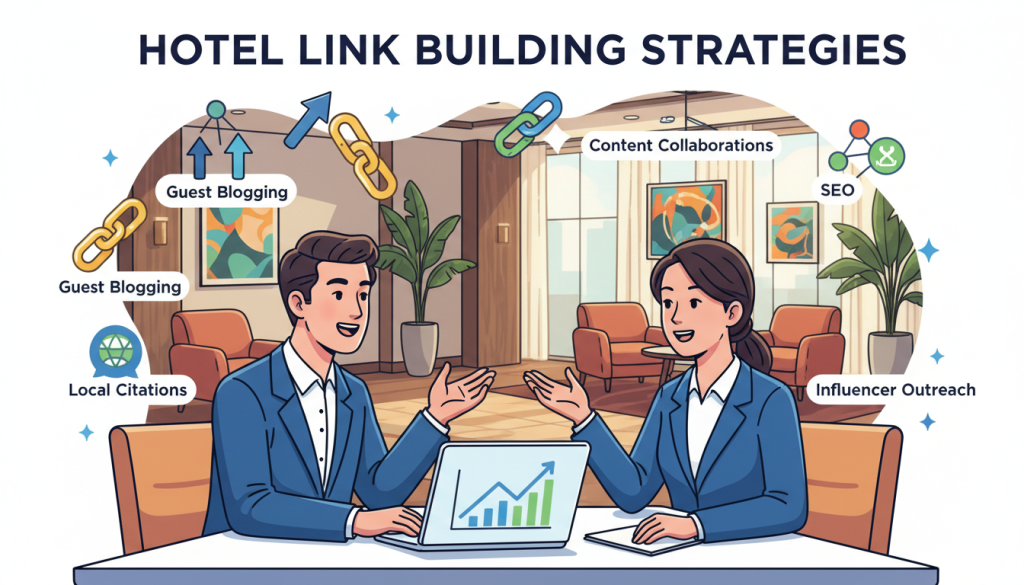
Guest Blogging Opportunities
Guest posts can be a clean way of building links for hotel websites, especially when the topic matches traveler intent. Start by finding sites that already cover your city, events, food scene, or nearby attractions. Use search operators like inurl:your topic and intext:your topic to spot pages that accept contributions.
You can also learn fast from competitor backlinks. Moz Link Intersect can compare up to five competing hotels and surface domains that link to more than one of them. That short list often reveals which sites publish guest features, “where to stay” roundups, and resource pages worth pitching.
For a step-by-step framework that supports hotel digital marketing goals, keep this link building strategy guide handy while you map targets and outreach.
Local Business Partnerships
Local partnerships are one of the simplest effective link building techniques because they’re rooted in real business relationships. Start with vendors you already pay and ask for a link on their “clients” or “customers” page. It’s practical, relevant, and often gets approved quickly.
Build a shared list across operations and marketing so nothing gets missed. These connections can create steady wins for building links for hotel websites without chasing cold leads every week.
| Partner Type | Examples Hotels Can Ask | Easy Value Exchange | Link Placement to Request |
|---|---|---|---|
| Operations vendors | Housekeeping services, security firms, valet services, food and beverage vendors | Short testimonial about reliability and response time | “Clients served” or “Customer stories” page |
| In-room suppliers | Amenities suppliers for soap, shampoo, coffee, linens | Photo and quote about the guest experience | Product page “Used by” or hospitality references section |
| Hotel tech providers | PMS providers, CRM platforms, booking engines | Mini case study with outcomes like higher direct bookings | Case studies library with a link to your hotel site |
| Local attractions | Museums, tour operators, theaters, event venues | Co-branded weekend itinerary or package page | Partner page or “Plan your visit” resources |
Utilizing Social Media Platforms
Social media won’t replace backlinks, but it speeds up discovery. When you publish a new guide, event page, or local itinerary, share it right away and then repurpose it in your newsletter. That extra reach can lead to natural citations, which supports building links for hotel websites over time.
Stay active in comments and location tags, and promote seasonal offers with clear details that others can reference. For press-style wins, HARO can connect your team with journalists looking for travel sources; choose Travel requests and respond only when your property has a real angle. These efforts tie link earning to hotel digital marketing in a way that feels earned, not forced.
Creating Quality Content for Link Building
Strong links start with pages people want to share. When your content helps travelers plan faster, it supports hotel website optimization and signals quality to search engines. The best link building strategies for hotels feel useful, not salesy.
Types of Content That Attract Links
Create destination-first resources that local sites and travel writers can cite. Think neighborhood guides written by staff, seasonal event calendars, and attraction pages built for real trip planning.
Location landing pages work well when they include specifics, like “0.3 miles from the convention center,” plus directions, transit options, and time estimates. Add a simple map, insider tips, and a relevant package so the page can earn mentions and support hotel SEO.
Keep every room description unique, and avoid repeating text across room types. Original photos help, too, because they give publishers something fresh to reference. For a deeper look at tying content to revenue, see increasing sales with SEO.
| Linkable Asset | What Makes It Citable | Hotel Detail to Include | Where Links Often Come From |
|---|---|---|---|
| Neighborhood guide | Clear picks, short routes, and “do this first” planning | Walking time from the lobby and best visit windows | Local blogs, tourism pages, relocation guides |
| Attraction landing page | Exact distance and travel options in one place | “0.3 miles from” format, directions, transit times, map | Event sites, venue pages, community resources |
| Seasonal event calendar | Dates, neighborhoods, and quick context for each event | Suggested stay length and nearby transit notes | City calendars, newsletters, travel journalists |
| Hotel history and “what’s unique” story | Local relevance and a strong angle that’s easy to quote | Timeline highlights and photos that can be embedded | Regional media, heritage groups, travel features |
Utilizing Visual Content
Visuals make your page feel more complete, which improves hotel website optimization and keeps readers engaged. Add short videos, infographics, and downloadable guides that summarize key details fast.
For outreach, visuals can be the edge. A simple infographic on seasonal weather patterns, top festival weeks, or average transit times gives writers a clean asset to reference when they cover the destination.
Engaging Storytelling for Audience Connection
Stories earn links when they connect the hotel to the place. Share staff picks for restaurants, local shops, and “what to do this weekend” ideas that match how travelers search.
Build topics from keyword tools like Semrush Keyword Magic Tool, Moz Keyword Explorer, or Google Keyword Planner, then write for intent. When pages answer booking-ready questions, hotel SEO improves, and the link building strategies for hotels become easier to sustain.
After publishing, promote the piece through social channels and email newsletters. Early visibility helps the right readers find it, save it, and reference it later.
Leveraging Local SEO for Link Building
For many travelers, a hotel search starts with a map and a “near me” query. That’s why local signals can carry more weight than broad campaigns. When your local presence is tight, SEO strategies for hotels feel less like a guessing game and more like steady, trackable progress.

Importance of Local Listings
Start with a complete Google Business Profile, since it shapes what shows up on Search and Maps. A full profile also builds trust: customers are 2.7× more likely to see a business as reputable when they find a complete listing.
Details matter. Keep your NAP consistent everywhere, add strong photos, and pick the right categories and attributes. Hotels with 100+ photos on GBP get 520% more calls than average, and those that post weekly see 70% more clicks to their sites.
Pair GBP work with hotel website optimization so the experience matches the promise. If your listing highlights “free parking” or “pet-friendly,” your pages should confirm it fast, with clear booking paths and location cues.
Strategies for Earning Local Backlinks
Local directories and travel platforms can support hospitality industry link building when you treat them as more than a checklist. Aim for accurate, complete profiles on places guests already trust, including TripAdvisor, Kayak, Hotels.com, Yelp, Bing Places, and business groups like chambers of commerce. Hotfrog can also help with local discovery when your listing is clean and consistent.
Use those sites to find partners, too. Search a category in your city—like ski rentals, wedding venues, or tour companies—then reach out with something useful: a neighborhood guide, a seasonal itinerary, or high-quality images they can share with proper credit.
For smart outreach, track unlinked mentions and local topics with Google Alerts, then ask for a link when a story references your property without one. For prospecting, tools like Moz Top Pages and Check My Links can reveal broken resources on local pages, giving you a polite reason to suggest a better replacement.
If you need a structured approach, local SEO services can help connect listings, content, and outreach so your links come from relevant pages, not random placements.
Engaging with Local Events and Organizations
Sponsoring community events can earn real backlinks, especially when the event website lists partners with live URLs. It also puts your hotel in front of people already planning trips, meetings, and weekends away.
Focus on relationships that make sense for guests: attractions, restaurants, museums, universities, and corporate event planners. Offer a simple perk, a short quote for their blog, or a “stay-and-do” mini guide. These small collaborations often bring the kind of local relevance that supports SEO strategies for hotels and reinforces hotel website optimization at the same time.
| Local action | What it strengthens | Link opportunity | Quick check |
|---|---|---|---|
| Google Business Profile updates (photos, posts, services) | Map visibility and trust signals | Local press and event pages referencing your updates | Weekly post cadence and fresh photos |
| NAP consistency across listings | Eligibility and confidence in location data | Cleaner citations that support hospitality industry link building | Same formatting for “Street” vs. “St.” everywhere |
| Directory profiles (TripAdvisor, Yelp, Bing Places, Hotfrog) | Discovery and referral traffic | Backlinks from profiles and local resource pages | Matching categories, photos, and booking URL |
| Partnerships with nearby businesses | Local relevance and guest value | Cross-linking on “Where to eat” or “Things to do” pages | One shared asset (guide, offer, or images) |
| Event sponsorships and community calendars | Brand presence in the area | Links from sponsor pages and listings | Confirm your link is followed and points to a relevant page |
Monitoring and Measuring Link Building Success
Link building only pays off when you can see what changed and why. For hotel SEO, steady tracking keeps your strategy grounded in real demand, not guesswork. It also helps keep backlink building for hospitality industry efforts clean, consistent, and focused on bookings.
Tools for Tracking Backlinks
Start simple with Google Alerts to catch brand mentions, nearby attraction mentions, and press coverage. When a site mentions your property but doesn’t link, a quick outreach email can turn that into a real referral.
Moz and Semrush make tracking easier with Lost & Found reports, so you can spot links that disappear and act fast. Moz Top Pages is also handy for finding 4xx pages that once earned links, while the Link Intersect Tool shows domains that link to competitors but not to you.
For outreach targets, Check My Links helps you scan pages for broken references you can replace with a better resource. If you want a more automated workflow, Writesonic SEO AI Agent can support ongoing discovery by surfacing potential linking partners and monitoring competitor profiles.
Key Metrics to Analyze
Referring domains matter more than raw link counts. In backlink building for hospitality industry campaigns, a mention from an established travel publisher can outperform dozens of low-value listings.
Track new links gained, links lost, and links reclaimed, and keep notes on what content earned each placement. Pay attention to click-through rate, but also tie each link to business outcomes like profile visits, website sessions, and direct booking interest.
Use a simple scorecard so results stay clear across campaigns that use effective link building techniques.
| Metric | What it tells you | What to do next |
|---|---|---|
| Referring domains (quality) | Whether authority and relevance are improving for hotel SEO | Prioritize outreach to travel, local news, and destination sites over low-trust directories |
| New vs. lost links | If momentum is building or slipping over time | Review Lost & Found reports weekly and queue fast follow-ups |
| Landing page impact | Which pages earn links that support bookings | Strengthen location pages and direct booking pages with clear, useful content |
| ROI per link | How each placement supports revenue and demand | Shift budget toward sources that drive qualified traffic, not just visibility |
Adjusting Strategies Based on Data
When links drop, investigate the cause before you respond. Sometimes the page was removed, sometimes the editor swapped your reference, and sometimes your own URL broke, which is easy to fix with a quick redirect.
Use broken-link checks on your own site, too. If Moz Top Pages shows a linked page returning a 404, repair it before a competitor takes that spot.
Link intersect exports can also sharpen your pitch. If competitors earn links from “best hotels” lists, guest posts, or local partnerships, mirror the approach with a stronger asset and clearer value.
Measurement works best as a steady loop, since broader gains can take three to six months. Teams that review results often, like the approach described in backlink tracking basics, tend to improve faster and waste less effort. This helps effective link building techniques stay aligned with hotel SEO goals without drifting off track.
Future Trends in Hotel Link Building
The next wave of link building strategies for hotels will reward brands that earn attention, not just placements. By 2025, search results will lean harder toward organic links from trusted sources, and that raises the bar for hotel digital marketing. Hotels that publish useful guides and local landing pages will have more to pitch, and more reasons for editors to cite them.
The Role of Influencer Marketing
Partnerships with travel bloggers and creators can scale building links for hotel websites when the work is done with care. Invite creators to review the property, then make it easy to link by sharing press-ready images, a destination map, and a short guide to signature experiences. When a post mentions your hotel but skips the URL, set up Google Alerts and request link attribution so the coverage turns into a backlink.
Evolving Search Engine Algorithms
As Google keeps raising its standards, trust and relevance will outweigh volume. Skip risky tactics like buying links, excessive swaps, or repeating exact-match anchor text, since those signals age poorly as algorithms change. Instead, align link building strategies for hotels with traveler intent by targeting long-tail searches tied to neighborhoods, amenities, and “near me” questions, plus clear FAQ-style answers that other sites can quote.
Emphasis on User Experience and Quality Links
User experience is now part of the link story, because engagement helps decide which pages deserve visibility. Keep pages fast (most visitors won’t wait more than 3 seconds), mobile-friendly, and easy to navigate so referral traffic sticks around. Use robots.txt at the site root to block low-value URLs, add noindex where needed, and strengthen internal links so authority flows to rooms and booking pages; for a deeper look at earning credible links, see best link building strategies that focus on quality, relevance, and real editorial standards in hotel digital marketing.
FAQ
What is hotel SEO, and why does link building matter for direct bookings?
Hotel SEO is the process of improving a hotel’s online presence so it ranks for accommodation searches tied to local intent, travel-specific intent, seasonality, and conversion optimization for bookings. Link building supports hotel SEO by earning trusted backlinks that raise visibility in organic results and send referral traffic to the hotel website. More visibility means more chances to win direct bookings and reduce dependence on OTAs and their commissions.
Why are page-one rankings so important for hotel discovery?
Clicks drop fast as you move down the search results. The #1 Google result earns 31.7% of all clicks, while the last result on page one gets 2.2%. For hotels, that gap can decide whether travelers find your property or book somewhere else, especially when OTAs compete for the same high-intent searches.
What is link building for hotels in simple terms?
Link building is the practice of earning inbound links (backlinks) from other websites to your hotel site. Those backlinks signal relevance and trustworthiness to search engines. In hotel digital marketing, it’s a core off-page SEO tactic alongside local SEO and strong on-page basics.
How do backlinks affect hotel SEO and revenue?
Backlinks remain one of Google’s top ranking factors. Links from authoritative travel sites, tourism organizations, directories, and local partners can improve rankings and drive referral traffic that’s more likely to convert. When those links point to strong booking and location pages, they can increase direct bookings and lower OTA reliance.
What’s the best way to think about link building strategies for hotels—volume or quality?
Quality wins. A small number of links from respected travel, tourism, or local sites can outperform many irrelevant links. Risky tactics like buying links, link exchange schemes, or repeating exact-match anchor text can trigger penalties and hurt hotel SEO over time.
What common link building myths should hotels avoid?
Three myths come up often in the backlink building for the hospitality industry. First, “more links is always better,” when relevance and authority matter more than volume. Second, “any outreach email works,” even though generic asks rarely succeed without clear value. Third, “shortcuts are fine,” but paid links, manipulative exchanges, and over-optimized anchors can put rankings at risk.
What’s the link building approach that works best for hotel websites?
The most reliable approach is to create destination-relevant, high-value assets—articles, infographics, videos, and downloadable guides or PDFs—then promote them through relationships, partnerships, and smart outreach. This is how visibility turns into backlinks that support hotel website optimization and direct booking growth.
Why is relationship-building so central to hospitality industry link building?
Travel and local publishers link to sources they trust and resources that help their readers. Relationships with local businesses, vendors, tourism groups, journalists, and creators create ongoing opportunities for mentions and links. Tools can speed up discovery, but they don’t replace real partnership-building.
How can hotels find guest blogging opportunities without guessing?
Use search operators to find relevant sites that accept contributions. Try queries using inurl:keywords to locate topic-focused URLs and intext:keywords to find pages already discussing your destination or niche. For competitive research, use the Moz Link Intersect Tool to compare up to five competitors and export a CSV of sites linking to two or more of them, then study which placements came from guest posts, list features, or resource pages.
What are the easiest local partnerships for building links for hotel websites?
Start with vendors and suppliers, because they’re often overlooked and highly relevant. Build a list across operations and marketing, then ask for inclusion on “customers” or “clients served” pages with a link to your hotel. Examples include housekeeping services, security firms, telephone systems, valet services, food and beverage vendors, cleaning supply companies, and in-room amenities suppliers like soap, shampoo, and coffee providers.
How can marketing vendors help with hotel backlink building?
Many marketing vendors publish testimonials and case studies. Hotels can offer a strong testimonial or a results-based story tied to outcomes like improved revenue, occupancy, or reduced OTA dependence. A well-written case study on a vendor site can earn a durable backlink and reinforce trust signals for travelers.
Can social media help with effective link building techniques for hotels?
Yes, indirectly. Social media helps new content get discovered faster, which increases sharing and the odds that bloggers, local publishers, or journalists cite it with a link. Posting consistently, engaging in comments, and promoting events and offers also keeps your brand visible and makes your assets easier to find and reference.
What is HARO, and how can hotels use it to earn press-style backlinks?
A: HARO (Help a Reporter Out) connects journalists with sources. Hotels can sign up, identify as a subject-matter expert, and choose Travel to match relevant queries. When a request aligns with a property’s unique angle—such as a Forbes query about hotels that sell iconic treats—a strong pitch can earn a high-authority mention and backlink.
What types of content attract backlinks in hotel link building?
The strongest “linkable assets” are destination-first resources others want to reference. Examples include neighborhood guides written by local staff, insider tips, seasonal event calendars, attraction guides, and stories about the hotel’s history or unique features. These assets support SEO strategies for hotels because they match real traveler intent and give other sites a reason to cite you.
What should a location-specific landing page include to earn links and bookings?
Each page should be unique and tied to a specific landmark, attraction, or transit hub. Include precise distance details like “0.3 miles from [attraction],” walking and driving directions, transportation options with estimated times, insider visiting tips, high-quality images of the hotel and nearby location, a map showing proximity, and an offer or package related to that location. These pages also support conversion-focused hotel website optimization.
Why do visuals help hotel link building strategies?
Visuals increase perceived value and make content easier to cite. Adding videos, images, infographics, and downloadable PDFs can boost shareability and “bookmark” behavior. Visual differentiation also strengthens outreach, because you can offer assets other articles may lack, such as weather-by-season charts, event timelines, or local data points.
How does storytelling help with hospitality link building?
Storytelling connects the hotel to the destination experience. Staff picks for restaurants, seasonal “what to do now” guides, and neighborhood narratives align with what travelers search and plan around. When content feels local and specific, it’s more likely to earn links from travel media, bloggers, and local organizations.
How should hotels choose topics that actually earn backlinks and bookings?
Use keyword research to align content with search intent. Tools like Moz Keyword Explorer, Semrush Keyword Magic Tool, and Google Keyword Planner can help identify demand across research queries and booking-ready terms. Then promote new content quickly via social channels and email newsletters to improve early traction and link earning.
Why is local SEO essential alongside hotel backlink building?
Travelers often search with geo-modifiers like “near me” or “closest to,” and hotels serve a fixed location. Local SEO makes your property visible on Search and Maps, while backlinks reinforce authority and trust. Together, they improve discovery for local-intent searches and protect visibility from OTA-heavy results.
What Google Business Profile actions support hotel SEO and link earning?
Claim and verify your Google Business Profile, keep NAP consistent, add high-quality photos, select accurate categories and attributes, respond to reviews, post regular updates, and include a direct booking link. A complete profile matters: customers are 2.7× more likely to consider a business reputable when they find a complete GBP on Search and Maps. Hotels with 100+ photos on GBP can get 520% more calls than average, and hotels that update GBP weekly see 70% more clicks to their websites than those that rarely update.
Which directories help with hotel link building, and how should hotels use them?
Relevant directories and resource pages can build local visibility and backlinks. Examples include Hotfrog plus travel platforms like TripAdvisor, Kayak, and Hotels.com, along with Yelp and Bing Places. Directories can also be prospecting tools: search categories related to your guests’ needs, find nearby businesses, and propose a partnership or resource that benefits their audience.
How can hotels turn unlinked mentions into backlinks?
Set up Google Alerts for the hotel name using quotation marks for an exact match, and adjust language, region, and frequency settings. When an article mentions the hotel without linking, reach out to request link attribution. Tools like Hunter.io can help locate author contact details to support outreach.
What is broken link building, and how can hotels use it locally?
Broken link building means finding dead pages that other sites still link to and offering a better replacement. You can use Moz Top Pages to identify competitor pages with 4xx status and high numbers of external links, then create a relevant hotel resource and suggest it as a replacement. You can also use the Check My Links browser extension to spot broken links on resource pages while you’re prospecting.
How do sponsorships and local events contribute to hotel SEO and backlinks?
Sponsoring local events can earn backlinks when the event website links back to the hotel. Relationships with attractions, restaurants, venues, wedding planners, and corporate event organizers can also lead to resource-page links and referral traffic. The best outreach focuses on audience benefit, such as exclusive offers, high-quality images, expert quotes, or truly useful guides.
What tools should hotels use to track backlinks and link building progress?
For monitoring mentions, use Google Alerts. For link building research and operations, use Moz tools like Top Pages and the Link Intersect Tool. For link retention, both Moz and Semrush offer Lost & Found style reporting to identify lost links and regain them. Check My Links helps confirm broken-link opportunities on target pages.
Which metrics matter most when measuring hotel link building success?
Focus on growth in referring domains and, more importantly, the quality and relevance of those sources. Track new links gained, links lost, and links reclaimed through broken-link replacement and outreach. Tie performance back to business outcomes like improved organic visibility, increased website clicks, and stronger direct booking potential—especially when links point to booking pages and location landing pages.
How should hotels handle lost backlinks?
Start by identifying what was lost and why, such as page removals, content updates, or a site redesign. Then send a friendly follow-up and offer an updated resource, a better image set, or a refreshed page that improves the reader experience. This is often more effective than pushing for reinstatement without adding value.
How long does it take for hotel link building to show results?
Link building is a long-term effort, and broader SEO gains often take 3–6 months to materialize. Progress is usually gradual, with compounding benefits as your hotel earns more authoritative mentions and your content library grows.
How can influencer marketing support backlink building in the hospitality industry?
Partnerships with travel bloggers and influencers can drive visibility, reviews, and editorial mentions that become backlinks. Hotels can make collaboration easier by offering high-quality images, destination guides, and unique on-property experiences worth documenting. Monitor for mentions with Google Alerts and request a link when coverage doesn’t include one.
How do evolving search algorithms change link building strategies for hotels?
Algorithms increasingly reward trust, relevance, and helpful content. Sustainable link earning comes from assets aligned with traveler intent, including long-tail, amenity-focused, and location-based queries. Avoid manipulative tactics like paid links, link exchange schemes, and repetitive exact-match anchors, since these tactics age poorly as enforcement improves.
What does voice search mean for hotel content and link building?
Voice search encourages conversational, question-style queries. Creating clear FAQ-style pages and direct-answer content can improve usability for travelers and make your site easier for other publishers to cite. Well-structured answers can also support stronger visibility for intent-driven searches.
How does user experience affect link building and hotel website performance?
Strong backlinks work best when they send visitors to a fast, mobile-friendly site. Users generally don’t want to wait more than 3 seconds for a page to load. Good navigation, clear room details, and a smooth booking flow help convert referral traffic into direct revenue and reinforce the value of your off-page SEO efforts.
What site controls help search engines focus on a hotel’s most valuable pages?
Hotels can guide crawling and indexing with tools like robots.txt (hosted at the site root) to block low-value URLs such as login pages, privacy policies, or expired offers. Use noindex when you want a page crawled but not shown in results. Strong internal linking also helps authority from earned backlinks flow to key conversion pages, supporting hotel SEO and direct bookings.

Boost Your Event’s Profile with Link Building
Over 90% of web pages get zero traffic from Google, according to multiple large SEO studies. That’s a tough reality if your ticket sales, sponsors, or sign-ups depend on search.
Link building for events gives you an edge that’s hard to copy. When you host or sponsor something real, you can earn backlinks from venue pages, partner sites, local calendars, and even news coverage. Those mentions don’t look forced, because they come from participation, not tricks.
The payoff is simple: Google-approved, earned links that match your topic and, for local shows, your city or region. That means stronger visibility when people search for what you’re offering, right when they’re ready to attend.
The best event marketing strategies also think beyond one tactic like guest posts. A smart mix helps you diversify your backlink profile, raise brand awareness, and build authority that competitors can see in the search results.
There’s also a bonus many brands miss: offline buzz can fuel online growth. Events create conversations, photos, and follow-up posts that naturally generate event promotion links over time.
Of course, it takes work. Hosting can require serious planning, time, and budget, while sponsorships are often quicker to launch but still powerful. If you want a clear framework for outreach and long-term results, this link building strategy is a helpful place to start.
Key Takeaways
-
Link building for events can earn backlinks that competitors can’t easily replicate.
-
Earned links are often topically and geographically relevant, which supports local search.
-
Strong event marketing strategies diversify authority beyond a single channel.
-
Events can drive both SEO gains and real-world exposure through buzz and press.
-
Hosting takes more resources, while sponsorships can be faster to execute.
-
Consistent event promotion links help build trust with Google and with customers.
What is Link Building for Events?
Link building for events is the work of earning links from other sites to your event page. Those links help people find dates, tickets, and details faster. They also help search engines trust what you publish.
When event backlinks come from respected sites, they can lift visibility for both local and national searches. Event website linking also supports brand recall, since readers see your name in places they already visit.
Understanding the Basics of Link Building
Most link building for events starts with two moves: hosting and sponsoring. Hosting puts your event on listings like Eventbrite, plus blogs and news sites that cover what’s happening. Sponsoring often earns a link from the event’s sponsor page, like the way BrightonSEO lists brands such as Ahrefs.
A clean link profile usually includes varied sources and natural anchor text. That means the words in the link should match what the page offers, like “conference schedule” or “speaker lineup.” If you want a practical primer, white-hat link building ideas translate well to event planning because they focus on quality and relevance.
Importance of SEO for Events
Search engines treat event backlinks as signs that an event is real, useful, and worth showing. Events also create steady chatter, so mentions can come from press releases, recap posts, and social shares. That mix can keep event website linking from looking one-note.
Local SEO matters, too. Links from venues, chambers of commerce, city publications, and neighborhood blogs can strengthen “near me” searches. For richer results, Google event structured data markup can make pages eligible for event-focused search features, and Google has cited Eventbrite seeing a 100% increase in typical year-over-year growth of traffic from Google Search after using event structured data.
Types of Links That Can Benefit Your Event
Not every link helps in the same way. The best picks fit your topic, audience, and location, while keeping link building for events steady over time. A balanced plan also spreads event website linking across listings, editorial coverage, and community calendars.
| Link type | Where it usually appears | Why it helps | Best fit |
|---|---|---|---|
| Event listing backlinks | Eventbrite and other event directories | Improves discovery for date-and-location searches and builds consistent citations | Ticketed events, webinars, conferences |
| Sponsor-page links | Official event websites with sponsor sections | Connects your brand to a trusted event and adds relevant event backlinks | Sponsors, exhibitors, partner brands |
| Editorial press links | Local newspapers, industry news sites, radio and TV sites | Often higher trust, strong reach, and natural anchor text | Major announcements, community impact stories |
| Community calendar links | Neighborhood sites, venue calendars, library boards, community groups | Supports local intent and helps event website linking look natural and varied | In-person events with a defined city or region |
| Niche blog and publication links | Industry blogs, association sites, topical newsletters | Matches search intent and brings qualified traffic, not just clicks | Specialty meetups, trade events, workshops |
- Hosting tends to earn listing links and coverage links as details spread.
- Sponsoring often earns stable links that stay live through the season.
- Outreach can add niche placements that speak to the right audience.
Strategies for Effective Link Building
Strong event SEO tactics start with simple moves that earn real mentions. Aim for pages that already guide attendees, sponsors, or local media. When those pages link to your event details, your visibility can rise fast.
For outreach for event links, use a mix of platforms and partners so your backlinks look natural. A community-first approach also helps, since most pages still don’t cite outside sources; that gap creates room for smart, shared linking. For more ideas on community-driven link building, see crowdsourced link building techniques.
Utilizing Social Media Platforms
Build share paths before tickets go on sale. Create Facebook Events, add your event link to your Instagram bio and LinkedIn Featured section, and place the same URL in your email footer for the month before launch.
Schedule posts leading up to the date and during the event, then reuse clips and photos after. That cadence supports event link outreach because people tend to share when they have clear, ready-to-copy details like location, time, and a single link.
- Post a “coming soon” landing page with one clear CTA and a short URL
- Pin the event link on X and LinkedIn for the final two weeks
- Ask speakers and sponsors to repost a prewritten caption with the link
Collaborating with Influencers
Pick creators and bloggers who already cover your topic and region. Ahrefs Content Explorer can surface authors by searching for your theme plus “events” or “conferences,” then filtering by titles to find pages built for discovery.
Keep outreach for event links tight: one reason their audience will care, one line on what makes the event useful, and one descriptive link to the main event page. If they say yes, offer assets they can publish fast, like a speaker quote, a short agenda, or a discount code.
Engaging with Local Businesses
Local partners are often the easiest wins for event SEO tactics. Venues, restaurants, coworking spaces, and charities can link from “upcoming events” pages, sponsor pages, or neighborhood calendars.
For event link outreach, check chambers of commerce, community blogs, and local news calendars. If you sponsor a small portion of a festival or fundraiser, ask for a credited link that points to the event page, not just a logo image.
| Channel | Best link source | Fast asset to offer | Event SEO payoff |
|---|---|---|---|
| Facebook Events + email | Shares from attendee posts and community pages | Short agenda graphic and one-track schedule | More branded searches and referral traffic spikes |
| LinkedIn groups + hashtags | Industry roundups and member newsletters | Speaker highlight blurbs with a single URL | Higher trust signals from relevant mentions |
| Influencers and bloggers | Event previews, “what to attend” lists, recaps | Media kit: photos, key facts, and quote-ready lines | Stronger topical authority and long-tail rankings |
| Local businesses + venues | Partner pages, sponsor pages, local calendars | Co-branded flyer and a partner discount | Local pack visibility and steady citations |
Creating Shareable Content for Events
Shareable content turns interest into action. It also earns event promotion links that help people find your event faster in search. Keep each asset clear, local when it helps, and easy to pass along.

Strong event marketing strategies start with a simple promise: give people something useful before you ask for a registration. That approach also supports event link building services, because great pages and downloads attract mentions you don’t have to chase.
Crafting Compelling Press Releases
A press release works best when it reads like news, not an ad. Lead with what’s timely, why it matters, and who benefits. Then add a clean link path so coverage can turn into event promotion links from local and national outlets.
Make it easy for editors and bloggers to pull details. Include a short event summary, key dates, and a direct line for media requests. If you’re building long-term credibility, study how smart outreach supports link building through relevant coverage and real community ties.
Designing Eye-Catching Event Pages
Your event page should do more than look good—it should help users decide fast. Build a dedicated events page on your site for anything upcoming, with clear ticket and contact paths from the first scroll. This is where event marketing strategies meet measurable conversions.
Add the details people search for, and keep them scannable. A complete page also improves the odds that event link building services can earn quality mentions, since others can confidently reference your listing.
| Event page element | What to include | Why it earns shares and links |
|---|---|---|
| Title and topic focus | Specific event name plus a plain-language topic line | Helps bloggers and calendars describe it accurately, leading to event promotion links |
| Schedule and venue | Full agenda, start/end times, address, parking or transit tips | Reduces friction for readers and gives publishers solid facts to cite |
| Notable participants | Speakers for conferences or judges for competitions, with short bios | Adds authority, which supports stronger event marketing strategies and higher pickup |
| Proof and social signals | Short testimonials, attendee quotes, or embedded social posts | Builds trust and gives people a reason to share your page |
| Call to action | Buttons for tickets, RSVP, and a contact option for groups | Turns traffic into registrations, which makes future outreach easier for event link building services |
| Search-friendly markup | Google event structured data markup, including a schedule when possible | Improves discoverability and can enhance how your event appears in Google |
For schema setup, WordPress sites can use the Event Schema WordPress plugin. If you’re not on WordPress, Google’s Data Highlighter can help you label key fields. Also, avoid relying on only one big listing site—post to options like brownpapertickets.com, punchbowl.com, and petaluma360.com, since those listings can bring fresh event promotion links.
Offering Free Resources or Downloads
Free downloads act like small favors that people remember. Build assets tied to the theme: a printable schedule, a venue checklist, speaker highlights, or behind-the-scenes prep notes. Pair each download with a short post so it has context, and it’s easier to share.
If you’re not ready to reveal everything, launch a “coming soon” page to collect interest and early mentions. Tools like SeedProd are often used for teaser pages, and that early buzz can support smarter event marketing strategies while creating new paths for event link building services to work.
Tracking and Measuring Link Building Success
Link building can feel like a win on launch day, then get fuzzy fast. To keep it clear, track what each mention sends back to your site. Strong event backlinks should lift rankings, sessions, and sign-ups, not just look good in a report.

Tools to Monitor Your Backlinks
Start by checking new links and the sites behind them. Ahrefs’ SEO Toolbar makes this quick in Google results, so you can review Domain Rating, referring domains, and estimated organic traffic before you pursue a listing or sponsorship. That kind of snapshot helps your event SEO tactics stay focused on quality.
For prospecting, Ahrefs Content Explorer is useful when you need writers and outlets that already cover your event topic. If your team runs higher-volume event link outreach, Respona can speed up the workflow with its Blogger Outreach template, built-in search operators like inurl:blog, filters, and a shared inbox for follow-ups.
When you want numbers you can plan with, try a free set of calculators like the Backlink ROI Planner to model incremental clicks, revenue, and payback before you spend. It’s a practical way to set targets for event backlinks and budget with less guesswork.
Analyzing Traffic and Engagement
Links matter most when they drive the right visitors at the right time. Compare referral traffic to key pages like the event landing page, ticket or registration flows, and sponsor pages. Then review engagement signals like time on page, scroll depth, and newsletter sign-ups tied to promotion.
Also split performance by timing. Many events see clear shifts in attention pre-event versus during-event, especially when social posts and third-party listings ramp up. If your event SEO tactics are working, you should see stronger branded search, steadier referral sessions, and more repeat visits as the date gets closer.
| What to track | Where to check | What it tells you | How to use it next |
|---|---|---|---|
| New and lost links | Ahrefs’ SEO Toolbar and link index tools | Whether event backlinks are growing and staying live | Reclaim broken mentions and focus on sites that keep links active |
| Link quality signals | Domain Rating, referring domains, organic traffic estimates | Authority and reach of each linking site | Prioritize partners and listings that can pass stronger equity |
| Referral traffic to key pages | Analytics for landing pages and registration paths | Which placements drive real visits and intent | Double down on sources that send converting traffic |
| Ranking movement on event terms | Search results tracking for target queries | Whether visibility is improving beyond direct referrals | Update content and internal links to support pages that are rising |
| Social engagement lift | Platform insights for posts tied to promotions | How links and shares reinforce awareness | Align messaging and timing with the channels that spike interest |
Adjusting Your Strategy Based on Data
Use the data to choose what to repeat, not just what to celebrate. If industry conference listings drive more qualified traffic than local directories, lean into that category next cycle. If community boards send steady visits but low registrations, tighten the pitch and the landing page match.
Keep your event link outreach flexible as results come in. Test angles like press coverage, blogger roundups, and partner sponsorship pages, then measure what earns links and sign-ups together. Over time, this feedback loop makes event SEO tactics sharper and keeps event backlinks tied to real outcomes.
Common Mistakes to Avoid in Link Building
Link building can lift registrations fast, but small missteps can waste time and budget. Many teams chase quick wins and miss what makes links work: relevance, trust, and a smooth user path. That’s why event website linking should be treated like part of the attendee journey, not a separate task.
Neglecting Mobile Optimization
If your event page is clunky on a phone, people bounce before they buy a ticket or share the link. Most discovery happens in Instagram, Facebook Events, and Google event listings, so mobile speed and clean layouts matter. Strong outreach for event links only pays off when the landing page loads fast, reads well, and makes registration easy.
Focusing Solely on Quantity Over Quality
Another trap is chasing volume targets and sponsoring anything that will publish a backlink. That approach often leads to weak placement quality, repeated patterns, and risky footprints. When you use event link building services, avoid “fire-and-forget” delivery; set clear guardrails for anchors, topical fit, and review standards, then audit what went live.
Ignoring Event-Specific Keywords
Links work best when the page matches the intent behind the click. Don’t skip event-specific keywords, local modifiers, and clear topic signals on teaser pages and main landing pages. Tight event website linking also means using internal links, helpful headers, and event schema so coverage from outreach for event links turns into search visibility and sign-ups.
FAQ
What is event link building?
A: Event link building is a way to earn event backlinks by participating in real events—most often by hosting or sponsoring. Because those links come from real-world involvement, competitors can’t easily copy them the way they can with common tactics like guest blogging.
Why is link building for events considered “Google-approved”?
It focuses on earned links from legitimate event websites, trusted event listings, and editorial coverage. These links are often topically relevant to your industry and can also be geographically relevant for local events, supporting visibility and search performance at the same time.
What are the biggest SEO benefits of event promotion links?
Strong event website linking can improve rankings by sending quality authority signals. It also helps diversify your backlink profile beyond repeatable tactics, boosts brand awareness, and strengthens perceived authority with both Google and competitors.
How does event link building support both online SEO and offline exposure?
Events create buzz that can lead to press mentions, blog coverage, and shares—along with new relationships through networking. That mix delivers SEO value from backlinks while also putting your brand in front of a concentrated audience in the real world.
Where do backlinks come from when you host an event?
Hosting often earns links from third-party event platforms—especially Eventbrite—plus blogs and press coverage that mention your event. These platforms cover both in-person and virtual formats like conferences, seminars, and workshops.
Where do backlinks come from when you sponsor an event?
Sponsorships commonly earn links from the event’s sponsor page or partner listings. A well-known example is BrightonSEO listing sponsors like Ahrefs on dedicated sponsor pages that link back to sponsor sites.
What types of event backlinks should I aim for?
A balanced profile usually includes event listing backlinks (Eventbrite and other listing sites), sponsor-page links, editorial links from local or national press, community calendar links (including Google Calendar and Apple iCalendar listings), and niche blog or industry publication links earned through outreach for event links.
How does event link building help local SEO?
Hosting or sponsoring geographically relevant events can improve visibility for location-based searches. Links from local venues, local companies, community blogs, and local news outlets can strengthen rankings for “near me” and city-specific queries.
What is event schema, and why does it matter for event SEO tactics?
A: Google event structured data markup (event schema) helps Google understand your event’s date, time, location, and schedule. That can make your pages eligible for Google’s event experience, improving discovery when people search for events near them.
Is there proof that event structured data can increase traffic?
Yes. Google has cited Eventbrite as seeing a 100% increase in typical year-over-year growth of traffic from Google Search after using event structured data, showing how structured event information can improve visibility.
How do I add event schema to my site?
If your site runs on WordPress, you can use the Event Schema WordPress plugin. If it’s not WordPress-based, you can use Google’s Data Highlighter to help Google interpret event details.
What should my event page include to attract links and registrations?
Include the event title, a clear description of topics, venue, full schedule, key figures (like speakers or judges), a strong reason to attend, proof from social media, and a clear call to action. A dedicated events hub page for upcoming events also makes it easier for media and partners to link to you.
Should I only list events on major sites like Eventbrite?
No. Eventbrite is powerful, but you can expand reach by listing on other platforms such as Meetup, Facebook Events, brownpapertickets.com, punchbowl.com, and petaluma360.com. Many third-party listings already include schema, which can help discovery.
How can social media help with event website linking?
Create a Facebook Event, add your event link to social profiles, and share it with your email list. Teaser campaigns—like a “coming soon” landing page plus social graphics—can drive early interest, shares, and natural links before tickets even launch.
When should I promote the event on social media?
Promotion should ramp up before and during the event. Research cited from Buffer found there were nearly as many posts leading up to an event as during the event (about 40% vs. 42%), which supports a consistent cadence that fuels sharing, mentions, and link growth.
How do I find bloggers and influencers for event link outreach?
Use Ahrefs Content Explorer to find authors and sites covering your topic. A common approach is searching queries like “SEO” AND (“conferences” OR “events”) and filtering using “In title,” then building a targeted list for event link outreach.
What makes outreach for event links actually work?
Keep the pitch concise and personal, include a descriptive link to the event page, and explain why the audience benefits. Good outreach ties the event to the publisher’s beat and makes it easy for them to share accurate details.
How can I spot event opportunities and the right voices to contact?
Monitor hashtags and join relevant groups on LinkedIn and Twitter to track conversations around conferences, meetups, and community events. This helps you find both sponsorship opportunities and the people who can amplify them.
How do local chambers of commerce help with link building for events?
Chambers of commerce often list local events and sponsorship opportunities, sometimes at discounted rates for members. They’re also a practical way to meet organizers and planners who control sponsor pages and event promotion links.
Are press releases still useful for earning event backlinks?
They can be, when tied to real news and distributed thoughtfully. Event participation often leads to coverage in press releases, blogs, and editorial press, which can generate earned links and strengthen authority—especially with local and national outlets.
What content attracts links before the event goes live?
A “coming soon” page can help build anticipation and attract early mentions. Tools like SeedProd are often used to publish teaser landing pages, giving partners something linkable while you finalize the full event details.
What free resources work well as link magnets for event marketing strategies?
Publish downloadable assets tied to the event theme, like schedules, checklists, speaker highlights, or behind-the-scenes prep notes. Pair them with supporting blog posts so they’re easy to reference, share, and link to.
How can I vet event sites before I commit to a sponsorship?
Use Ahrefs’ SEO Toolbar in Google results to quickly review signals like Domain Rating, referring domains, and organic traffic. This helps you prioritize quality events that are more likely to drive meaningful link equity and referral traffic.
Can I streamline outreach for event promotion links without losing quality?
Yes. Platforms like Respona support structured outreach workflows, including a Blogger Outreach template, keyword-based prospecting, personalization, contact discovery, and follow-up management. That can help scale outreach for event links while keeping targeting tight.
What should I track to measure success with event SEO tactics?
Track the number and quality of backlinks earned, referral traffic from listings and sponsor pages, search ranking changes, and social engagement lift tied to promotion. Also compare pre-event versus during-event performance across event pages, third-party listings, and social campaigns.
How do I decide which events and sponsorships to repeat?
Use performance data to identify which event categories, locations, and partners drove the best links, traffic, and registrations. Then double down on the outreach angles that worked best—press coverage, niche blogs, community boards, or sponsor placements.
What’s the biggest time-and-budget reality with event link building?
Hosting can require major planning, staffing, and budget. Sponsorships are often easier to execute, but they can still be powerful for acquiring links—especially when the event has strong media, influencer, and audience attention.
What common mistakes hurt event backlink results?
Three big ones are neglecting mobile optimization, chasing quantity over quality, and ignoring event-specific keywords. Weak mobile pages can reduce registrations from social feeds and event listings, and low-quality events rarely deliver strong links or coverage.
Why shouldn’t I sponsor every event that offers a link?
Sponsoring “anything and everything” can dilute results and waste budget. Prioritize events that already attract media, influencers, your target customers, and industry leaders, because popular events tend to earn more links and pass more value.
Is it a mistake to focus only on big industry conferences?
It can be limiting. Major conferences can be efficient, but branching into local concerts, sporting events, meetups, fairs, and charity runs can open up more high-quality, hard-to-copy event backlinks and local press opportunities.
How do I avoid losing links and registrations due to poor targeting?
Choose events that match your brand and audience. Misaligned sponsorships often generate low engagement, fewer mentions, and weaker link equity, even if the sponsor page link is guaranteed.
How important is follow-up for event link building services and campaigns?
Follow-up is a big deal. Staying in touch with organizers, partners, and media before, during, and after the event can unlock additional coverage, late additions to resource pages, and post-event recap links.
What is a “sponsored events” page, and why should my site have one?
It’s a page on your site that lists events you sponsor and explains what types of events you support, along with organizer contact details. It builds linkable proof, attracts inbound partnership requests, and reduces research time for future sponsorship opportunities.

Effective Link Building Strategies for Scaleups
More than half of all website traffic often starts with search, which makes one thing clear: if you are not earning trust online, you are missing demand.
For fast-growing teams, link building for scaleups can be a steady growth lever. It lifts visibility, builds authority, and helps your best pages get found. But it is also tough to scale. It takes time, SEO skill, and quick adjustments when Google updates its rules.
Backlinks work like votes of confidence. Jens Rhoades and Andy Hill often stress a key point: not all votes count the same. A link from a trusted, relevant site can carry far more weight than a bunch of random mentions. That is why quality beats quantity in a scalable link building strategy.
In practice, scaling usually means assigning at least one person to own it. Hitting 5–10 strong links per week can require sourcing prospects, finding contact info, writing personal outreach, choosing anchor text with care, tracking everything in a spreadsheet, and sometimes drafting guest posts.
It also means drawing a hard line on compliance. Google Search Essentials warns that links meant to manipulate rankings can be treated as link spam. Paid links, direct link swaps, and “freebies for links” can backfire fast.
In the sections ahead, you will see how a scalable link building strategy becomes an operating model. That includes tools like Respona, Ahrefs, and Semrush, plus proven tactics such as guest posting, broken link building, resource pages, and journalist requests. Just as important, it relies on real relationships and partnerships, not one-off cold pitches.
Key Takeaways
-
link building for scaleups boosts reach and authority, but it is hard to scale without focus.
-
Backlinks act as trust signals, and relevance plus domain authority shape their impact.
-
A few high-quality links can outperform many low-quality links.
-
Plan for the workload: outreach, tracking, anchor text choices, and content creation.
-
Follow Google Search Essentials and avoid risky link schemes that can trigger penalties.
-
A scalable link building strategy combines the right tools, varied tactics, and relationship-driven outreach.
Understanding Link Building Basics
Link building is the work of getting other websites to point to yours. For scaleups, it can feel like a mix of marketing, PR, and sales. The goal is simple: earn mentions that fit your niche and bring real value.
This is where link building techniques for growing businesses start to matter most. Not because you want “more links,” but because you want the right sites to vouch for you in public.
What is Link Building?
In practical terms, link building means securing backlinks through methods that make sense for your audience. That can include guest posting, resource page placements, broken link building, and reclaiming lost links by fixing outdated URLs.
It also covers digital PR, like responding to journalist requests, and selective partnerships with influencers who already speak to your market. A helpful overview of tactics and planning is outlined in a link building strategy guide.
- Guest contributions that teach or share useful data
- Broken link fixes that replace dead pages with your relevant resource
- Brand mention reclamation when a site cites you but forgets the link
- Digital PR that earns citations from trusted publications
Why is Link Building Important for Scaleups?
Search engines treat backlinks like signals of trust, but not all signals carry the same weight. Google and Bing look at context, topic match, and the credibility of the site that links to you. A link from a respected industry resource can help more than dozens of random directory links.
For effective link building for scaleups, the hard part is not the concept. It’s the volume of research, outreach, and follow-up needed to keep quality high while moving fast. That’s why scaleups tend to build repeatable workflows and review them often as algorithms shift.
| What search engines check | What it looks like in the real world | What it changes for a scaleup |
|---|---|---|
| Relevance | A SaaS security company earns a link from a cybersecurity publication | Better rankings on high-intent queries and clearer topical authority |
| Authority and trust | A mention from Forbes, TechCrunch, or an established industry association | Stronger brand signals that support growth across new markets |
| Placement and context | A link inside a useful paragraph, not hidden in a footer | More qualified referral traffic and better engagement |
| Natural patterns | Steady links from varied sources over time | Lower risk and a system you can scale without constant cleanup |
Common Misconceptions About Link Building
One myth is that more links is always better. Low-quality backlinks can drag down performance, and in some cases create real risk if they look manipulative. Solid link building techniques for growing businesses focus on fit, not shortcuts.
Another myth is that old-school tactics alone will carry you. Blog comments, forums, and basic guest blogging can still help to a point, but they rarely compete with strong content, real relationships, and credible coverage.
Link exchanges also get treated as “safe” far too often. Google warns against link schemes, and swap networks can waste time fast. Effective link building for scaleups tends to stay grounded in relevance, authenticity, and a process you can run week after week.
Identifying Your Target Audience
The fastest way to waste outreach is to chase huge prospect lists that your buyers never read. For advanced link building strategies for scaleups, audience clarity matters because the best links send qualified referral traffic and support trust in your niche. Think of each link as a public vote; the right votes come from relevant pages with real readers.
Link building tips for growing startups start here too. If a page won’t influence your ideal customer, it may not help your pipeline, even if the domain looks strong.
Defining Your Ideal Customer Profile
Start with an Ideal Customer Profile (ICP): industry, buyer role, budget range, and what “success” looks like after they adopt your product. There is no one-size-fits-all. A scaleup selling eCommerce tools might earn coverage by sending products for review to online publications, while a home improvement brand can request links from suppliers and reach out to local site owners who already serve the same customers.
For advanced link building strategies for scaleups, the hardest links often come from digital PR and journalist requests. Those placements tend to carry stronger “vote” value because they’re earned, editorial, and tied to reputation.
Use this quick “good-fit” check before you pitch:
- Relevance: the site speaks to your customer’s problems and language.
- Reputation: it has a clean editorial standard and a real audience.
- Results: it can drive referral traffic, demos, or brand searches—not just a backlink count.
Tools for Audience Research
Good research keeps link building tips for growing startups practical. BuzzSumo helps you spot which topics earn shares and links, and it can surface creators who already shape your niche. Quora and YouTube show the questions people ask in plain English, plus the formats they prefer, which is useful when you upgrade content with a skyscraper-style refresh.
When you want to move faster, SpyFu can reveal competitor keywords, anchor text patterns, and the sites that already link to them. Ahrefs and Semrush round out the stack by mapping backlink profiles, finding gaps, and tracking progress even in weeks when you’re not actively pitching. If you need a tighter process, link building for startups can help connect research to higher-authority placements.
| Tool | Best for | What to capture for outreach | How it ties to link quality |
|---|---|---|---|
| BuzzSumo | Content discovery and influencer research | Most-linked topics, author names, and sites that repeatedly cover your niche | Prioritizes publishers that already link to similar stories, raising editorial fit |
| Quora | Real audience questions and objections | Recurring pain points, phrases, and “best tool” threads | Improves relevance by aligning pitches with what buyers actively seek |
| YouTube | Formats that keep attention | High-retention topics, comparison angles, and tutorial titles | Helps you create assets publishers cite because they explain complex steps fast |
| SpyFu | Competitor keyword and link clues | Top pages, anchor patterns, and linking domains worth replicating | Speeds prospecting by focusing on sites already “voting” in your category |
| Ahrefs | Backlink profile analysis | Link gaps, broken links, and pages with high linking velocity | Supports advanced link building strategies for scaleups by ranking opportunities by impact |
| Semrush | SEO tracking and competitive research | Authority trends, keyword clusters, and referral signals over time | Keeps outreach tied to long-term visibility, not short-term spikes |
Creating Buyer Personas
Turn your ICP into 2–3 buyer personas, then map where each persona learns and who they trust. That list becomes your link target map: industry blogs, trade publications, associations, tool roundups, podcasts, and YouTube channels. This is where link building tips for growing startups stay focused, because every pitch connects to a clear reader need.
Match persona pain points to angles that publishers cite, like original benchmarks, checklists, teardown posts, and “what changed in 2026” explainers. Track outcomes that matter and skip vanity metrics, such as irrelevant rank jumps, spammy backlink totals, or guest posts that don’t strengthen brand credibility.
Creating Quality Content for Link Building
Quality content and link building go hand in hand. When a scaleup publishes one strong asset, it can attract mentions for months. That’s the content–link flywheel, and it’s a big driver of effective link building for scaleups.
Content also keeps outreach honest. You’re not “asking for a favor.” You’re offering something useful, clear, and worth citing. That’s true whether you run outreach in-house or pair content with link building services for scaleups.

Types of Content That Attracts Links
Start with comprehensive guides that deserve to rank. A practical way to build them is the Skyscraper technique: review the best pages, spot what they miss, then add better examples, fresh data, stronger visuals, and clearer steps.
Original research is another link magnet. A short survey, a study pulled from product usage, or a simple benchmark can earn citations fast. Even surprising results can help, since people like to discuss and debate what they didn’t expect.
Case studies tend to get cited because they show proof. Brian Dean’s work at Backlinko is a well-known example of case-study-driven content that people reference when they explain a tactic or a result.
Visual assets can pull links from publishers who want something easy to embed. Infographics work well, and “guestographics” can be pitched as visual versions of evergreen articles. Instructographics go one step further and teach step-by-step, like Jackie Blum’s instructographic inspired by Dale Carnegie’s How to Win Friends and Influence People, which drew strong engagement on Medium.
Tools, templates, and widgets can earn organic mentions because they save time. TalentSmart, led by Travis Bradberry (author of Emotional Intelligence 2.0), offers tools like tests and calendars, and Harvard has linked to TalentSmart in an emotional intelligence tools list.
| Linkable Asset | Why It Earns Links | Best-Fit Outreach Angle | Common Pitfall |
|---|---|---|---|
| Evergreen “10X” guide | Becomes a go-to reference for a topic and keeps earning links over time | Show what’s new: added examples, visuals, and missing steps vs. current top results | Rewriting what already exists without adding real value |
| Original research | Publishers cite data to support their own claims and stories | Offer a clean stat plus a chart and a short methodology summary | Hiding the method or making the sample unclear |
| Case study | Proof beats theory, so others cite results when they teach a tactic | Lead with the measurable outcome and the key decisions behind it | Only sharing wins, with no context on trade-offs or limits |
| Instructographic | Easy to scan, easy to share, and fits well in newsletters and roundups | Pitch it as a “how-to” visual that complements an existing article | Design-first graphics that don’t teach anything useful |
| Tool or template | People link to utilities they can use right away | Position it as a shortcut that supports common workflows | Shipping a tool with vague instructions or no clear use case |
Best Practices for Creating Shareable Content
Build assets that solve one specific problem with unique insight. Make the page easy to skim, cite, and trust, with clear headings, sources, and visuals. This is the kind of work that supports effective link building for scaleups without chasing random placements.
Promotion matters as much as publishing. Share through social media, email newsletters, and influencer outreach so the right people see it early. If you need extra execution help, careful outsourced link building can reduce workflow drag while you keep strategy and quality control in-house.
Repurpose one long-form piece into multiple formats. Gary Vaynerchuk is known for a high-volume, multi-format model: one core idea becomes channel-ready clips, posts, and visuals. A simple schedule helps too, like one long-form piece each week and smaller assets built from it.
Plan for timing, not instant wins. Many teams report it takes 1–3 months to see ranking movement from link work, so consistency is key. That steady pace also helps link building services for scaleups keep a natural rhythm while your content library grows.
Resourcing can stay flexible as you scale. Use in-house talent when you can, and pull in support from 99designs or Upwork when you need speed. Tools can help with drafts and outlines, but the final product should stay original, accurate, and genuinely useful.
Engaging in Outreach Strategies
Outreach is where great content turns into real placements. For link building outreach for scaleup companies, cold email is still the workhorse, but it’s tough: average response rates hover near 10%, and many replies are a “no.” That’s why teams win with steady volume, clear value, and sharp relevance.
Link building tips for growing startups often sound simple, yet execution is the hard part. Treat outreach like a pipeline: research, send, follow up, and log results so each round gets better.

Crafting Effective Outreach Emails
Write like a person, not a blast. Start with a real subject line, then lead with why your message fits their audience today. Generic greetings are a red flag; add at least one specific detail that proves you know their work.
Templates save time, but they should never read like a template. Build a short core pitch, then swap in a personal line, a tailored angle, and one clean call to action.
- Personal hook: a recent article, podcast episode, or product update you actually read
- Value: a data point, graphic, or quote they can use without extra work
- Fit: one sentence on how your topic matches their readers
- Low-friction ask: a suggested placement or a quick “yes/no” question
When guest post pitches come inbound, use quality control. Check the sender’s domain, look up the company, ask for published samples, and avoid pay-to-play or urgency-driven language. Alignment beats volume, even in link building outreach for scaleup companies.
Building Relationships with Influencers
One-off asks don’t scale. The goal is a repeatable system where creators want to share, cite, and collaborate over time.
A smart move is to cite credible voices and then notify them when the piece goes live. If you reference Tim Ferriss and his work on habits and productivity, a simple heads-up can earn a share, which can spark more mentions.
Also, don’t aim only at the biggest accounts. Micro-influencers in a tight niche often respond faster and drive higher engagement. Tools like BuzzSumo can help surface creators who already talk about your topic, which supports link building tips for growing startups that need faster feedback loops.
Networking with Industry Leaders
Digital PR can deliver strong links because it meets journalists where they work. A practical model is responding to reporter requests through HARO-style workflows, with a clear owner and a tight daily routine.
Some teams hire specialists on Upwork to draft responses at scale. A common pay structure is $10 per question, plus a $10 bonus when a response gets featured. Operations stay simple: set up a company email, use a crisp signature, check requests three times per day, and answer every query that truly matches your expertise.
| Channel | Best for | Daily cadence | Quality guardrails | Expected payoff |
|---|---|---|---|---|
| Cold outreach email | Targeted placements on niche sites | Send in batches, then follow up 2–3 times | 1+ personal detail, clear fit, no generic greeting | Steady wins when paired with strong content and tracking |
| Influencer collaboration | Reach and repeat shares over time | Ongoing touchpoints, not a single ask | Offer assets first; avoid transactional language | More mentions, secondary links, and higher trust |
| Journalist requests (HARO-style) | Editorial links and brand credibility | Log in 3x/day; answer as many relevant queries as possible | Only respond where you have real expertise; keep answers tight | ~20% answer-to-link benchmark; often under $100 per editorial link |
The strongest programs blend all three paths and keep the focus on long-term partners. That mix supports link building outreach for scaleup companies while reinforcing link building tips for growing startups that need momentum without burning trust.
Leveraging Social Media for Link Building
Social media can turn solid content into steady referral traffic and earned mentions. For a scalable link building strategy, treat each channel as a distribution lane, not a dumping ground for links.
Even when platform links are nofollow, they still help the right people discover your work. That discovery is often what sparks the real prize: an editor, creator, or partner adding an editorial backlink later.
Choosing the Right Platforms
Start where your audience already spends time and shares resources. LinkedIn tends to work well for B2B explainers and research, while X can spread timely insights fast.
Match format to channel. YouTube is built for demos and tutorials, Instagram favors visual summaries, and iTunes fits audio-first interviews that travel during commutes.
Strategies for Sharing Your Content
Social promotion supports link earning because people can’t link to what they never see. Pair posts with email newsletters and light influencer outreach so your best pages get a real launch window, not a quiet release.
Use Gary Vaynerchuk’s “abundance of content” model: publish one strong guide, then repurpose it into threads, carousels, short clips, and quote graphics. This is one of the link building techniques for growing businesses that scales without lowering quality.
When you publish a 10X or skyscraper-style piece, share the “citable parts” in public: a chart, a benchmark, or a short checklist. For deeper platform-specific ideas, social media link building workflows can help you plan posts, timing, and tracking in one place.
- Turn one report into 5–8 micro-assets (stats, visuals, clips, and FAQs).
- Place links where users expect them (bio, About section, captions), then keep the copy value-first.
- Add UTM tags so GA4 can separate true referral lifts from “noise” traffic.
Engaging with Your Audience
Engagement is where links often start. Ask simple questions, respond with substance, and invite stories that make people reference your work in their own posts.
Thought leadership also helps: clear ideas, short lessons, and useful quotes can travel beyond your follower list. Over time, that consistency supports a scalable link building strategy because you earn attention before you ask for it.
Use engagement to speed up creator relationships. If you cite a creator’s work, tag them and share a tight takeaway; Tim Ferriss-style crediting often leads to reshares and new discovery loops, which fits link building techniques for growing businesses that rely on trust.
| Platform | Best asset type | Link placement that feels natural | Primary metric to watch | Why it helps link earning |
|---|---|---|---|---|
| Research highlights, playbooks, hiring or ops lessons | Post body with a short teaser + profile website link | Clicks and saves in the first 2 hours | Puts data in front of decision-makers who publish and cite sources | |
| X | Threads, news reactions, quick charts | First reply with the full URL after value posts | Reposts and link clicks | Fast distribution to writers and newsletters looking for timely references |
| YouTube | Tutorials, product walkthroughs, case breakdowns | Description link + pinned comment | Watch time and description clicks | Evergreen discovery that drives “how-to” citations and roundups |
| Carousels, before/after visuals, short Reels | Link in bio + caption context | Saves and shares | High share rate boosts reach, which increases odds of earned mentions elsewhere | |
| iTunes | Interviews, expert panels, story-driven episodes | Show notes link and episode description | Downloads and show-note clicks | Builds authority signals and leads to guest pages and editorial references |
Monitoring and Measuring Link Building Success
When growth is the goal, measurement keeps outreach honest. With effective link building for scaleups, you want to know which links raise search visibility and which ones just add noise. The same mindset helps you judge link building services for scaleups by results, not promises.
Key Metrics to Track
Start with quality signals: relevance to your category, the authority of the referring domain, and whether the page gets real traffic. A smaller set of strong links often beats a long list of weak ones.
Next, tie reporting to outcomes: organic sessions, assisted conversions, demo requests, free trials, and pricing-page visibility. For effective link building for scaleups, each new backlink should support a clear path from discovery to product value.
Operational metrics matter, too. Track outreach throughput and response rate; cold outreach often lands around 10%, with plenty of “no” replies. Also watch time-to-impact over weeks, not days, since many teams don’t see ranking movement for 1–3 months.
| Metric | What it tells you | How to read it | Why it matters for scaleups |
|---|---|---|---|
| Referring domain relevance | Topical match and audience fit | Closer to your niche usually means better referral quality | Protects brand trust and drives qualified visits |
| Authority and trust signals | Strength of the linking site | Look for consistent quality, not one-off spikes | Supports stable rankings as you scale content |
| Anchor text and link placement | Context and intent alignment | Editorial context near product value beats sidebar links | Improves buyer-intent discovery on feature and comparison pages |
| Referral traffic and assisted conversions | Whether links drive pipeline | Measure demos, trials, and pricing-page visits from referrals | Turns authority into revenue signals |
| Outreach response rate | Efficiency of your prospecting and pitch | Benchmark near 10% for cold outreach, then improve subject and offer | Keeps acquisition predictable for link building services for scaleups |
Tools for Link Tracking and Analysis
Ahrefs is strong for backlink audits, anchor text patterns, and competitor checks. Semrush pairs well for wider SEO workflows, including competitive research that supports content and outreach planning.
Majestic adds Trust Flow and Citation Flow for a quick quality read, plus bulk checks when you’re triaging lists. AgencyAnalytics helps centralize reporting with integrations like Google Search Console, so trend lines stay easy to review.
For brand protection and quick wins, Mention and Google Alerts help spot linkless mentions you can turn into citations. If you’re fixing issues, a Chrome Broken Link Checker extension can surface broken inbound links that are worth reclaiming. If you need a deeper SaaS-focused approach, SaaS link building frameworks often combine these tools into one reporting rhythm.
Adjusting Your Strategy Based on Data
Plan regular reviews because Google updates can weaken tactics that once worked. When the numbers shift, update your playbook instead of scaling the same outreach sequence harder.
Use performance data to rebalance effort toward tactics that earn authoritative links and meaningful referral traffic. Strong internal links also help: move authority from high-traffic blog posts to feature, comparison, and pricing pages so link equity supports conversions.
Competitive backlink gap analysis adds another feedback loop. It shows where rivals earn editorial mentions, reviews, and integration pages that tend to convert well, helping link building services for scaleups stay focused on revenue paths instead of vanity metrics.
Continuous Improvement and Growth
Most pages never earn traction, so link building for scaleups has to stay sharp. The teams that win treat every month like a new test. They set clear targets, then check what moved rankings, traffic, and demo requests. Over time, advanced link building strategies for scaleups become less about luck and more about repeatable habits.
Learning from Competitors
Competitor research can cut weeks off prospecting. Use Ahrefs, Semrush, and SpyFu to study who links to your rivals, which pages attract links, and what anchor text looks natural. Then build a stronger version of the asset and pitch the same publishers with a clear reason to switch. For a practical framework, review this b2b link building guide and map the ideas to your product pages and core topics.
Adapting to Industry Changes
Google Search Essentials and algorithm updates are the rules of the road. Avoid paid links, shady exchanges, or “freebies for links” because penalties erase progress fast. As link building for scaleups grows, document your process, train the team, and keep quality checks in place. Budget matters too: Glassdoor often pegs U.S. link building specialist pay around $60K a year, while some remote hires may run $1,000–$1,500 per month.
Future Trends in Link Building
Expect more weight on penalty-safe tactics: digital PR, journalist requests, original research, and tools like calculators and templates. Strong teams also reclaim lost links, fix broken inbound links, and convert select brand mentions without forcing every mention into a link. Systems will matter more as volume rises, with platforms like Respona supporting outreach workflows and email hygiene; keep daily sends modest, often around 15–45 per inbox. Done right, advanced link building strategies for scaleups create steady authority while keeping your backlink profile clean and believable.
FAQ
What is link building for scaleups, in plain English?
Link building is the work of earning or securing backlinks to your site from other websites. For scaleups, it usually includes guest posting, resource page placements, broken link building, digital PR and journalist requests, influencer partnerships, and reclaiming or fixing links that should already point to you.
Why is link building important for scaleups?
Backlinks act like votes of confidence that can improve search visibility and brand authority. Backlinko and other SEO research consistently cite links and brand signals as key ranking elements. When reputable sites endorse your content, it signals trust and relevance, which can support stronger rankings and steady organic traffic growth.
Why is link building so hard to scale for growing businesses?
It’s not “hard” in a technical sense, but it’s tedious and time-intensive. Scaling usually breaks because the work requires SEO judgment, careful quality control, and constant adaptation to Google updates and changing search rules.
How many quality links should a scaleup aim to earn each week?
A common, realistic target is roughly 5–10 quality links per week. Hitting that pace usually takes at least one dedicated person because the workload adds up: sourcing opportunities, finding contact details, personalizing outreach, choosing anchor text, tracking in spreadsheets, following up, and often writing or editing guest content.
Are backlinks really “votes,” and do all votes count the same?
Backlinks work like votes, but not all votes carry equal weight. SEO educators like Jens Rhoades and Andy Hill emphasize that relevance and authority matter: a link from a trusted, topical site is a much stronger trust signal than a random link from an unrelated domain.
Is quality over quantity still the standard in modern link building?
Yes. A smaller number of high-quality backlinks can outperform a large batch of low-quality links. Low-quality links can hurt SEO performance and damage credibility, especially as search engines get better at evaluating link intent and site reputation.
What link building tactics are considered risky or non-compliant?
Google Search Essentials warns that links intended to manipulate rankings may be treated as link spam. High-risk tactics include paid links that pass ranking credit, direct link exchanges (“you link to me and I’ll link to you”), and “freebies for links” arrangements. Scaleups do best with authenticity, relevance, and editorial merit.
What does a scalable link building strategy look like for scaleups?
Effective link building for scaleups usually combines specialized tools (like Respona, Ahrefs, and Semrush) with diversified tactics (guest posting, broken link building, resource pages, and journalist requests). The most scalable model is relationship-driven, built on repeat collaboration and partnerships rather than one-off cold pitches.
How do we choose link targets that actually drive growth?
Start with your Ideal Customer Profile (ICP) and target sites your buyers already trust and read. Big prospect lists are not the goal if the pages send zero referral traffic or have weak topical relevance. Good-fit links come from relevant, reputable domains where the “vote” supports long-term authority.
What’s the best way to define an ICP for link building outreach for scaleup companies?
Tie ICP to your business model and niche, because there’s no one-size-fits-all approach. For example, eCommerce brands can earn product reviews from online publications. Home improvement businesses can often earn links from suppliers and relevant site owners. For many scaleups, the hardest—and most valuable—links come through digital PR and journalist requests.
Which tools help with audience research and prospecting?
BuzzSumo helps you spot top-performing content and discover influencers in your niche. Quora and YouTube reveal the questions and formats your audience engages with, which is useful for content angles and “skyscraper” improvements. SpyFu can show competitor keywords, anchor text patterns, and linking sites to speed prospecting. Ahrefs and Semrush are staples for competitor backlink analysis and ongoing SEO support.
What are buyer personas, and how do they improve link building at scale?
Buyer personas translate ICP into real publishing targets and story angles. Instead of “get links,” you map each persona to the places they learn—industry blogs, associations, tool roundups, podcasts, and YouTube channels—then craft content that answers their pain points in a way publishers want to cite.
What types of content attract links for growing startups and scaleups?
Linkable assets tend to be highly useful and easy to reference. Common winners include comprehensive evergreen guides and “10X” pages built with the Skyscraper technique, original research and surveys, case studies (Brian Dean and Backlinko are often cited for case-study-driven SEO content), infographics and “guestographics,” and tools/templates/widgets that simplify work.
What’s an example of an infographic approach that earns links?
“Instructographics” are infographics that read like step-by-step articles. One often-cited example is Jackie Blum’s instructographic inspired by Dale Carnegie’s “How to Win Friends and Influence People,” shared on Medium and widely discussed—showing how visual teaching assets can travel and earn mentions.
How can tools and templates support scalable link building?
Helpful tools can attract organic mentions because they reduce effort for users. For instance, TalentSmart (known for Travis Bradberry’s “Emotional Intelligence 2.0”) offers tools like tests and calendars, and Harvard has linked to TalentSmart on an emotional intelligence tools list. That kind of citation is the result of usefulness, not aggressive pitching.
How long does it take for link building to impact rankings?
It’s rarely instant. In one industry data point, 44.6% of link builders reported it takes 1–3 months to notice ranking influence. Scaleups should plan for lag time and focus on consistent, sustainable execution.
Why do content and link building work better together?
Quality content and link building go hand in hand. A strong linkable asset can act as a multiplier, earning many links over time. This creates a flywheel: better content earns better links, which improves visibility, which leads to more discovery and citations.
What makes outreach emails effective for scaleups?
Cold email is still the backbone of outreach, but the average response rate is around 10%, and about half of replies can be negative. The wins come from volume plus personalization and value. Templates help you move faster, but every message should include at least one real personalized detail that proves you know the recipient’s work.
How should we handle inbound guest post pitches without risking SEO?
Use a quality screen. Check whether the sender’s domain and identity are legitimate, research the company, ask for real writing samples, and avoid urgency-driven or pay-to-play pitches. The safest guest content is aligned to your niche, serves your audience, and meets editorial standards.
How do influencer relationships help with scalable link building for growing businesses?
Scale comes from repeatable relationships, not one-off link requests. A practical tactic is “mention influencers”: if you cite someone like Tim Ferriss (“The 4-Hour Workweek”), share the piece and notify them. Even a reshare can expand reach and increase mentions. Micro-influencers are often more responsive than the biggest names, and BuzzSumo can help you find them.
How can scaleups use journalist requests as an advanced link building strategy?
Journalist requests are a high-value digital PR channel because they can earn editorial links from trusted publications. One scalable approach is hiring specialists on Upwork to answer HARO (Help a Reporter Out) queries: set up a company email and signature, check requests three times per day, and respond to relevant questions consistently.
What are typical costs and results for a HARO-style workflow?
One referenced operating model pays about per question plus a bonus if the answer is featured. The same source cites a rough conversion rate of about 20% from answer to link, which can translate into high-quality editorial links for under 0 when executed with discipline.
Which social platforms are best for link building at scale?
Choose platforms based on where your audience consumes and shares content. YouTube is strong for video discovery, Instagram works well for visual snippets, and podcast platforms (often discussed as iTunes) support audio distribution. Social doesn’t replace link building, but it increases the odds your best work gets seen and cited.
How should we promote a new “10X” skyscraper piece to earn links?
Share the most cite-worthy parts: strong data points, visuals, and short clips that publishers can reference. Pair social promotion with email newsletters and influencer outreach because people can’t link to what they haven’t discovered.
How does repurposing content support link building techniques for growing businesses?
Repurposing increases distribution surface area. Gary Vaynerchuk is known for a high-volume model: publish one long-form asset, then break it into channel-native pieces for multiple platforms on a schedule. More reach leads to more potential mentions, citations, and earned links.
What link building metrics should scaleups track (and which should they ignore)?
Track link quality signals like topical relevance and the authority of referring domains, plus outcomes the business cares about: organic traffic, conversions, and search visibility. Avoid vanity metrics such as spammy backlink counts or irrelevant rank jumps. SEO strategist Daniel Noakes has warned that reporting can look “good” while doing little for real brand growth.
What tools help with link tracking, reporting, and maintenance?
Ahrefs supports detailed backlink analysis, including anchor text and referring domain quality. Semrush is often paired for competitor and SEO stack support. Majestic offers Trust Flow and Citation Flow, plus bulk checking at scale. AgencyAnalytics centralizes reporting with many integrations, including Google Search Console. For monitoring mentions, Mention and Google Alerts help spot linkless brand mentions you can convert. For maintenance, a Chrome Broken Link Checker extension helps find broken links you should fix.
How often should scaleups review and adjust their link building process?
Regularly. Search rules change, and Google updates can weaken tactics that worked last quarter. Keep a repeatable system, but review performance and refresh the playbook often so you scale what earns authoritative links and meaningful referral traffic.
How can competitor research speed up link building for scaleups?
Competitor backlink research can shortcut prospecting. Use Ahrefs or Semrush to see where competitors earn links, then create something better and pitch the same kinds of sites. SpyFu can add extra insight by showing competitor keywords, anchor text patterns, and linking sites—use it for inspiration, not copying.
What are the biggest “myths” that hold scaleups back in link building?
One myth is that more links is always better; low-quality links can drag performance down. Another is that old-school tactics like blog commenting, forums, basic guest blogging, and Quora are enough; they may work to a degree but rarely win competitive SERPs alone. A third is that link exchanges are always safe; Google warns against link schemes, so the safer path is relevance, authenticity, and editorial value.
What does a “well-oiled link building machine” look like in practice?
It’s a documented, repeatable process that uses multiple white-hat tactics, clear quality standards, and consistent execution. It also includes maintenance work like reclaiming lost links, fixing broken inbound links, and converting selective linkless mentions—without forcing every mention into a promotional link.
What’s the resourcing reality—do scaleups need in-house staff or link building services for scaleups?
Many scaleups need dedicated ownership, whether that’s in-house, outsourced, or hybrid. One cited benchmark pegs the average U.S. link building specialist salary around K/year. Other options include remote talent cited around
FAQ
What is link building for scaleups, in plain English?
Link building is the work of earning or securing backlinks to your site from other websites. For scaleups, it usually includes guest posting, resource page placements, broken link building, digital PR and journalist requests, influencer partnerships, and reclaiming or fixing links that should already point to you.
Why is link building important for scaleups?
Backlinks act like votes of confidence that can improve search visibility and brand authority. Backlinko and other SEO research consistently cite links and brand signals as key ranking elements. When reputable sites endorse your content, it signals trust and relevance, which can support stronger rankings and steady organic traffic growth.
Why is link building so hard to scale for growing businesses?
It’s not “hard” in a technical sense, but it’s tedious and time-intensive. Scaling usually breaks because the work requires SEO judgment, careful quality control, and constant adaptation to Google updates and changing search rules.
How many quality links should a scaleup aim to earn each week?
A common, realistic target is roughly 5–10 quality links per week. Hitting that pace usually takes at least one dedicated person because the workload adds up: sourcing opportunities, finding contact details, personalizing outreach, choosing anchor text, tracking in spreadsheets, following up, and often writing or editing guest content.
Are backlinks really “votes,” and do all votes count the same?
Backlinks work like votes, but not all votes carry equal weight. SEO educators like Jens Rhoades and Andy Hill emphasize that relevance and authority matter: a link from a trusted, topical site is a much stronger trust signal than a random link from an unrelated domain.
Is quality over quantity still the standard in modern link building?
Yes. A smaller number of high-quality backlinks can outperform a large batch of low-quality links. Low-quality links can hurt SEO performance and damage credibility, especially as search engines get better at evaluating link intent and site reputation.
What link building tactics are considered risky or non-compliant?
Google Search Essentials warns that links intended to manipulate rankings may be treated as link spam. High-risk tactics include paid links that pass ranking credit, direct link exchanges (“you link to me and I’ll link to you”), and “freebies for links” arrangements. Scaleups do best with authenticity, relevance, and editorial merit.
What does a scalable link building strategy look like for scaleups?
Effective link building for scaleups usually combines specialized tools (like Respona, Ahrefs, and Semrush) with diversified tactics (guest posting, broken link building, resource pages, and journalist requests). The most scalable model is relationship-driven, built on repeat collaboration and partnerships rather than one-off cold pitches.
How do we choose link targets that actually drive growth?
Start with your Ideal Customer Profile (ICP) and target sites your buyers already trust and read. Big prospect lists are not the goal if the pages send zero referral traffic or have weak topical relevance. Good-fit links come from relevant, reputable domains where the “vote” supports long-term authority.
What’s the best way to define an ICP for link building outreach for scaleup companies?
Tie ICP to your business model and niche, because there’s no one-size-fits-all approach. For example, eCommerce brands can earn product reviews from online publications. Home improvement businesses can often earn links from suppliers and relevant site owners. For many scaleups, the hardest—and most valuable—links come through digital PR and journalist requests.
Which tools help with audience research and prospecting?
BuzzSumo helps you spot top-performing content and discover influencers in your niche. Quora and YouTube reveal the questions and formats your audience engages with, which is useful for content angles and “skyscraper” improvements. SpyFu can show competitor keywords, anchor text patterns, and linking sites to speed prospecting. Ahrefs and Semrush are staples for competitor backlink analysis and ongoing SEO support.
What are buyer personas, and how do they improve link building at scale?
Buyer personas translate ICP into real publishing targets and story angles. Instead of “get links,” you map each persona to the places they learn—industry blogs, associations, tool roundups, podcasts, and YouTube channels—then craft content that answers their pain points in a way publishers want to cite.
What types of content attract links for growing startups and scaleups?
Linkable assets tend to be highly useful and easy to reference. Common winners include comprehensive evergreen guides and “10X” pages built with the Skyscraper technique, original research and surveys, case studies (Brian Dean and Backlinko are often cited for case-study-driven SEO content), infographics and “guestographics,” and tools/templates/widgets that simplify work.
What’s an example of an infographic approach that earns links?
“Instructographics” are infographics that read like step-by-step articles. One often-cited example is Jackie Blum’s instructographic inspired by Dale Carnegie’s “How to Win Friends and Influence People,” shared on Medium and widely discussed—showing how visual teaching assets can travel and earn mentions.
How can tools and templates support scalable link building?
Helpful tools can attract organic mentions because they reduce effort for users. For instance, TalentSmart (known for Travis Bradberry’s “Emotional Intelligence 2.0”) offers tools like tests and calendars, and Harvard has linked to TalentSmart on an emotional intelligence tools list. That kind of citation is the result of usefulness, not aggressive pitching.
How long does it take for link building to impact rankings?
It’s rarely instant. In one industry data point, 44.6% of link builders reported it takes 1–3 months to notice ranking influence. Scaleups should plan for lag time and focus on consistent, sustainable execution.
Why do content and link building work better together?
Quality content and link building go hand in hand. A strong linkable asset can act as a multiplier, earning many links over time. This creates a flywheel: better content earns better links, which improves visibility, which leads to more discovery and citations.
What makes outreach emails effective for scaleups?
Cold email is still the backbone of outreach, but the average response rate is around 10%, and about half of replies can be negative. The wins come from volume plus personalization and value. Templates help you move faster, but every message should include at least one real personalized detail that proves you know the recipient’s work.
How should we handle inbound guest post pitches without risking SEO?
Use a quality screen. Check whether the sender’s domain and identity are legitimate, research the company, ask for real writing samples, and avoid urgency-driven or pay-to-play pitches. The safest guest content is aligned to your niche, serves your audience, and meets editorial standards.
How do influencer relationships help with scalable link building for growing businesses?
Scale comes from repeatable relationships, not one-off link requests. A practical tactic is “mention influencers”: if you cite someone like Tim Ferriss (“The 4-Hour Workweek”), share the piece and notify them. Even a reshare can expand reach and increase mentions. Micro-influencers are often more responsive than the biggest names, and BuzzSumo can help you find them.
How can scaleups use journalist requests as an advanced link building strategy?
Journalist requests are a high-value digital PR channel because they can earn editorial links from trusted publications. One scalable approach is hiring specialists on Upwork to answer HARO (Help a Reporter Out) queries: set up a company email and signature, check requests three times per day, and respond to relevant questions consistently.
What are typical costs and results for a HARO-style workflow?
One referenced operating model pays about $10 per question plus a $10 bonus if the answer is featured. The same source cites a rough conversion rate of about 20% from answer to link, which can translate into high-quality editorial links for under $100 when executed with discipline.
Which social platforms are best for link building at scale?
Choose platforms based on where your audience consumes and shares content. YouTube is strong for video discovery, Instagram works well for visual snippets, and podcast platforms (often discussed as iTunes) support audio distribution. Social doesn’t replace link building, but it increases the odds your best work gets seen and cited.
How should we promote a new “10X” skyscraper piece to earn links?
Share the most cite-worthy parts: strong data points, visuals, and short clips that publishers can reference. Pair social promotion with email newsletters and influencer outreach because people can’t link to what they haven’t discovered.
How does repurposing content support link building techniques for growing businesses?
Repurposing increases distribution surface area. Gary Vaynerchuk is known for a high-volume model: publish one long-form asset, then break it into channel-native pieces for multiple platforms on a schedule. More reach leads to more potential mentions, citations, and earned links.
What link building metrics should scaleups track (and which should they ignore)?
Track link quality signals like topical relevance and the authority of referring domains, plus outcomes the business cares about: organic traffic, conversions, and search visibility. Avoid vanity metrics such as spammy backlink counts or irrelevant rank jumps. SEO strategist Daniel Noakes has warned that reporting can look “good” while doing little for real brand growth.
What tools help with link tracking, reporting, and maintenance?
Ahrefs supports detailed backlink analysis, including anchor text and referring domain quality. Semrush is often paired for competitor and SEO stack support. Majestic offers Trust Flow and Citation Flow, plus bulk checking at scale. AgencyAnalytics centralizes reporting with many integrations, including Google Search Console. For monitoring mentions, Mention and Google Alerts help spot linkless brand mentions you can convert. For maintenance, a Chrome Broken Link Checker extension helps find broken links you should fix.
How often should scaleups review and adjust their link building process?
Regularly. Search rules change, and Google updates can weaken tactics that worked last quarter. Keep a repeatable system, but review performance and refresh the playbook often so you scale what earns authoritative links and meaningful referral traffic.
How can competitor research speed up link building for scaleups?
Competitor backlink research can shortcut prospecting. Use Ahrefs or Semrush to see where competitors earn links, then create something better and pitch the same kinds of sites. SpyFu can add extra insight by showing competitor keywords, anchor text patterns, and linking sites—use it for inspiration, not copying.
What are the biggest “myths” that hold scaleups back in link building?
One myth is that more links is always better; low-quality links can drag performance down. Another is that old-school tactics like blog commenting, forums, basic guest blogging, and Quora are enough; they may work to a degree but rarely win competitive SERPs alone. A third is that link exchanges are always safe; Google warns against link schemes, so the safer path is relevance, authenticity, and editorial value.
What does a “well-oiled link building machine” look like in practice?
It’s a documented, repeatable process that uses multiple white-hat tactics, clear quality standards, and consistent execution. It also includes maintenance work like reclaiming lost links, fixing broken inbound links, and converting selective linkless mentions—without forcing every mention into a promotional link.
What’s the resourcing reality—do scaleups need in-house staff or link building services for scaleups?
Many scaleups need dedicated ownership, whether that’s in-house, outsourced, or hybrid. One cited benchmark pegs the average U.S. link building specialist salary around $60K/year. Other options include remote talent cited around $1,000–$1,500/month, or partnering with link building services for scaleups for speed and expertise while keeping strict quality and compliance standards.
How can automation help with link building without risking quality?
Automation should support systems, not replace judgment. Platforms like Respona can streamline prospecting, contact discovery, personalization workflows, shared inbox relationship management, recurring searches for new opportunities, and pre-launch checks. To protect email health, keep daily sending limits low (often 15–45 per day) and use multiple sender emails instead of blasting from one account.
What are the future trends in advanced link building strategies for scaleups?
The trend line favors penalty-safe approaches: digital PR and journalist requests at scale, thought leadership, original research, tools/templates, brand mention reclamation, broken backlink fixing, and proactive content updates that replace outdated resources. The teams that win treat link building as a long-term relationship and publishing discipline, not a short-term hack.
What are the most reliable link building tips for growing startups trying to scale?
Focus on relevant, reputable sites your buyers trust, build one strong linkable asset at a time, and run consistent outreach with real personalization. Track results against business outcomes, not ego metrics, and commit to regular strategy reviews so your scalable link building strategy keeps working as search rules evolve.
,000–
FAQ
What is link building for scaleups, in plain English?
Link building is the work of earning or securing backlinks to your site from other websites. For scaleups, it usually includes guest posting, resource page placements, broken link building, digital PR and journalist requests, influencer partnerships, and reclaiming or fixing links that should already point to you.
Why is link building important for scaleups?
Backlinks act like votes of confidence that can improve search visibility and brand authority. Backlinko and other SEO research consistently cite links and brand signals as key ranking elements. When reputable sites endorse your content, it signals trust and relevance, which can support stronger rankings and steady organic traffic growth.
Why is link building so hard to scale for growing businesses?
It’s not “hard” in a technical sense, but it’s tedious and time-intensive. Scaling usually breaks because the work requires SEO judgment, careful quality control, and constant adaptation to Google updates and changing search rules.
How many quality links should a scaleup aim to earn each week?
A common, realistic target is roughly 5–10 quality links per week. Hitting that pace usually takes at least one dedicated person because the workload adds up: sourcing opportunities, finding contact details, personalizing outreach, choosing anchor text, tracking in spreadsheets, following up, and often writing or editing guest content.
Are backlinks really “votes,” and do all votes count the same?
Backlinks work like votes, but not all votes carry equal weight. SEO educators like Jens Rhoades and Andy Hill emphasize that relevance and authority matter: a link from a trusted, topical site is a much stronger trust signal than a random link from an unrelated domain.
Is quality over quantity still the standard in modern link building?
Yes. A smaller number of high-quality backlinks can outperform a large batch of low-quality links. Low-quality links can hurt SEO performance and damage credibility, especially as search engines get better at evaluating link intent and site reputation.
What link building tactics are considered risky or non-compliant?
Google Search Essentials warns that links intended to manipulate rankings may be treated as link spam. High-risk tactics include paid links that pass ranking credit, direct link exchanges (“you link to me and I’ll link to you”), and “freebies for links” arrangements. Scaleups do best with authenticity, relevance, and editorial merit.
What does a scalable link building strategy look like for scaleups?
Effective link building for scaleups usually combines specialized tools (like Respona, Ahrefs, and Semrush) with diversified tactics (guest posting, broken link building, resource pages, and journalist requests). The most scalable model is relationship-driven, built on repeat collaboration and partnerships rather than one-off cold pitches.
How do we choose link targets that actually drive growth?
Start with your Ideal Customer Profile (ICP) and target sites your buyers already trust and read. Big prospect lists are not the goal if the pages send zero referral traffic or have weak topical relevance. Good-fit links come from relevant, reputable domains where the “vote” supports long-term authority.
What’s the best way to define an ICP for link building outreach for scaleup companies?
Tie ICP to your business model and niche, because there’s no one-size-fits-all approach. For example, eCommerce brands can earn product reviews from online publications. Home improvement businesses can often earn links from suppliers and relevant site owners. For many scaleups, the hardest—and most valuable—links come through digital PR and journalist requests.
Which tools help with audience research and prospecting?
BuzzSumo helps you spot top-performing content and discover influencers in your niche. Quora and YouTube reveal the questions and formats your audience engages with, which is useful for content angles and “skyscraper” improvements. SpyFu can show competitor keywords, anchor text patterns, and linking sites to speed prospecting. Ahrefs and Semrush are staples for competitor backlink analysis and ongoing SEO support.
What are buyer personas, and how do they improve link building at scale?
Buyer personas translate ICP into real publishing targets and story angles. Instead of “get links,” you map each persona to the places they learn—industry blogs, associations, tool roundups, podcasts, and YouTube channels—then craft content that answers their pain points in a way publishers want to cite.
What types of content attract links for growing startups and scaleups?
Linkable assets tend to be highly useful and easy to reference. Common winners include comprehensive evergreen guides and “10X” pages built with the Skyscraper technique, original research and surveys, case studies (Brian Dean and Backlinko are often cited for case-study-driven SEO content), infographics and “guestographics,” and tools/templates/widgets that simplify work.
What’s an example of an infographic approach that earns links?
“Instructographics” are infographics that read like step-by-step articles. One often-cited example is Jackie Blum’s instructographic inspired by Dale Carnegie’s “How to Win Friends and Influence People,” shared on Medium and widely discussed—showing how visual teaching assets can travel and earn mentions.
How can tools and templates support scalable link building?
Helpful tools can attract organic mentions because they reduce effort for users. For instance, TalentSmart (known for Travis Bradberry’s “Emotional Intelligence 2.0”) offers tools like tests and calendars, and Harvard has linked to TalentSmart on an emotional intelligence tools list. That kind of citation is the result of usefulness, not aggressive pitching.
How long does it take for link building to impact rankings?
It’s rarely instant. In one industry data point, 44.6% of link builders reported it takes 1–3 months to notice ranking influence. Scaleups should plan for lag time and focus on consistent, sustainable execution.
Why do content and link building work better together?
Quality content and link building go hand in hand. A strong linkable asset can act as a multiplier, earning many links over time. This creates a flywheel: better content earns better links, which improves visibility, which leads to more discovery and citations.
What makes outreach emails effective for scaleups?
Cold email is still the backbone of outreach, but the average response rate is around 10%, and about half of replies can be negative. The wins come from volume plus personalization and value. Templates help you move faster, but every message should include at least one real personalized detail that proves you know the recipient’s work.
How should we handle inbound guest post pitches without risking SEO?
Use a quality screen. Check whether the sender’s domain and identity are legitimate, research the company, ask for real writing samples, and avoid urgency-driven or pay-to-play pitches. The safest guest content is aligned to your niche, serves your audience, and meets editorial standards.
How do influencer relationships help with scalable link building for growing businesses?
Scale comes from repeatable relationships, not one-off link requests. A practical tactic is “mention influencers”: if you cite someone like Tim Ferriss (“The 4-Hour Workweek”), share the piece and notify them. Even a reshare can expand reach and increase mentions. Micro-influencers are often more responsive than the biggest names, and BuzzSumo can help you find them.
How can scaleups use journalist requests as an advanced link building strategy?
Journalist requests are a high-value digital PR channel because they can earn editorial links from trusted publications. One scalable approach is hiring specialists on Upwork to answer HARO (Help a Reporter Out) queries: set up a company email and signature, check requests three times per day, and respond to relevant questions consistently.
What are typical costs and results for a HARO-style workflow?
One referenced operating model pays about $10 per question plus a $10 bonus if the answer is featured. The same source cites a rough conversion rate of about 20% from answer to link, which can translate into high-quality editorial links for under $100 when executed with discipline.
Which social platforms are best for link building at scale?
Choose platforms based on where your audience consumes and shares content. YouTube is strong for video discovery, Instagram works well for visual snippets, and podcast platforms (often discussed as iTunes) support audio distribution. Social doesn’t replace link building, but it increases the odds your best work gets seen and cited.
How should we promote a new “10X” skyscraper piece to earn links?
Share the most cite-worthy parts: strong data points, visuals, and short clips that publishers can reference. Pair social promotion with email newsletters and influencer outreach because people can’t link to what they haven’t discovered.
How does repurposing content support link building techniques for growing businesses?
Repurposing increases distribution surface area. Gary Vaynerchuk is known for a high-volume model: publish one long-form asset, then break it into channel-native pieces for multiple platforms on a schedule. More reach leads to more potential mentions, citations, and earned links.
What link building metrics should scaleups track (and which should they ignore)?
Track link quality signals like topical relevance and the authority of referring domains, plus outcomes the business cares about: organic traffic, conversions, and search visibility. Avoid vanity metrics such as spammy backlink counts or irrelevant rank jumps. SEO strategist Daniel Noakes has warned that reporting can look “good” while doing little for real brand growth.
What tools help with link tracking, reporting, and maintenance?
Ahrefs supports detailed backlink analysis, including anchor text and referring domain quality. Semrush is often paired for competitor and SEO stack support. Majestic offers Trust Flow and Citation Flow, plus bulk checking at scale. AgencyAnalytics centralizes reporting with many integrations, including Google Search Console. For monitoring mentions, Mention and Google Alerts help spot linkless brand mentions you can convert. For maintenance, a Chrome Broken Link Checker extension helps find broken links you should fix.
How often should scaleups review and adjust their link building process?
Regularly. Search rules change, and Google updates can weaken tactics that worked last quarter. Keep a repeatable system, but review performance and refresh the playbook often so you scale what earns authoritative links and meaningful referral traffic.
How can competitor research speed up link building for scaleups?
Competitor backlink research can shortcut prospecting. Use Ahrefs or Semrush to see where competitors earn links, then create something better and pitch the same kinds of sites. SpyFu can add extra insight by showing competitor keywords, anchor text patterns, and linking sites—use it for inspiration, not copying.
What are the biggest “myths” that hold scaleups back in link building?
One myth is that more links is always better; low-quality links can drag performance down. Another is that old-school tactics like blog commenting, forums, basic guest blogging, and Quora are enough; they may work to a degree but rarely win competitive SERPs alone. A third is that link exchanges are always safe; Google warns against link schemes, so the safer path is relevance, authenticity, and editorial value.
What does a “well-oiled link building machine” look like in practice?
It’s a documented, repeatable process that uses multiple white-hat tactics, clear quality standards, and consistent execution. It also includes maintenance work like reclaiming lost links, fixing broken inbound links, and converting selective linkless mentions—without forcing every mention into a promotional link.
What’s the resourcing reality—do scaleups need in-house staff or link building services for scaleups?
Many scaleups need dedicated ownership, whether that’s in-house, outsourced, or hybrid. One cited benchmark pegs the average U.S. link building specialist salary around $60K/year. Other options include remote talent cited around $1,000–$1,500/month, or partnering with link building services for scaleups for speed and expertise while keeping strict quality and compliance standards.
How can automation help with link building without risking quality?
Automation should support systems, not replace judgment. Platforms like Respona can streamline prospecting, contact discovery, personalization workflows, shared inbox relationship management, recurring searches for new opportunities, and pre-launch checks. To protect email health, keep daily sending limits low (often 15–45 per day) and use multiple sender emails instead of blasting from one account.
What are the future trends in advanced link building strategies for scaleups?
The trend line favors penalty-safe approaches: digital PR and journalist requests at scale, thought leadership, original research, tools/templates, brand mention reclamation, broken backlink fixing, and proactive content updates that replace outdated resources. The teams that win treat link building as a long-term relationship and publishing discipline, not a short-term hack.
What are the most reliable link building tips for growing startups trying to scale?
Focus on relevant, reputable sites your buyers trust, build one strong linkable asset at a time, and run consistent outreach with real personalization. Track results against business outcomes, not ego metrics, and commit to regular strategy reviews so your scalable link building strategy keeps working as search rules evolve.
,500/month, or partnering with link building services for scaleups for speed and expertise while keeping strict quality and compliance standards.
How can automation help with link building without risking quality?
Automation should support systems, not replace judgment. Platforms like Respona can streamline prospecting, contact discovery, personalization workflows, shared inbox relationship management, recurring searches for new opportunities, and pre-launch checks. To protect email health, keep daily sending limits low (often 15–45 per day) and use multiple sender emails instead of blasting from one account.
What are the future trends in advanced link building strategies for scaleups?
The trend line favors penalty-safe approaches: digital PR and journalist requests at scale, thought leadership, original research, tools/templates, brand mention reclamation, broken backlink fixing, and proactive content updates that replace outdated resources. The teams that win treat link building as a long-term relationship and publishing discipline, not a short-term hack.
What are the most reliable link building tips for growing startups trying to scale?
Focus on relevant, reputable sites your buyers trust, build one strong linkable asset at a time, and run consistent outreach with real personalization. Track results against business outcomes, not ego metrics, and commit to regular strategy reviews so your scalable link building strategy keeps working as search rules evolve.

SEO for Musicians: Boost Your Online Presence
More than 100,000 new tracks can hit Spotify in a single day, according to Spotify executives. That’s a lot of noise, even if your songs are great. If fans can’t find you fast, they’ll click on someone else.
This guide is a simple, DIY roadmap for seo for musicians who want steady discovery without buying attention. Think of SEO as the clear clues that help Google and YouTube understand who you are, what you sound like, and where you play. When those clues are strong, your pages can show up when people search.
The goal is to optimize musician online presence so the right listeners land on your site, your videos, and your music profiles. That includes your bio, track descriptions, lyric pages, show listings, and even captions. You’re not chasing an algorithm. You’re being specific so search engines can match you with real people.
Most fans don’t search your name at first. They search a genre, a lyric line, a song title they half remember, or “live music” plus their city. Strong music industry seo helps you appear in those moments, when curiosity is high and the next click can turn into a follow, a stream, or a ticket sale.
As you move through this article, you’ll build a cleaner path for fans, event organizers, and industry pros to find your website, tour dates, and releases organically. If you want extra proof along the way, it also helps to look for case studies, ask for a free audit, or request a custom SEO strategy to see what’s holding you back.
Key Takeaways
-
seo for musicians helps people discover your music through search, not just feeds.
-
Talent isn’t the issue—visibility is, especially with massive daily uploads on streaming platforms.
-
To optimize musician online presence, focus on clear basics like bios, show pages, and track details.
-
music industry seo applies to your website, Google results, YouTube, Spotify, and Apple Music.
-
Many searches start with genres, lyrics, or local show intent, not artist names.
-
Social proof formats like case studies and a free audit can help you spot quick wins.
Understanding SEO Fundamentals
Search is how many fans discover new music today. That’s why music marketing & seo matters, even if you’re focused on writing and performing. When your pages and profiles send clear signals, you give Google, YouTube, Spotify, and Apple Music better “clues” about your sound, your name, and your location.
Good seo strategies for musicians go beyond adding a few phrases to a bio. They connect your website, videos, and track descriptions so they match real searches for lyrics, song titles, genres, and local shows. The goal is simple: stronger musician search engine ranking when people are already looking for what you do.
What is SEO and Why it Matters for Musicians
SEO (Search Engine Optimization) is the work that helps your content show up higher in search results. It applies to your website and to places where your music lives, like YouTube descriptions and streaming metadata. When your pages load fast, look great on mobile, and answer what people search, platforms tend to trust you more.
Local credibility helps too. If your artist name, email, and contact info match across your site, directories, and a Google Business Profile, it’s easier to appear for nearby searches like gigs, events, and music lessons. That consistency supports music marketing & seo without extra hype—just clean signals.
If you want structured help, SEO consulting can focus on revenue, conversions, and niche audiences, so your growth isn’t left to guesswork. Testing and research matter because what works for a touring act can differ from what works for a local studio musician.
Key SEO Terms Every Musician Should Know
These terms come up often, and knowing them keeps your plan simple. They also help you spot quick wins that can lift musician search engine ranking over time.
- Long-tail keywords: longer searches with clear intent, like “indie folk wedding band in Austin.”
- Metadata: titles, descriptions, and tags on pages, videos, and tracks.
- Headings: on-page labels that guide readers and clarify topics for search.
- Image alt text: a short description that helps search and accessibility.
- Backlinks: other sites linking to you, like venues, blogs, or press pages.
- Domain authority: a rough measure of site trust based on quality signals, including links.
- Google Business Profile: your local listing for searches on Google and Maps.
- NAP consistency: keeping name, address, and phone the same everywhere you’re listed.
- Keyword density: how often a term appears; a light touch (around 1%) reads better.
- Analytics: measurement tools that show traffic, clicks, and what content drives action.
| Term | Plain-English meaning | Where musicians use it most | Why it supports visibility |
|---|---|---|---|
| Metadata | Titles and descriptions that explain what a page or track is about | Website pages, YouTube videos, Spotify/Apple Music track details | Helps platforms match your content to searches for songs, lyrics, and genres |
| Backlinks | Links from other websites pointing to yours | Press pages, venue calendars, festival listings, interviews | Builds trust signals that can improve musician search engine ranking |
| NAP consistency | Keeping your contact details identical across listings | Google Business Profile, local directories, event pages | Strengthens local credibility for searches tied to shows and services |
| Technical SEO | Site health work like speed, mobile layout, and crawl fixes | Band sites, EPK pages, tour pages | Reduces friction so search engines and fans can access your pages fast |
| Analytics | Numbers that show what gets found and what converts | Google Analytics, Search Console, YouTube Studio | Reveals which music marketing & seo efforts bring real listeners and clicks |
When these basics work together, seo strategies for musicians feel less like jargon and more like a steady system. Each profile update, track description, and fast-loading page becomes another clear clue about who you are and who your music is for.
Building a Strong Website
Your website is the one place you fully control, even when algorithms and platforms shift. Solid musician website optimization keeps your music, story, and next steps in one easy hub. It also helps search engines understand what each page is about so people can find you faster.
website visibility improves when your pages are simple, clear, and easy to explore. Most clicks stay on Google’s first page, so small fixes can have a real payoff over time.

Essential Features of a Musician’s Website
Start with a clean layout and navigation that never makes fans guess. A tight menu, a readable font, and clear buttons help people move from listening to taking action. These musician website SEO techniques also make pages easier for crawlers to scan.
Give key items their own pages, not buried social posts. A bio page builds trust, a merch page supports revenue, and a tour page drives ticket clicks. To optimize musician online presence, keep the tour section current and connect it with Bandsintown, Songkick, and Eventbrite so dates can surface in event-style results.
- Dedicated pages for bio, music, tour dates, and merchandise
- Internal links that connect new releases to related pages (lyrics, videos, press)
- Photo and video pages with descriptive file names and alt text
Optimizing Site Speed and Mobile Usability
Mobile search is the default for most fans, so your site should feel built for thumbs. Responsive design, tap-friendly buttons, and short forms reduce friction. That user comfort supports musician website optimization and can keep visitors on the page longer.
Speed is a deal breaker when someone is trying to stream a track or grab tickets. Compress images with TinyPNG, and use WebP when you can to cut load times. Then check your work in Google PageSpeed Insights and fix the biggest issues first.
| Website element | What to do | Why it helps fans and search |
|---|---|---|
| Tour dates page | Update dates weekly and link out to ticket pages; connect with Bandsintown, Songkick, and Eventbrite | Supports discovery in event-style listings and builds trust with accurate info |
| Navigation and internal links | Keep menu short and add links between releases, videos, and merch | Improves crawling, reduces drop-offs, and guides listeners to action |
| Titles and snippets | Use clear page titles and concise summaries that match what the page delivers | Helps searchers choose your result and sets the right expectation |
| Images | Compress with TinyPNG, switch to WebP, and use descriptive alt text | Faster pages, better accessibility, and stronger relevance signals |
| Mobile layout | Use responsive design, readable spacing, and tap-friendly buttons | Helps you optimize musician online presence where most browsing happens |
| Performance checks | Run Google PageSpeed Insights and address top warnings first | Better load time and smoother experience, which supports musician website SEO techniques |
Keyword Research for Musicians
Keyword research is the first step that keeps seo for musicians from turning into guesswork. Start by listing your artist name, your sound, and what fans often ask for. Then build one master list and reuse it across your site pages, bios, posts, and profiles so your music industry seo stays consistent.
Strong musician-focused themes tend to repeat: artist name, genre, location, song titles, lyrics, upcoming tour dates, and descriptors like mood, topic, and collaborators. Think in fan language, not industry jargon. Examples that match real search intent include “indie rock band New York,” “R&B artist in Atlanta,” and “melancholy indie pop breakup song.”

Tools for Finding Relevant Keywords
Use a mix of tools so you can balance volume, competition, and timing. Google Keyword Planner helps you spot search volume and competition levels. Google Trends shows what’s rising, what’s fading, and how interest shifts by season.
Keywords Everywhere can speed things up because it shows volume and related terms as you browse Google and YouTube. Ubersuggest is useful when you need fresh ideas, plus quick checks on volume, competition, and content angles. Together, these tools support musician search engine ranking by turning ideas into phrases people already use.
| Tool | Best for | What to look at first | How musicians can apply it |
|---|---|---|---|
| Google Keyword Planner | Finding demand and difficulty | Search volume and competition | Prioritize “upcoming indie concert in Chicago” and map it to a tour page |
| Google Trends | Timing and seasonality | Rising terms and regional interest | Plan content around spikes like “summer reggaeton anthem” |
| Keywords Everywhere | Fast discovery while browsing | Related keywords and volume | Expand from “live jazz in New York” into nearby intent phrases |
| Ubersuggest | Keyword ideas and content suggestions | Keyword suggestions and competition | Build posts around “best live jazz venues in Chicago” and similar long queries |
Long-Tail vs. Short-Tail Keywords
Short-tail keywords are broad, like “indie rock band” or “jazz venues.” They can bring awareness, but they are often crowded. Long-tail keywords are more specific, like “best live jazz venues in Chicago,” and they tend to match clear intent.
For music industry seo, long-tail phrases often connect faster with the right listener because they include context like city, vibe, or event timing. Try pairing location with purpose, like “R&B artist in Atlanta,” or pairing mood with format, like “melancholy indie pop breakup song.” Used with care, this approach supports musician search engine ranking without making your writing feel forced.
As you place keywords on-page, keep it natural and light. Repeating the same phrase too much can hurt flow and trust. A simple rule is to write for humans first, then weave in seo for musicians terms where they fit the sentence.
Creating Quality Content
Search engines tend to reward pages that answer real questions and keep people reading. That’s why strong content matters in music marketing & seo, where attention is the first hurdle. When fans stay longer, click deeper, or share a post, it sends a clear signal that your site is worth showing.
To optimize musician online presence, think beyond a single “news” page. Build a simple content rhythm that matches how people search: songs, shows, stories, and where to book you. For a useful snapshot of how content supports local discovery, local search visibility tips can help frame what fans expect when they look for creators nearby.
The Importance of Blogging for Musicians
Blogging gives search engines more context about your sound, your scene, and your momentum. A steady stream of posts can support tour dates, a new single, or a merch drop without forcing everything through social feeds.
It also helps fans connect the dots. Posts about your writing process, rehearsal notes, or how a track was recorded can spell out your genre, influences, and location in a natural way. Over time, these details strengthen seo strategies for musicians because they make your brand easier to understand and easier to match to a search.
Mix formats so the page feels alive: short essays, embedded performance videos, and behind-the-scenes clips. Each one is another chance to add clear titles, tight descriptions, and helpful tags on your site and on platforms like Spotify.
| Content piece | What it signals to fans | Where it can show up | Quick way to keep it searchable |
|---|---|---|---|
| Studio recap post | New material and creative direction | Google results for your artist name and song themes | Use genre + city + instrumentation in the first paragraph |
| Live performance clip | Stage energy and crowd fit | Video results and show-related searches | Name the venue, event type, and set highlight in the description |
| Playlist you curate | Taste, mood, and community | Platform discovery and share traffic back to your site | Title it by vibe and use a short intro with the listening context |
| Release day explainer | Story behind the track | Searches for lyrics, collaborators, and meaning | Include collaborators, mood, and credits in plain language |
Tips for Writing Engaging Music-Related Articles
Write specific, not vague. “Indie rock from Austin with fuzzy guitars and tight drums” paints a clearer picture than “unique sound,” and it supports music marketing & seo without feeling forced.
Use phrases people actually type: the mood of the track, the theme, the instruments, and any collaborators. If you mention Spotify, treat every upload like a small clue trail—clean titles and strong descriptions help both platform search and Google visibility.
- Lead with the hook: one sentence that says what the post is about and why it matters today.
- Keep keywords light: work them into headings and body copy in a natural way, then move on.
- Build discovery loops: link to a related show recap, a lyric post, or a video so readers keep exploring.
For distribution, email still does heavy lifting because it reaches fans even when algorithms shift. Tools like Promoly can help send a new track to industry contacts and supporters, keeping plays and replies moving while you optimize musician online presence across channels.
Don’t ignore lyric search, either. Uploading lyrics to Genius and Musixmatch can place your song title or a standout line in front of new listeners who start on Google, which supports seo strategies for musicians in a very practical way.
Leveraging Social Media for SEO
Social media can push your songs, videos, and show updates into new circles fast. When those posts lead people back to your site, they support musician digital presence optimization in a practical way. Over time, steady traffic and shares can also lift musician search engine ranking for your name and key releases.
Think of each platform as a different stage. Instagram works well for visual stories, short clips, and behind-the-scenes moments. YouTube and TikTok shine for performance footage, music videos, and quick hooks that travel. Facebook still matters for events, updates, and fan groups that like to talk and plan.
How Social Media Impacts Your SEO
Social posts can create signals that support music marketing & seo without feeling forced. A post that gets saved, shared, or quoted can bring new visitors to your site and content library. When blogs, local press, or playlists reference your work, those mentions may turn into backlinks that build authority.
Profiles also act like mini landing pages in search results. Keep your artist name, genre cues, and contact details consistent across bios, headers, and pinned posts. Mixed phone numbers, outdated locations, or multiple spellings can confuse fans and slow musician search engine ranking.
Best Practices for Promoting Music Online
Start with profile basics, then keep it tight. Use clear keywords in bios and captions, and pair hashtags with plain-language phrases so your posts read like a human wrote them. This helps musician digital presence optimization while keeping your tone natural.
- Instagram: Add descriptive captions, then include hashtags that match the release, mood, and city.
- YouTube: Treat it like a search engine—strong titles, detailed descriptions, and smart tags help discovery.
- TikTok: Lead with the hook, then use a short caption that matches what people might search.
- Facebook: Keep event pages updated and post reminders that answer who, what, where, and when.
YouTube descriptions deserve extra care. Add a short artist bio, lyrics or key lines, and a simple call to visit your site for tickets, merch, or release notes. This supports music marketing & seo because viewers have a clear next step beyond the platform.
| Platform | Best Content Fit | Optimization Moves That Help Discoverability | Traffic Driver |
|---|---|---|---|
| Behind-the-scenes, cover art, rehearsal clips | Keyword-rich bio, captions with search-friendly phrases, balanced hashtags | Story links and profile link to new releases and tour pages | |
| YouTube | Music videos, live sessions, lyric videos | Search-focused titles, detailed descriptions, tags, consistent thumbnails | Links in descriptions that send viewers to your site and mailing list |
| TikTok | Hooks, trends, quick performance moments | Clear captions, repeatable series themes, strong first seconds | Profile link and pinned videos that guide fans to full tracks |
| Events, community updates, local show promos | Complete About section, accurate locations, active event pages | Event responses and posts that direct fans to ticket and RSVP pages |
Cross-promotion keeps your ecosystem moving. Share blog posts, gig announcements, and release updates across platforms, then point people back to your site for the full details. That steady loop can expand reach, encourage sharing, and support musician search engine ranking through stronger engagement and cleaner brand signals.
Utilizing Music Platforms
Streaming platforms have their own search bars, and fans use them in real ways. They look up an artist name, a genre, a mood, a lyric, or even a half-remembered song title. That’s why music industry seo isn’t just about Google—it also shapes how you show up inside Spotify and Apple Music.
To optimize musician online presence, start with what you already have. Your artist bio, track notes, and YouTube captions are fast wins. A few clear, specific phrases can help listeners find you when they browse and when the platform recommends music.
SEO Strategies for Platforms like Spotify and Apple Music
Platform search is driven by relevance and behavior. So your best move is to match the words fans use, without sounding forced. This is seo for musicians at the practical level: clear language, consistent naming, and complete fields that guide discovery.
In Spotify for Artists and Apple Music for Artists, write bios with concrete details. Include your genre, city, and style in plain terms. A line like “Chicago-based R&B artist blending neo-soul and electronic influences” uses searchable descriptors that still read like a real intro.
Track descriptions can do more than fill space. Use mood, theme, and collaborators to add context. Phrases such as “melancholy indie pop breakup song” or “summer reggaeton anthem” reflect how people browse playlists and radio stations.
Metadata is not busywork. Genre, language, instrumentation, and mood can affect recommendations and voice search through Siri and Alexa. When these fields are complete, your catalog has more paths to surface.
How to Optimize Your Music Profiles
Keep your naming consistent across platforms. Use the same artist name, capitalization, and featured-artist formatting on every release. Small mismatches can split plays and confuse listeners who try to save your music.
Use lyrics to expand your reach beyond the app. Submitting lyrics to Genius and Musixmatch can improve how songs appear in Google results for lyric searches. It also helps fans confirm they found the right track.
Press still matters for authority. Interviews, reviews, and playlist features signal activity and credibility, which supports optimize musician online presence across search and discovery feeds. When coverage points back to your official website, it can also strengthen your wider visibility without changing your sound.
| Platform asset | What to add | Why it helps discovery | Quick quality check |
|---|---|---|---|
| Artist bio (Spotify for Artists, Apple Music for Artists) | Genre + city + style descriptors in natural sentences | Improves matching for artist, genre, and vibe searches | Reads like a short intro, not a list of tags |
| Track description / notes | Mood, theme, and collaborator names where relevant | Aligns with playlist browsing and recommendation context | Mentions 1–2 concrete phrases fans might type |
| Metadata fields | Language, instrumentation, mood, release credits | Feeds ranking signals and voice assistant queries | No missing fields that the platform offers |
| Lyrics listings | Accurate lyrics with correct song and artist formatting | Supports lyric-based searches and confirmation clicks | Spelling matches the official release and punctuation is clean |
| Off-platform coverage | Interviews, reviews, and features that cite your official site | Builds credibility signals that support music industry seo | Site name and artist name match your platform profiles |
Tracking and Analyzing Your SEO Efforts
SEO is a loop: you publish, you watch results, then you tighten what works. For musician website optimization, that means checking how fans find your pages, what they do next, and where they drop off. Strong seo strategies for musicians come from small, steady tweaks, not guesswork.
When you review key metrics, start with traffic trends and which songs, pages, or blog posts pull people in. Then track keyword movement and on-page engagement like time on page and clicks to your email list or show calendar. Add technical signals, too, because musician website SEO techniques only pay off when pages load fast and work well on mobile.
Key Metrics to Monitor for Success
If you play gigs or teach locally, keep an eye on your Google Business Profile performance and reviews. Calls, direction requests, and profile visits can show if local visibility is rising. Reviews also support trust, which can lift local rankings over time.
Tools for Analyzing Your SEO Performance
Google Analytics shows what sources send traffic and how visitors move through your site. SEMrush helps you spot keyword wins and losses, while Google PageSpeed Insights flags issues that hurt speed and user experience. For local consistency, Moz Local keeps your NAP aligned across directories, and a periodic technical SEO audit can catch crawl and index problems before they spread. Track outreach, too—links from venues, press coverage, and reputable music sites can boost trust—and use schedulers for Instagram, YouTube, and TikTok to keep engagement steady.
FAQ
What is SEO for musicians?
SEO (Search Engine Optimization) is the process that helps your music and content show up higher in search results on Google and YouTube—and also within streaming services like Spotify and Apple Music. It helps discovery happen when people search lyrics, song titles, your artist name, your genre, or local shows.
Why does music industry SEO matter if my music is already on streaming platforms?
Talent alone isn’t enough if people can’t find you online. Music industry SEO helps you stand out among millions of competing artists by improving visibility and discoverability, so fans, event organizers, and industry professionals can find your website, music, and tour dates organically.
Where does musician website optimization fit into an SEO strategy?
Your website is the one place you fully control. Musician website optimization supports your musician search engine ranking by giving search engines clear, reliable “clues” about who you are, what you sound like, and where to find tickets, merch, and new releases.
How does SEO apply beyond my website?
SEO applies to Google results, YouTube search, social platforms, and even streaming services. Your bios, track descriptions, YouTube captions, and consistent profiles all shape how your music surfaces when people search.
What are common ways people search for musicians online?
Many fans search by genre, location, lyrics, or a remembered song title. Others search for upcoming shows nearby, like “upcoming indie concert in Chicago,” or for scenes and venues, like “best live jazz venues in Chicago.”
What does it mean to give search engines “clear clues”?
It means being specific and intentional in your bio, website copy, track descriptions, and YouTube captions. Instead of “chasing algorithms,” you use clear language—genre, location, sound, and themes—so platforms understand your music and match it to real searches.
What are keywords in plain English?
Keywords are the words and phrases people type into search, such as your artist name, genre, hometown, and song titles. For SEO for musicians, strong keyword themes include location (“R&B artist in Atlanta”), style (“indie rock band New York”), and intent (“2025 tour dates”).
What are long-tail keywords, and why should musicians use them?
Long-tail keywords are more specific searches with clearer intent, like “best live jazz venues in Chicago.” They often bring more targeted listeners than broad terms like “jazz,” which are more competitive and less specific.
What keyword research tools should beginner musicians use?
Useful tools include Google Keyword Planner (search volume and competition), Google Trends (rising terms and seasonality), Keywords Everywhere (keyword ideas while browsing Google/YouTube), and Ubersuggest (keyword and content ideas). Many musicians start by building a master keyword list and applying it across their website structure and online presence, a process emphasized by Dayna Young of FANDA.
How often should I repeat keywords on my website?
A simple guideline is around 1% keyword density. That keeps your writing natural and readable while still helping search engines understand the topic of each page.
What is metadata, and where does it show up?
Metadata is the information that describes your content, like titles, descriptions, and tags. On your website, it includes title tags and meta descriptions (the snippet people see on Google). On YouTube and streaming platforms, it includes video titles, descriptions, tags, and music metadata fields.
What are headings and image alt text, and why do they matter?
Headings are the main labels on a page that help readers scan and help search engines understand structure. Image alt text is a short description of an image that supports accessibility and can add context, such as including your band name, release title, or “new single” when it fits naturally.
What are backlinks and domain authority in musician website SEO techniques?
Backlinks are links from other websites to yours, like a venue site, music blog, interview, or review. Domain authority is a trust signal that can grow as reputable sites link to you, supporting stronger musician search engine ranking over time.
What is a DIY path for SEO strategies for musicians?
Start with keyword research, then update your website structure and page copy, and optimize your bios and track descriptions across platforms. Next, publish valuable content (like blog posts and videos), keep your tour dates current, and build credibility through features and links. Finally, measure results with analytics and refine what’s working.
What pages should a musician website include?
A simple structure with clear navigation works best. Dedicated sections for your bio, tour dates, and merchandise help fans and search engines find key info fast, supporting musician digital presence optimization.
How do I improve tour visibility in Google search?
Keep a clean, updated tour page on your website. Connecting dates through platforms like Bandsintown, Songkick, and Eventbrite can also help, since these listings often show up in Google event results and map-based searches.
Why is mobile-first design so important for musician website SEO?
Mobile traffic dominates search activity. Search engines prioritize mobile-friendly sites, so a responsive website that works smoothly on phones and tablets supports better visibility and a better fan experience.
How can I speed up my musician website?
Compress images with TinyPNG and use modern formats like WebP. Then test your site with Google PageSpeed Insights to find the biggest performance issues, since speed affects user experience and rankings.
How does blogging help music marketing & SEO?
Blogging gives search engines more context about your sound, story, and location, and it creates more entry points for discovery. It can support launches and tour moments, attract new fans through search, and strengthen your overall musician online presence optimization.
What should I write about if I’m new to content creation?
Focus on useful, specific topics: your music journey, release stories, behind-the-scenes clips, performance videos, and tour updates. Use searchable phrasing tied to mood, themes, collaborators, and instrumentation to help listeners find you.
How does social media impact SEO for musicians?
Social platforms amplify reach, drive traffic to your website and content, and can lead to backlinks when people share or reference your work. Strong engagement also supports broader visibility signals that help optimize musician online presence.
Which social platforms should musicians prioritize for discoverability?
Match the platform to audience behavior. Instagram works well for visual storytelling and behind-the-scenes, YouTube and TikTok are strong for performance content and music videos, and Facebook is useful for events, updates, and community building.
Is YouTube really a search engine for musicians?
Yes. YouTube functions like a major search engine, so titles, descriptions, tags, and captions matter. Adding lyrics, a short bio, and links to your website and socials can help your videos rank and convert viewers into fans.
How do Spotify and Apple Music relate to SEO for musicians?
Fans search inside streaming apps by artist name, genre, mood, and sometimes lyrics or a remembered title. Complete metadata and clear descriptions help your music surface in platform search and recommendations, supporting music industry seo and platform discovery.
What should I include in an artist bio for better discovery?
Use clear, descriptive language with genre, location, and style. A specific line like “Chicago-based R&B artist blending neo-soul and electronic influences” gives stronger signals than a vague description and supports musician website SEO techniques across profiles and press kits.
How should I write track descriptions to help discovery?
Describe the theme, mood, and collaborators using searchable phrasing. Examples include “melancholy indie pop breakup song” or “summer reggaeton anthem,” which align with how fans actually search.
Why is it important to fill out every metadata field on music platforms?
Fields like genre, mood, instrumentation, and language improve clarity for recommendations and can help with voice search through assistants like Siri and Alexa. More complete details create stronger “clues” for discovery.
How can lyrics help me get discovered on Google?
Uploading lyrics to Genius and Musixmatch can help your songs appear in top results when people search a lyric line or song name. That’s a major entry point for new listeners.
What is a Google Business Profile, and do musicians need one?
A Google Business Profile helps local discovery, especially if you perform regularly in a city or teach music lessons. It can improve visibility in map results and local searches tied to gigs and events.
What is NAP consistency, and why does it matter for local searches?
NAP stands for name, address, and phone. Keeping those details consistent across your website and directories increases credibility and can improve local rankings, since mismatched info can confuse search engines and fans.
How can Moz Local help with musician digital presence optimization?
Moz Local helps keep your NAP details consistent across directories. That consistency supports local credibility for searches tied to shows, events, and services like lessons.
How do email campaigns support SEO strategies for musicians?
Email drives steady traffic to your website, releases, and content, which supports engagement and visibility over time. Tools like Promoly can also help distribute music to industry professionals and fans, keeping your content active and shareable.
What metrics should I track to know if my musician website SEO is working?
Monitor website traffic trends, keyword performance, engagement with content, and technical signals like page speed and mobile usability. If you work locally, also track views, actions, and reviews on your Google Business Profile.
What tools help track and improve SEO for musicians?
Google Analytics helps you understand audience behavior and traffic sources. SEMrush helps track keyword performance. Google PageSpeed Insights shows speed and usability issues that can affect rankings.
How do case studies and success stories fit into musician search engine ranking?
Case studies and success stories can show real outcomes, like growth in search visibility, website traffic, or ticket clicks. They also help you understand what music marketing & SEO tactics worked for similar artists.
Can I request a free audit or a custom SEO strategy for my music?
Yes. Many musicians start by requesting a free audit to spot website issues, weak “clues” in bios and metadata, and missed opportunities in tour listings and profiles. A custom SEO strategy can then map a clear plan to improve visibility across your website, Google, YouTube, Spotify, and Apple Music.

Boost Your Sales: SEO for Product Pages Tips
More than 80% of marketing pros say SEO boosts business performance, yet many product pages still read like quick spec sheets. That gap is expensive when shoppers start on Google and decide in seconds whether to trust what they see.
In ecommerce, seo for product pages is the work of tuning product titles, descriptions, and images so your items show up, look credible, and earn the click. It’s not about tricking an algorithm. It’s about helping real people find the right product fast, with details that make them feel sure.
Competition is tighter than ever, from Amazon to Walmart to brand sites fighting for the same search terms. Your product page is the main sales floor, and it needs to be clear, helpful, and easy to scan on a phone. Strong seo tips for product pages can turn “just browsing” traffic into buyers.
Discovery is shifting, too. Traditional search still matters, but generative AI is now answering questions and pulling facts from pages it trusts. That makes clean structure and accurate content a sales asset, because it’s easier to quote in AI-generated answers.
This guide will walk through the pillars that move the needle: keyword research, persuasive on-page copy, image and video basics, internal links and site structure, speed and mobile readiness, plus structured data like product schema. With the right seo for product pages, each listing can act like a steady, always-on salesperson.
Key Takeaways
-
seo for product pages improves visibility, organic traffic, and sales.
-
High-performing product pages build trust with clear titles, descriptions, and images.
-
seo tips for product pages matter more in crowded search results and marketplaces.
-
Generative AI rewards pages that are structured, accurate, and easy to cite.
-
The core playbook includes keywords, copy, media optimization, links, speed, mobile, and schema.
-
Small improvements on product pages can add up across an entire catalog.
Why SEO Matters for Product Pages
Shoppers rarely search for a store’s homepage when they want a specific item. They search for the exact product, model, size, or finish, and they expect to land on the right match. That’s why a smart product page seo strategy focuses on helping search engines surface individual listings, not just category pages.
Today, discovery also happens inside AI summaries. Clear language, scannable details, and consistent formatting make it easier for systems to pull accurate facts. Strong seo for ecommerce products supports both classic rankings and these newer ways people find what to buy.
Modern relevance signals can be very practical: in-stock status, delivery windows, return terms, and price clarity. When those details are easy to spot, shoppers feel less friction, and search platforms have more confidence in the match. If you need help tightening these signals across a catalog, ecommerce SEO services can align on-page, technical fixes, and link management without losing momentum.
Understanding Search Intent
Most product pages serve transactional intent. People who land there are often comparing options or ready to buy, so the page needs to answer “Is this the right one for me?” fast. That’s where seo for ecommerce products and a focused product page seo strategy work best: matching the query to the exact variant, use case, or compatibility detail.
Intent also changes by context. “Same-day delivery running shoes” signals urgency, while “waterproof hiking boots wide” signals fit. When the page reflects that intent with specific specs and plain wording, it stays relevant in both search results and AI-driven overviews.
| What the shopper wants | Relevance signals that help | What to show on the product page |
|---|---|---|
| Fast delivery | Shipping speed, local availability, cut-off times | Delivery date range near the price and in the checkout path |
| Confidence in fit and use | Specificity, compatibility, size range, materials | Specs list, sizing guidance, “works with” details, care notes |
| Value check | Price clarity, promotions, returns, warranty | Total price, return window, warranty terms, clear savings callouts |
| Proof it’s worth buying | Popularity signals, reviews volume, external mentions | Ratings, review highlights, Q&A, trust elements and policies |
The Impact on Sales Conversions
Product-page optimization does two jobs at once: it helps search engines understand the page, and it helps the shopper decide. A clean layout, strong images, and clear calls to action reduce hesitation without adding fluff.
Speed matters here, too. A site that loads in one second can convert five times more than a site that loads in 10 seconds. When pages feel sluggish, shoppers bounce before they even see the key details.
Kyle Risley at Shopify has noted that Google often ranks popular brands and products. That’s why branded searches and quality links can create a flywheel: more visits lead to stronger signals, which can lift visibility for non-branded queries. In practice, seo for ecommerce products supports this growth while your product page seo strategy keeps each listing ready to convert.
Common buyer concerns still need answers, just not as a bulky FAQ block. A short shipping note, a tight return summary, and a few review snippets can remove doubt right where it shows up in the buying flow.
Conducting Keyword Research
Keyword research is where a strong product page starts. It helps shoppers find the exact item they want, faster. When you optimize product page seo, you’re really lining up your pages with real demand.
A simple rule works well: build 3–5 product-focused keywords per page, with one main term as the lead. That keeps the message tight and avoids a scattered page. It also supports seo best practices for product pages without turning your copy into a list of phrases.

Tools for Keyword Research
Two reliable options are Ahrefs Keyword Explorer and Google Keyword Planner. They help you spot search volume, related terms, and wording that matches how people shop. The goal is to choose terms that fit what you sell, not just what looks popular.
Today, keywords also sit inside bigger signals. Shoppers and search engines look at details like brand, color, size, materials, and style. They also react to clear information, like availability, shipping speed, price, and local pickup, so optimize product page seo with those realities in mind.
| Tool | Best for | What to pay attention to | How it helps product pages |
|---|---|---|---|
| Ahrefs Keyword Explorer | Finding keyword gaps and close variants | Keyword difficulty, SERP patterns, and matching terms | Helps align the main keyword with supporting terms that fit the product’s attributes |
| Google Keyword Planner | Estimating demand and seasonality | Search volume ranges, trend shifts, and phrase order | Supports seo best practices for product pages by keeping targeting grounded in real queries |
Identifying Long-Tail Keywords
Long-tail keywords are longer, more specific searches. They often face less competition, which can make ranking feel more realistic. Even better, they tend to match shoppers who are ready to buy.
Look for “product questions” people type when they’re close to a decision. Think fit, compatibility, care, or use cases. This approach supports seo best practices for product pages while keeping the page helpful, not stuffed—especially since Google’s Panda update pushed sites away from heavy keyword repetition.
- Specific attributes: size, material, color, or model details shoppers care about
- Use-case intent: searches tied to a clear need, like gifting or replacing a worn item
- Question phrasing: queries that sound like a shopper talking to a store associate
Optimizing Product Descriptions
When someone lands on a product page, they want clarity fast. A strong description answers the real questions behind the search and helps improve product page seo without feeling salesy.
Google also rewards pages that feel made for people. That means writing unique copy for each listing and variant, instead of reusing the same template across colors or sizes.

Copying manufacturer text can backfire. It often creates duplicate content across many stores, and that can weaken trust signals and rankings under common product page seo guidelines.
Writing Compelling Copy
Lead with what the shopper gets, not just what the item is. Use simple benefits, clear specs, and everyday terms pulled from sales calls and support tickets.
Keep it easy to scan. A short line with bold-like emphasis using italics can spotlight key details, so shoppers don’t face a wall of text.
Make sure the basics are obvious: what it is, the price, and shipping speed. Don’t hide the Buy button; keep it within a screen-sized scroll so the path to purchase stays smooth.
If you want a quick gut-check on common page issues, SEO mistakes to avoid can be a useful lens when you review your layout and clarity.
Using Keywords Naturally
Your main terms should fit where shoppers expect them, like the page title area, headings, and the first lines of the description. Used well, they support relevance and improve product page seo while keeping the copy readable.
Skip repetition that sounds forced. Keyword stuffing reads like spam, and it can hurt performance under product page seo guidelines.
| Shopper intent | What the description should do | Helpful phrasing to include |
|---|---|---|
| Informational | Explain the problem the product solves in plain language | “Helps reduce invoice errors,” “Cuts manual entry steps” |
| Commercial | Support decision-making with proof and clear tradeoffs | “Works with QuickBooks,” “SOC 2 monitoring,” “ROI in weeks” |
| Transactional | Remove last-minute friction and confirm key details | “Ships in 2 days,” “Free returns,” “Start free trial” |
Clear structure also helps modern search results and AI summaries. Short sentences, concrete terms, and tidy formatting keep the meaning intact, even when the page is skimmed.
Enhancing Product Images for SEO
Product photos do more than look nice. They show shoppers what they’re paying for, build trust fast, and can prevent returns caused by missing details. For product page optimization for search engines, strong images also support engagement, which can help keep visitors from bouncing.
Use multiple high-quality shots that cover all angles, plus close-ups of textures, ports, labels, and sizing cues. When a product’s look changes by position—like a recliner, a sneaker on-foot, or a backpack fully packed—show it that way. This is one of the most practical seo tips for product pages because it answers questions before shoppers need to ask.
Great visuals can also expand your reach in image search, which creates an extra path to discovery beyond standard listings. With more people using image-based search to find similar items online, rich media adds context that text alone can miss.
Importance of Alt Text
Alt text helps screen readers describe images for people who are visually impaired, so it improves accessibility. It also gives search engines clearer signals about what each photo shows, which supports product page optimization for search engines even if it isn’t the biggest ranking factor.
Write alt text like a short, accurate description: product type, key attribute, and a helpful detail (color, material, or a standout feature). If you want a deeper walk-through of structured content that pairs well with image metadata, structured data for products is a solid next stop.
Image File Names Best Practices
File names are easy to fix and easy to ignore, so they’re a quick win. Use product-specific names that match what’s in the photo, such as “nike-air-max-90-white-side-view.jpg” or “lodge-cast-iron-skillet-12-inch-handle.jpg.” This supports seo tips for product pages by reinforcing relevance and keeping assets easy to manage.
| Image element | Better approach | Why it helps shoppers and search |
|---|---|---|
| File name | Brand + model + key trait (color/size/material) | Clear context for crawlers and cleaner asset libraries |
| Alt text | Plain description of what’s visible in the shot | Accessibility support and stronger image search matching |
| Size & format | Resize to display size and compress before upload | Faster load times, better browsing, fewer drop-offs |
| Image set | Multiple angles, close-ups, and in-use photos | More confidence, fewer unanswered questions, richer discovery |
Keep performance in mind as you add media. Large files slow pages, and speed affects both conversions and overall experience. Compress and resize images so they load quickly while staying sharp, which supports product page optimization for search engines without sacrificing clarity.
Creating User-Friendly URL Structures
A clean URL and clear navigation help shoppers feel oriented. They also help search engines crawl with less friction. For seo for product pages, this is a quick win for trust, even if it is not the main ranking driver.
It helps to keep effort in balance. Shopify’s Kyle Risley has noted that product page URLs aren’t a big ranking factor, so changing them alone rarely moves the needle. Still, readable paths reduce confusion and make sharing links easier.
Best Practices for URLs
Use short, product-relevant slugs that match the page topic and category path. Stick with lowercase words and hyphens, and avoid special characters. This supports seo best practices for product pages without making links look cluttered.
Try to limit extra parameters when you can. If your platform adds tracking codes, use canonicals and keep one preferred version indexable. For a practical breakdown of slugs and hierarchy, see URL slugs vs breadcrumbs.
- Keep it stable: avoid frequent URL changes, especially on top sellers.
- Keep it focused: one clear topic per URL, not a string of keywords.
- Keep it fast: limit heavy apps; Shopify “Built for Shopify” apps can reduce speed drag.
The Role of Breadcrumbs
Breadcrumbs show shoppers where they are and how to move up a level. That clear trail also helps bots understand your store’s structure, which supports crawl efficiency. This is part of seo for product pages because it strengthens internal pathways.
Breadcrumbs should mirror your real category tree and use consistent labels across templates. When products are discontinued, update internal links and remove dead ends so users do not bounce. That simple upkeep reinforces seo best practices for product pages and keeps the site easier to crawl.
| Element | What it does for shoppers | What it does for crawling |
|---|---|---|
| URL slug | Sets clear expectations from the link before a click | Signals topic focus in the path and supports stable canonical URLs |
| Breadcrumbs | Helps users jump back to category and compare options faster | Reinforces hierarchy and improves discovery of nearby pages |
| Redirects + canonicals | Prevents broken links and reduces “page not found” frustration | Consolidates signals, avoids duplicate URLs, and protects crawl budget |
Driving Traffic with Internal Linking
Internal links connect pages on your site, so shoppers can move with purpose instead of bouncing. They also help search engines crawl your catalog and understand what matters most. As you optimize product page seo, a clean link path keeps users engaged and makes your product page seo strategy easier to scale.
Keep it useful, not noisy. Link when it helps a shopper take the next step, and skip links that repeat the same idea. A simple sitemap can show how pages relate, so you can spot gaps and fix weak paths before they cost you traffic.
Linking to Related Products
On product pages, add links to related items and to the best-fit category page. This supports comparison shopping and helps people find add-ons that match their needs. To boost trust, feature reviews and short videos, using tools like Judge.me or Yotpo, and add AggregateRating markup so star ratings can show in Google results.
Incorporating Blog Posts and Guides
Blog posts and buying guides can answer pre-purchase questions and keep shoppers moving toward checkout. Link those resources from product pages, and link back to key items from the guide to strengthen your internal structure; increase sales with SEO is often the result when that structure stays tight. Track page performance in Google Search Console, watch for crawl issues, and make sure mobile pages load fast so your optimize product page seo work turns into measurable gains for your product page seo strategy.
FAQ
What is ecommerce product page SEO?
Ecommerce product page SEO is the process of optimizing product titles, descriptions, and images so your listings show up more often in search results and drive organic traffic and sales. It helps search engines understand each product page and helps shoppers feel confident enough to buy.
Why does SEO matter so much for product pages right now?
Competition is intense, and discoverability on Google is harder in crowded categories and marketplaces. Your product pages are the main selling point, so they need to be high-performing, informative, and optimized to build trust and convert ready-to-buy shoppers.
How is generative AI changing product page SEO strategy?
Traditional SEO still matters, but discovery now includes AI-generated answers. Clear, structured, accurate product content is more likely to be used or cited in AI summaries, which makes generative engine optimization (GEO) part of a modern product page SEO strategy.
What are the biggest pillars of product page optimization for search engines?
Strong seo for ecommerce products usually comes down to keyword research, persuasive on-page copy, rich media optimization (images and video), internal linking and structure, page speed, mobile readiness, and structured data like product schema.
What is search intent, and how does it affect SEO for product pages?
Search intent is the “why” behind a query. Product pages often match transactional intent, meaning people landing on them are frequently ready to buy. That’s why keyword intent should guide both your keyword research and the way you write and format your page.
What “relevance” signals matter most for modern search and AI summaries?
Modern systems look for details that match what shoppers want right now, like product availability, shipping speed, price, and specific attributes. Clear metadata such as brand name, color, size, and materials also helps both search engines and AI tools interpret the page accurately.
How does improving product page SEO help conversions, not just rankings?
A: Product page seo best practices serve two goals at once: helping search engines understand the page and convincing the shopper to buy. Better structure, clearer benefits, stronger visuals, and trust signals can lift both visibility and conversion rate.
How much does page speed affect sales on product pages?
It can be massive. A site that loads in one second can have a conversion rate five times higher than a site that loads in 10 seconds. Slow product pages can push shoppers away before they even see your offer.
What role do branded searches and links play in product page rankings?
Shopify’s Kyle Risley has noted that Google tends to rank popular brands and products. Building signals like branded queries and links can help a store compete for non-branded searches over time, creating a flywheel where more visits help show Google the site is worth promoting.
How many keywords should I target on a single product page?
A practical approach is to focus each product page around 3–5 product-focused keywords, with one main keyword as the primary target. This supports clearer messaging and helps avoid thin, unfocused content.
Which tools help with keyword research for product pages?
Two widely used options are Ahrefs Keyword Explorer and Google Keyword Planner. They help you find relevant terms and search volume, which you can then map into your title tags, meta descriptions, headings, and product descriptions.
Why are long-tail keywords important for SEO tips for product pages?
Long-tail keywords tend to have less competition and often match more specific, high-intent searches. They also align well with “product questions,” which can attract shoppers who are close to making a decision.
How do I write product descriptions that rank and sell?
Strong descriptions explain what the product is, why it matters, how much it costs, and what shipping speed looks like. Keep the content skimmable with short sections and bolded highlights, and make sure the Buy call to action isn’t buried below the fold.
What should I avoid when trying to optimize product page SEO?
Avoid copying and pasting manufacturer descriptions, since that can create duplicate content and confuse search engines about which page is the original source. Also avoid keyword stuffing, which has been targeted by Google updates like Panda and can hurt performance.
Where should keywords go on a product page?
Use keywords naturally in title tags, meta descriptions, headings, and the main body copy. Keep sentences readable and focused on helping the shopper, since clarity and structure also support performance in AI-driven discovery.
Why do product images matter for product page SEO guidelines?
Images build confidence because shoppers can see what they’re paying for. Multiple high-quality photos from different angles can reduce uncertainty, improve engagement, and help products appear in image search results.
What is alt text, and why is it important?
Alt text is a short description of an image that improves accessibility for visually impaired users and supports image search relevance. It’s part of image SEO, along with optimizing an image’s title and caption, and it helps search engines understand what the image shows.
What are image file name best practices for SEO?
Use descriptive, product-specific file names that reflect what the image shows, including key attributes like color or material when relevant. Also keep file sizes reasonable by resizing and compressing images to protect page speed and conversions.
Do product page URLs really matter for rankings?
Clean, readable URLs support usability and crawlability, but Shopify’s Kyle Risley cautions against obsessing over URLs because they “really aren’t a big ranking factor.” It’s usually smarter to focus on content quality, images, speed, and internal structure.
What are the best practices for user-friendly URL structures on ecommerce sites?
Use consistent, readable slugs that reflect the product and category structure, and avoid unnecessary parameters when possible. Don’t change URLs often, and if products are discontinued, manage pages thoughtfully so shoppers don’t hit dead ends and internal links stay accurate.
What do breadcrumbs do for SEO for product pages?
Breadcrumbs reinforce site hierarchy and make it easier for shoppers to move between categories and products. That clearer structure also helps search engines crawl and understand the relationships across your catalog.
How does internal linking improve product page SEO?
Internal links help shoppers navigate, keep people engaged longer, and make it easier for search engines to crawl and interpret site hierarchy. A sitemap can also help you spot missing pathways and improve overall structure.
Should I link to related products from a product page?
Yes. Linking to related products and relevant category pages helps shoppers compare options and discover complements, which can increase confidence and conversion. It also helps search engines understand how products connect across the store.
How can blog posts and guides support SEO for ecommerce products?
Buying guides and educational content can answer pre-purchase questions, build topical authority, and create useful internal links back to product pages. Clear, accurate structure also improves the odds of being surfaced in AI-driven results.
How can reviews improve product page SEO and click-through rate?
Reviews act as trust signals and can make a listing feel safer to buy from. Tools like Judge.me and Yotpo can help collect and display reviews, and AggregateRating markup can support star ratings in Google results.
How do I measure whether I’m improving product page SEO?
Use Google Search Console to track product page URL performance, monitor rankings, and catch technical issues. Make sure the page is mobile-ready with responsive design so it performs well for shoppers on phones and desktops.
What are quick product page SEO best practices for mobile shoppers?
Prioritize fast loading, readable formatting, strong images, and a prominent Buy button within one screen-sized scroll. Mobile shoppers are often ready to purchase, so clarity and speed make a direct difference.
What are some practical seo tips for product pages that also support AI-era discovery?
Keep content structured and specific, including availability, shipping speed, price, and clear product attributes. This approach can improve product page SEO while also making the page easier for AI systems to summarize and reference.
